 Guide On Map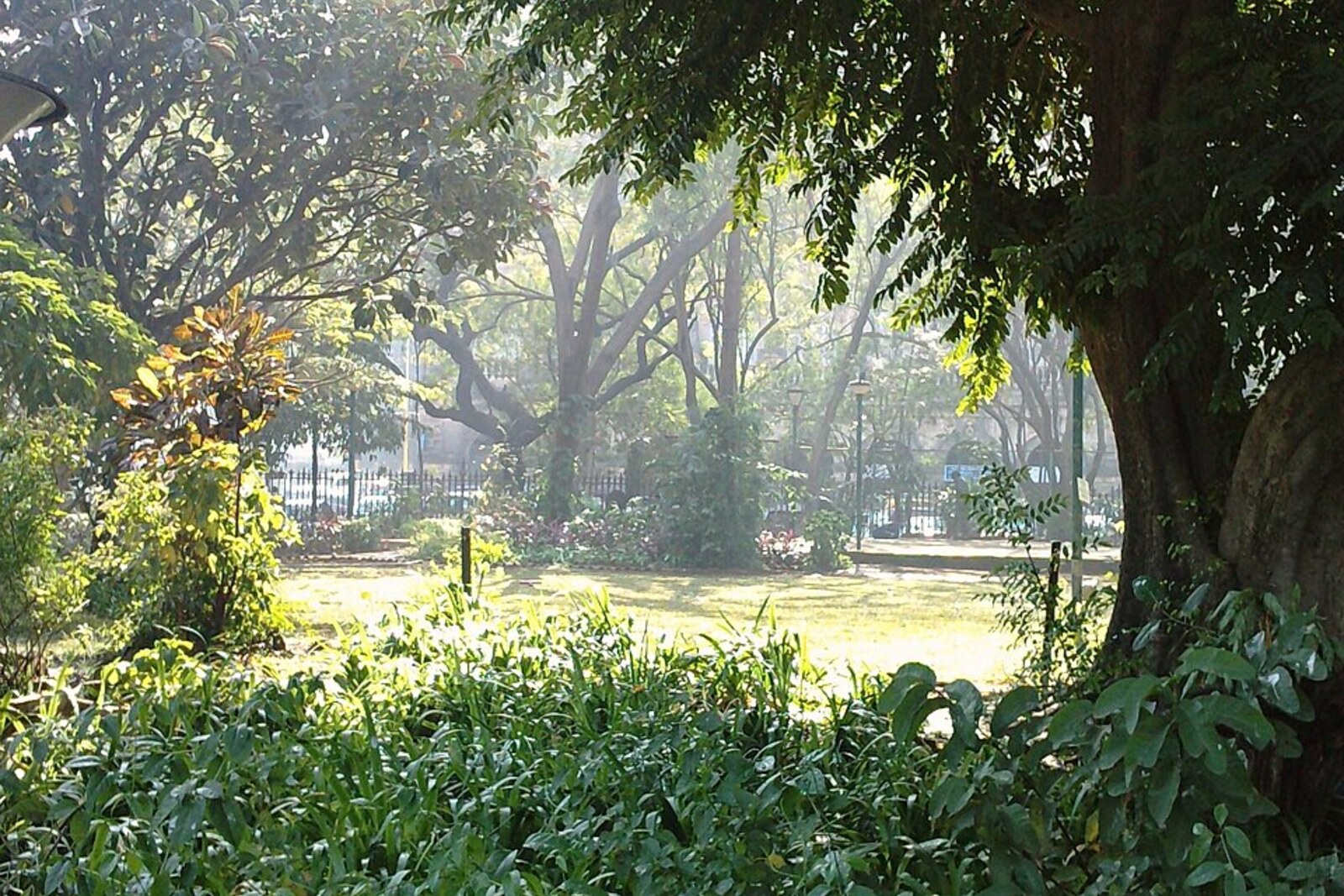
Look around first
What to notice
- Cast-iron fence
- Lawn
- Stone arcades
- Red Red House
The story of the place
The circle of stone arcades rose around the edges of the former Bombay Green, an open trading square. Cotton and opium deals were made here under the open sky; after the fort was demolished, the municipality sold the edge plots to English trading firms and left the center for a garden. Trade moved behind the matching facades of offices and banks, while a lawn behind a cast-iron fence remained at the center of the business district. At lunchtime, employees still come out here with food boxes.
Inside the cast-iron fence is a garden, and around it runs a curve of stone arcades with banks and offices. During the day, employees come out onto the lawn with lunch boxes. This pairing of a garden and a business district was conceived as early as the nineteenth century.
The whole square was once called Bombay Green. Here, cotton and opium merchants made deals in the open air. After the fort was demolished, the municipality sold plots around the edges to English trading firms and set aside the center for a public garden. Commerce moved into buildings with matching facades, and the former trading ground became a circle of offices.
In one of these buildings, the red Red House, was the newsroom of the Bombay Chronicle. The lawyer and politician Ferozeshah Mehta founded it as an Indian answer to the influential The Times of India. In nineteen thirteen, he invited the British journalist Benjamin Guy Horniman to become its editor. Horniman wanted to give supporters of Indian self-government a daily newspaper in English. By then, he had already been earning his living as a journalist in India for seven years; the editor's chair was both his profession and his place in society.
In the spring of nineteen nineteen, the British administration passed the Rowlatt Act, which allowed people to be imprisoned without ordinary legal proceedings. Horniman campaigned for the act's repeal, and on April eighth he printed an appeal for nonviolent resistance in the Bombay Chronicle. The Governor of Bombay, George Lloyd, sought to stop this campaign and preferred to deport the editor rather than take the case to trial.
Five days after the publication, on April thirteenth, thousands of people gathered in the Amritsar garden of Jallianwala Bagh. Brigadier General Reginald Dyer, having decided to punish the participants in the banned gathering, ordered soldiers to open fire without warning. Hundreds were killed. Military censorship hindered the transmission from Punjab of information about the shooting and the punishments that followed.
The correspondent Govardhan Das wanted to get eyewitness accounts past this ban and sent them to the newsroom of the Bombay Chronicle. Horniman printed the account he received. On April twenty-sixth, he was taken from his sickbed, and the next day he was put aboard the steamer Takada and sent to England. The newspaper was required to submit its material to the censor in advance. The publishers suspended publication and resumed it only after that requirement was lifted a week later. Govardhan Das was sentenced to three years in prison for transmitting information.
In England, Horniman secured the publication in the Daily Herald of photographs brought out of India, and then published a book about Amritsar. He was not allowed to return for a long time. In the newsroom, his assistant Syed Abdullah Brelvi remained, intending to preserve the newspaper's former course. In nineteen twenty-four, Brelvi took charge of the Bombay Chronicle and ran it for a quarter of a century. Horniman was able to return only in nineteen twenty-six.
Until independence, the garden was called Elphinstone Circle, in memory of John Elphinstone, a former Governor of Bombay. In nineteen forty-seven, it was renamed in Horniman's honor. The journalist lived to see his name on the map and died a year later.
The Bombay Chronicle closed in nineteen fifty-nine. Mumbai Samachar is now published in Red House. The circle bears the name of the deported editor, and the street by the former newsroom bears the name of Brelvi, who continued publishing the newspaper after Horniman's removal.
Useful on site
An open urban space with a garden at its center. Access to individual garden entrances may change; the facades and arcades are best read from the outer edge of the circle.
Checked: June 30, 2026. Check the official source before visiting.The garden is good for a break, but take in the whole circle: its meaning lies not in a single facade, but in the connection between the green center, the banks, the offices, and the newsroom.