 Guide On Map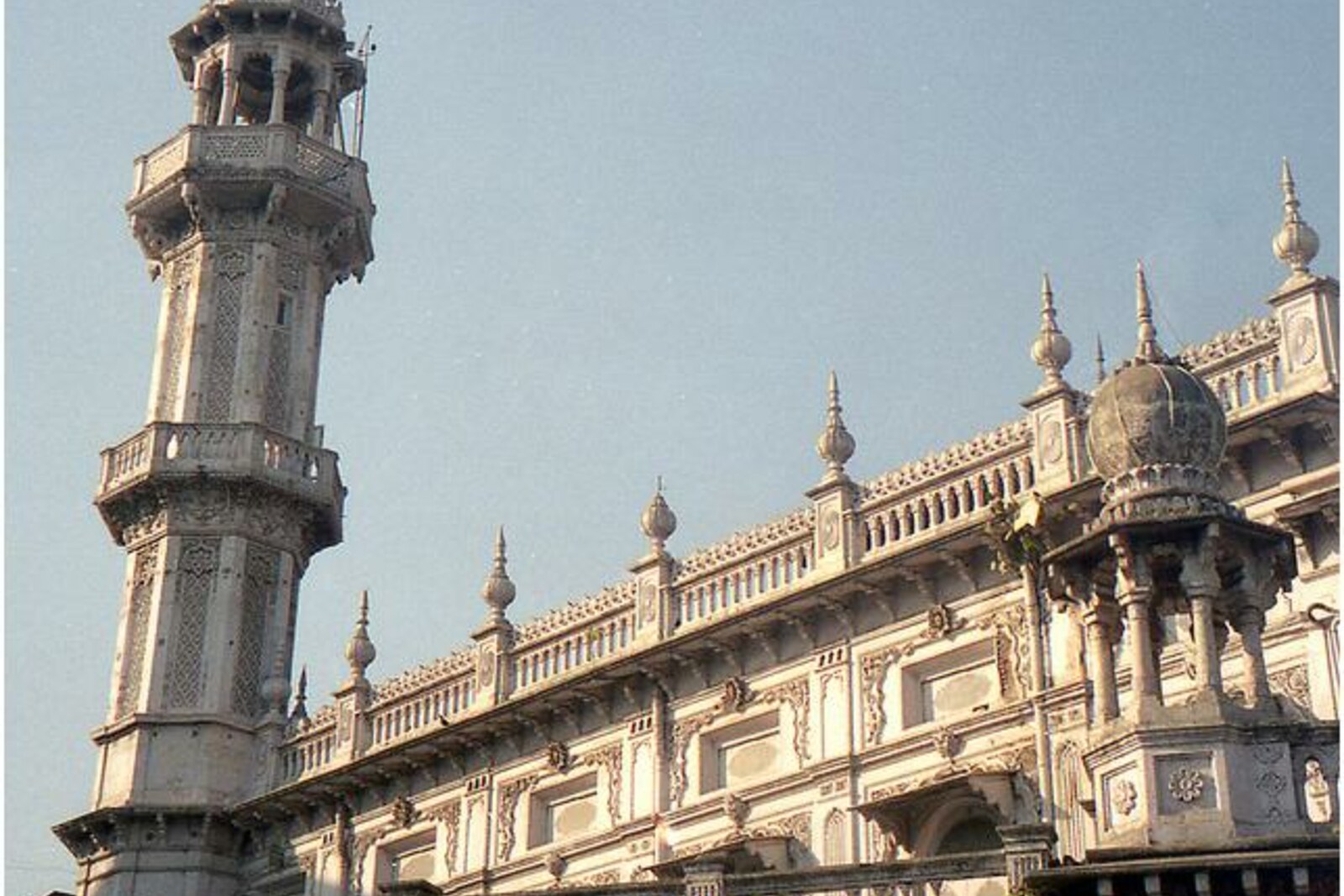
Look around first
What to notice
- Tall minarets
- Commercial premises on the ground floor
- Western gate
- The “Suleman Usman Mithaiwala” sign
The story of the place
Beneath the tall minarets, the mosque continues beyond its facade: the prayer hall and courtyard stand beside a kitchen, warehouses, residences, and shops along the edge of the ground floor. This complex was maintained by a Memon charitable endowment connected with the trading community from Kutch; buildings on this site appeared as early as the nineteenth century. Mohammed Ali Road ends through the western gate, and on Ramadan evenings the lanes by the mosque fill with tables and market stalls.
In the early nineteen thirties, Suleman, a young baker's assistant, came from Pune to Bombay to earn a living. He had no bakery of his own; all he could rely on was his skill with dough. Suleman rented a tiny commercial space right beside Minara Masjid and began selling baked goods. In nineteen thirty-six, he opened a proper sweet shop here. On its sign, he joined his own name with that of his father, Usman—this was how Suleman Usman Mithaiwala came into being.
The choice of location explains the mosque's layout. The Memons, a Muslim trading community connected with Kutch, established a charitable endowment in eighteen seventy-nine under a scheme approved by the Bombay High Court. The buildings had existed earlier; a city inventory dates the mosque to around eighteen seventy. The endowment included a prayer hall, a courtyard, warehouses, residential houses, and commercial premises along the outer perimeter of the ground floor. Here, people prayed, lived, stored goods, and sold them side by side. Because of its tall minarets, the mosque came to be called Minara Masjid—the mosque of minarets.
Suleman found himself in precisely the part of the complex where religious and commercial life met door to door. His little bakery grew into a family business; after him, his sons continued the shop. The main store still occupies premises beneath the mosque on Ebrahim Merchant Road—named for a former trustee of Minara Masjid. During Ramadan, the family sells Aflatoon, a dense milk sweet, Firni, and Malpua here, although Suleman began with the everyday work of a baker.
On those same evenings, the trustees feed more than one thousand people at the breaking of the fast. Food is prepared in an internal kitchen, laid out in the prayer hall, and, once the meal is over, a team quickly clears and washes the floor before the evening prayer. Outside, vendors set up counters and tables in the lanes. Over several decades, family shops and temporary vendors have spread a night market by the gates: at the hour the daytime fast ends, a large community gathers in the mosque at once, then heads straight out to the commercial premises along its outer perimeter.
The western gate faces Mohammed Ali Road, and the stretch given that name ends at the mosque. Before India's independence, two municipal councillors proposed renaming part of Sydenham Road—the name this thoroughfare had at the time—in honor of Mohammed Ali Jauhar. Jauhar was a poet-journalist and a leader of the Khilafat Movement: after the First World War, he sought to preserve the Ottoman Caliphate and, together with his brother Shaukat Ali, led campaigns in Bombay. The councillors pointed out that the movement's headquarters was in the city. The section from Mahatma Jyotiba Phule Mandai (Crawford Market) to Minara Masjid received Mohammed Ali's name; beyond the mosque, the renamed stretch ended.
Historians still dispute whom the road sign refers to. According to another version, it is Mohammed Ali Rogay, a nineteenth-century Bombay merchant and philanthropist to whom local historical tradition attributes the founding of several schools. The sign bears neither the Muslim scholar's title “Maulana” nor the surname “Jauhar,” so both interpretations have remained. Mohammed Ali Road ends at the western gate, while beneath the minarets stands the shop where Suleman once placed his own name beside his father's.
Useful on site
An active mosque and an evening food street; access and passage depend on prayer, Ramadan, and current restrictions.
Checked: June 28, 2026. Check the official source before visiting.The mosque remains an active religious space: do not enter during prayer out of curiosity, and check access on site. In the food crowd, choose a counter without rushing, watch your personal belongings, and do not stand in the middle of a queue for a photograph.