 Guide On Map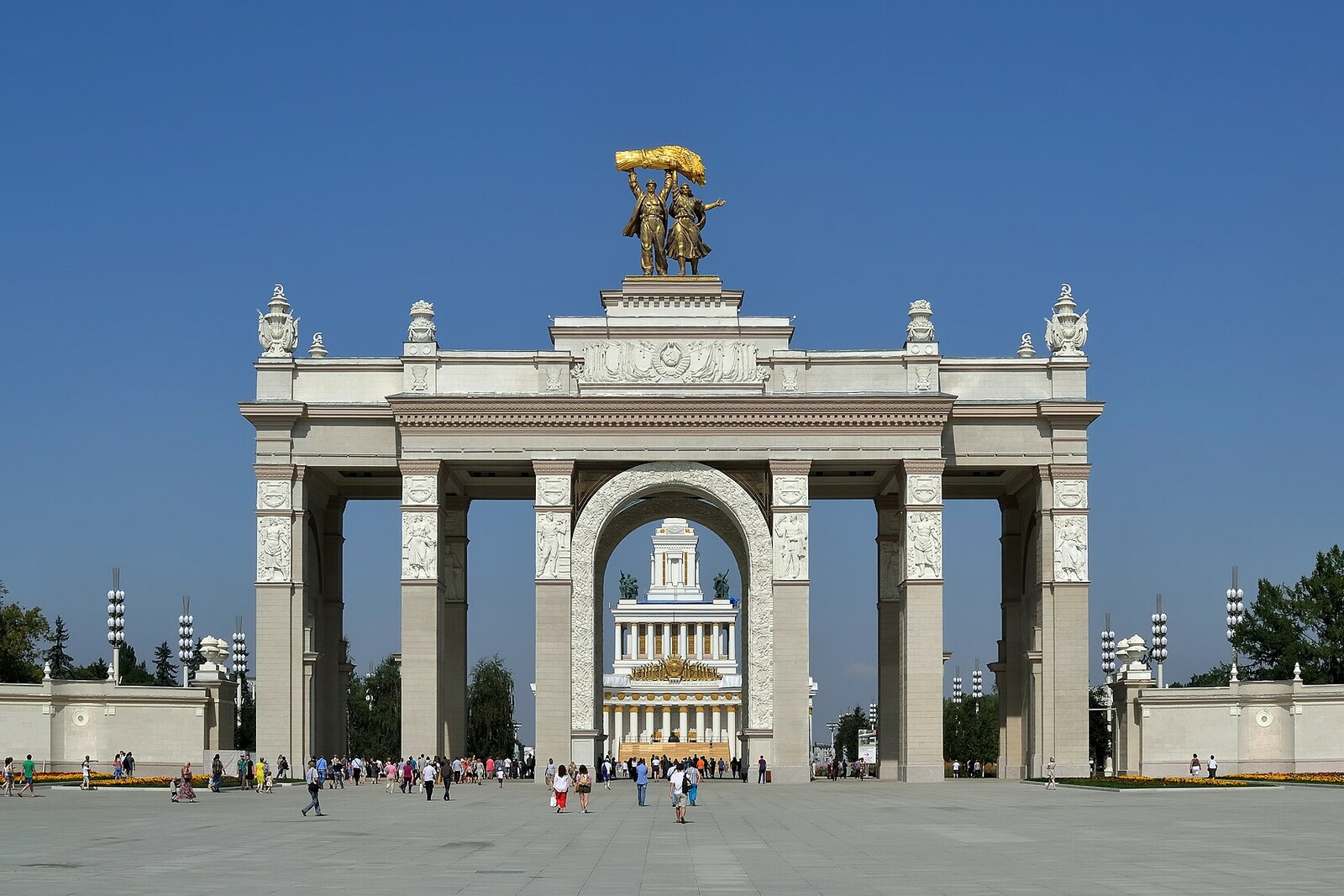
Look around first
What to notice
- Golden sculptural group
- Sheaf of wheat
- Tractor driver's leather jacket
- Central Pavilion framed by the arch
The story of the place
The former main gates survive farther north and now serve as the Northern Entrance. The new arch was placed on the central axis of the exhibition complex, with the future metro station and the flow of people from the city already taken into account. The distant view determined the size of the main passage: the entire Central Pavilion fits within the arch's opening. From here, a straight chain of squares and alleys leads deeper into the exhibition.
The golden pair above the arch are often mistaken for the famous Worker and Kolkhoz Woman. These are different people. The man is a tractor driver, wearing a heavy leather jacket and protective goggles. Together with a woman collective farm worker, he raises a sheaf of wheat.
The predecessor of this pair appeared at the All-Union Agricultural Exhibition in nineteen thirty-nine. At the time, the figures stood on a fifty-meter tower near the Main Pavilion. The man supported the sheaf with one hand and placed the other around the woman's waist. The emblem was printed on tickets and posters: visitors were greeted by what looked almost like a married couple presenting the harvest they had gathered.
After the war, the organizers decided to reopen the exhibition. On July twelfth, nineteen forty-nine, the Main Exhibition Committee resolved to relocate the Main Entrance. The old gates stood farther north and did not seem ceremonial enough to the committee. The new site was chosen on the central axis of the entire complex, on the side facing Yaroslavskoye Highway—the name then used for this section of today's Prospekt Mira. The plans for this site already took into account the future metro station and the flow of people from the city. The former main gates then became the Northern Entrance.
Architect Innokenty Melchakov won the closed competition and was commissioned to turn the beginning of the walk into a postwar triumphal arch. The height of the central opening was calculated so that the entire Central Pavilion would be visible through it. This is where the straight sequence of squares and alleys begins: the arch sets the direction of the entire route in advance.
The tower with the old emblem was dismantled. The old figures were not moved: for the top of the new arch, sculptor Sergei Orlov created a different version of the familiar subject. Orlov came to monumental sculpture from ceramics. He worked in the laboratory of the Moscow Museum of Ceramics and collaborated with the Dmitrov Porcelain Factory; before this, his usual medium had been small, mass-produced figures that could fit on a table or in a display case.
Here, Orlov had to raise human figures to a height of thirty-two meters. He removed the man's hand from the woman's waist and made the tractor driver hold the sheaf with both hands. He added work goggles and heavy clothing. The composition was reduced from thirteen meters to eight meters sixty-five centimeters, but the gesture became more strained: both people were now occupied with the same load.
Orlov proposed covering the concrete figures with golden smalt—pieces of opaque glass in different shades. They were laid in the direction of the folds in the clothing, so the color helped distinguish the figures' volume from below. The sheaf itself was made lighter: it was hammered from sheets of copper and gilded.
By nineteen seventeen, the concrete had cracked, some of the smalt had fallen away, and the sheaf had lost almost all its gilding. The restorers examined the entire surface, marked the damage on detailed maps, and preserved as much of the old glass as its condition allowed. Light and dark pieces of smalt from nineteen fifty-four still remain in the folds of the clothing; missing sections have been filled according to the original pattern, and the copper sheaf above them has been gilded again.
Useful on site
Accessible from the grounds daily, 00:00–23:59.
Checked: date not specified. Check the official source before visiting.First view the arch from a distance, then move closer to the columns: the composition at the top is easier to read as part of the overall silhouette, while the figures' occupations are clearer from closer by.