 Guide On Map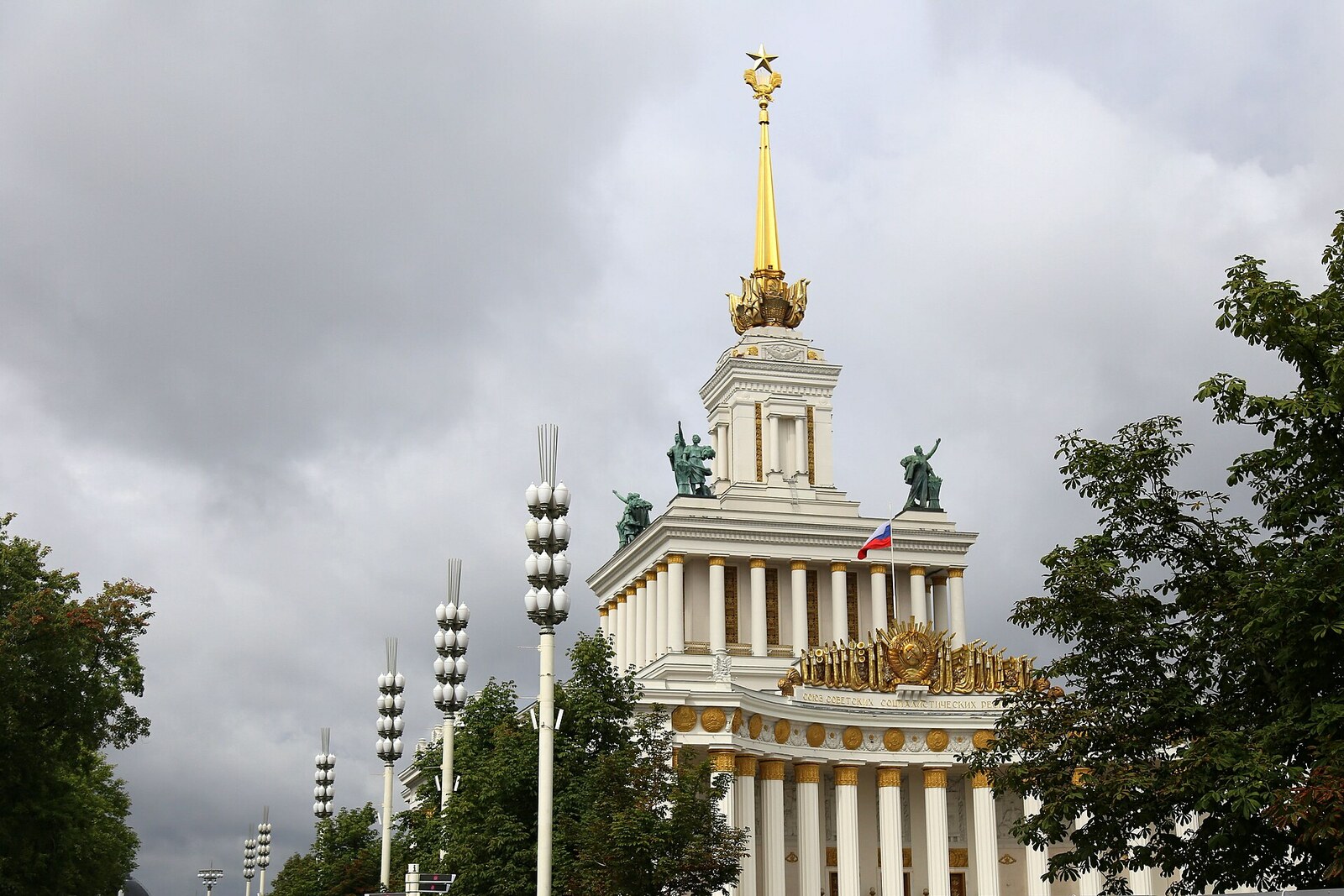
Look around first
What to notice
- Plaster procession
- Central banner with Lenin's profile
- Worker with an infant
- Damaged and restored figures
The story of the place
In the former ninth hall behind the colonnade, a plaster procession covers the entire wall: more than fifteen hundred figures march beneath banners, passing a high-rise building, a hydroelectric power station, and the Shukhov Tower. At the front stand a worker with an infant on his shoulder and a kolkhoz woman, while Lenin's profile remains on the central banner. Restored and damaged heads can be seen among the dense crowd: this wall still bears traces of several different eras.
This pavilion was originally called the Main Pavilion. In nineteen fifty-four, visitors were meant to begin their introduction to the All-Union Agricultural Exhibition here. Nine halls explained how the country was organized and presented collective farms, state farms, industry, and science. The final hall was called “The Soviet Union in the Struggle for Peace Throughout the World.” There, the entire narrative culminated in a single wall.
For this wall, the monumental sculptor Yevgeny Vuchetich led a group of eight artists. They had to complete the state commission in time for the exhibition's opening and provide the final scene for its introductory pavilion. For three years, the sculptors modeled a procession covering ninety square meters: more than fifteen hundred people moved beneath banners, passing a high-rise building, a hydroelectric power station, and the Shukhov Tower. At the front walked a worker and a kolkhoz woman carrying the coat of arms of the Soviet Union. The work was titled “Glory to the Soviet People, the Standard-Bearer of Peace!”
Work began when Joseph Stalin led the country and his image was required in an official composition of this kind. The design included a separate figure of Stalin, and the sculptors placed his profile alongside three others on the central banner. But Stalin died in nineteen fifty-three, before the pavilion opened. The separate figure was removed while the work was still in the studio; the four profiles on the banner were left in place.
After the campaign against the cult of personality began, the exhibition organizers started altering the already completed procession. Three profiles were painted over, leaving only Vladimir Lenin, the founder of the Soviet state. The coat of arms held by the worker and the kolkhoz woman was removed, and an infant appeared on the worker's shoulder. The high relief was then hidden from the public. While Vuchetich was still alive, the result of three years of work disappeared behind exhibition paneling.
In the nineteen nineties, retail kiosks and additional floors were installed inside. Workers completely covered the high relief with plywood, nailing the sheets directly to the structure. Several plaster heads were smashed or torn off. The composition's existence was known from documents, but the work itself was long considered lost.
In two thousand fourteen, restorers dismantled the false wall and found the entire procession behind it. Some of the detached heads had been preserved by people who had once picked up the fragments; they now handed them over to the restoration workshop. The artist-restorer Inna Pchyolova supervised the cleaning, consolidation of the plaster, and reconstruction of missing sections. By two thousand sixteen, the high relief had been returned to public view. However, the restorers did not recreate Vuchetich's original design; they preserved the last historical version.
After the restoration, the pavilion is once again used for art exhibitions. Behind the colonnade, in the former ninth hall, fifteen hundred plaster people still march. One profile of Lenin remains on the central banner, and an infant sits on the worker's shoulder; the coat of arms and the three painted-over profiles have not been restored.
Useful on site
The pavilion is temporarily closed; the facade is accessible from the grounds every day.
Checked: date not specified. Check the official source before visiting.This stop works fully from outside. Use zoom for the upper levels; plan any possible viewing of the interior as a separate visit.