 Guide On Map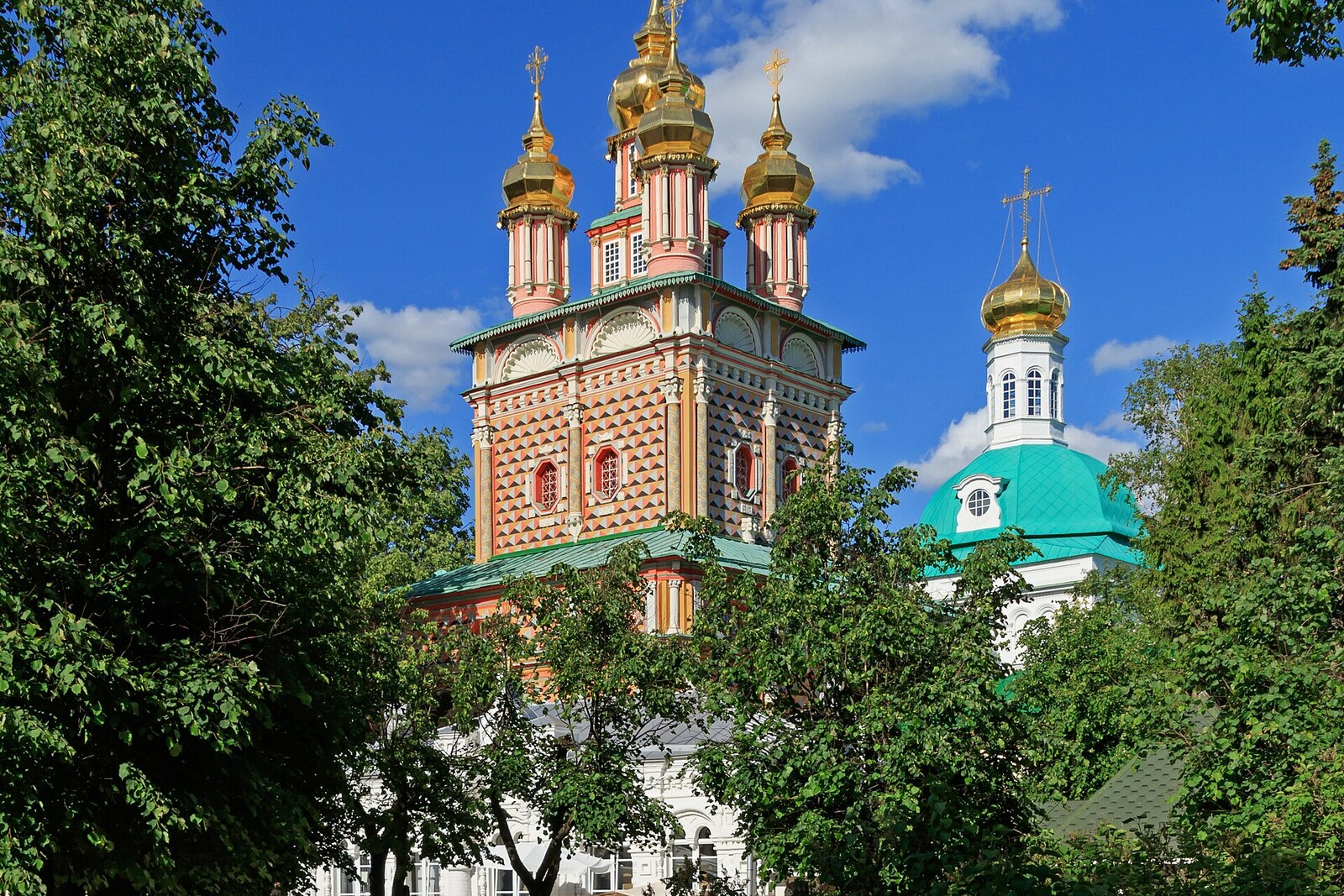
Look around first
What to notice
- The five domes of the Church of St. John the Forerunner
- Two successive arches
- The ceremonial exterior portal
- The foundation of the Red Tower
The story of the place
The main entrance leads to the eastern wall of the monastic fortress: the tsar and the patriarch were admitted here, while people, carts, and animals were left to use the neighboring Dormition Gates. The present five-domed church replaced the Church of St. Sergius: the old church was dismantled, and its altar was transferred to the Refectory Church of St. Sergius. Two successive arches and the lower part of the Red Tower have preserved the line of the former driveway; the ceremonial exterior portal was added only in the nineteenth century. Today all visitors enter through the arches, and above the second one the Church of the Nativity of St. John the Forerunner remains active.
On the night leading into August eighth, sixteen eighty-nine, seventeen-year-old Tsar Pyotr arrived at these gates seeking protection. Formally, Russia then had two tsars. His half-brother Ivan Alexeyevich was regarded as the senior one, though because of severe illness he took almost no part in affairs. Their elder sister, Sofya Alexeyevna, ruled for both of them. She sought to continue her regency, while the grown-up Pyotr demanded to be admitted to government.
At night, Pyotr was told that armed Streltsy—soldiers of the permanent Moscow regiments—were gathering in the Moscow Kremlin and that an attack on his court at Preobrazhenskoye was being prepared. Historians debate whether an actual order to kill him had been given: the opponents accused one another of conspiracy. Pyotr himself believed the threat. He left behind his mother, wife, and almost his entire court, mounted a horse, and galloped with several companions to the Trinity Lavra of St. Sergius.
This choice explains the old purpose of the Holy Gates. The stone walls turned the monastery into a fortress, and the road from Moscow approached its eastern side. The main passage was opened for the tsar and the patriarch. Other people, carts, and animals used the neighboring Dormition Gates. Pyotr entered here not as a pilgrim: he was seeking a fortress where his tsarist title could be backed by locked gates and orders of his own.
From the monastery, Pyotr ordered colonels, courtiers, and servicemen to come to him. He was risking everything he had. His own court lived separately at Preobrazhenskoye, and his armed support still consisted of small play regiments that had grown out of military exercises. If the Moscow regiments had remained with Sofya, his flight could have been portrayed as the panic of a junior tsar incapable of governing the country.
For the first few days, the outcome was unclear. Sofya tried to persuade her brother to return, but Pyotr refused and forbade her to come to the monastery. Then the patriarch, military commanders, courtiers, and ever more Streltsy detachments arrived to join him. Fyodor Shaklovity, head of the Streltsy Prikaz and Sofya's chief military supporter, sought to preserve her rule. When he was arrested in Moscow and brought to Pyotr at the Trinity Lavra of St. Sergius, Sofya had no one left to resist for her. After an investigation, Shaklovity was executed, Sofya was removed to Novodevichy Convent, and Pyotr returned to Moscow and took control of the government. Ivan retained the tsarist title but still took almost no part in affairs.
Four years later, construction began on the present church above this passage. The old Church of St. Sergius was dismantled, and its altar was transferred to the new Refectory Church of St. Sergius. The replacement was paid for by Grigory Dmitrievich Stroganov, one of the country's wealthiest salt industrialists. The new church was dedicated to the Nativity of St. John the Forerunner.
The Forerunner is the name given to John, the prophet of the Gospels, who prepared people for Christ's appearance and baptized Him in the Jordan River. Here, the choice of name had another addressee: St. John the Forerunner was considered the heavenly patron of Tsar Ivan Alexeyevich. Construction began while Ivan remained officially the senior of the two tsars. He died in sixteen ninety-six, and the church was consecrated only in sixteen ninety-nine, when Pyotr was already ruling alone.
The five-domed Church of St. John the Forerunner did not yet exist on the night of Pyotr's flight, and the ceremonial exterior portal appeared only in the nineteenth century. Pyotr passed through the Red Tower and the arch of the old Church of St. Sergius, which stood on the site of the present church. The tower's foundation and the line of the two successive passages have survived. Now all visitors enter through them; above the second arch, the Church of the Nativity of St. John the Forerunner remains active, named for the heavenly patron of the brother who, after that night, remained tsar in title only.
Useful on site
Passage through the gates depends on the operating regime of the active monastery. Services in the gate church are held on a separate schedule; entry to the interior is not guaranteed.
Checked: date not specified. Check the official source before visiting.Do not linger in the middle of the passage, and let liturgical processions and organized groups pass.