 Guide On Map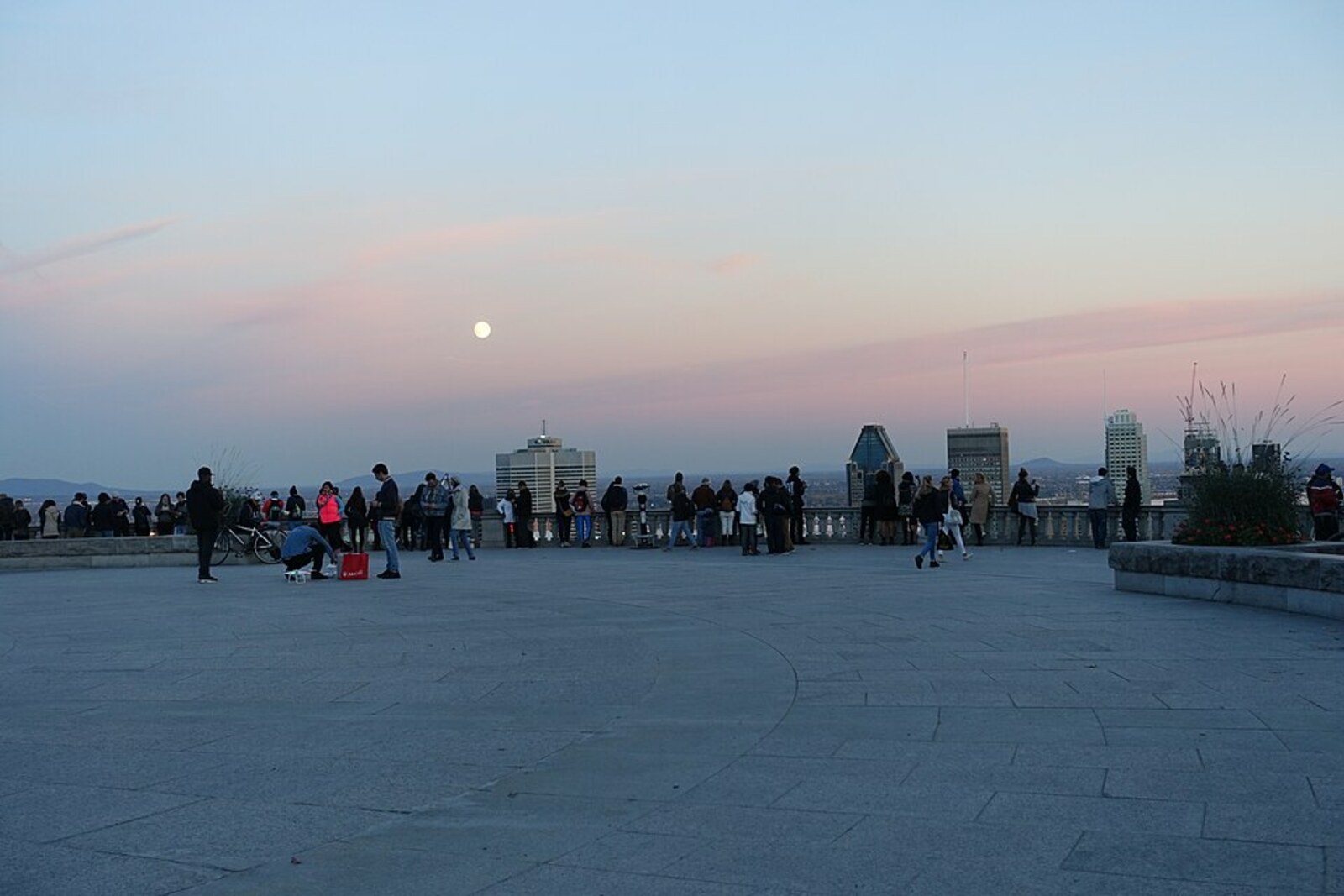
Look around first
What to notice
- Stone balustrade
- Open semicircle of the terrace
- Commemorative plaque
- Panorama of Montreal
The story of the place
The belvedere’s broad semicircle appeared in nineteen oh six. City specialists chose an open terrace: a pavilion above the cliff would have altered the silhouette of Mount Royal when viewed from below. So they left the center of the space clear and separated people from the slope with a stone balustrade. People gather here for the panorama of Montreal; the terrace received its name much later.
On June twenty-first, nineteen ninety-seven, Mayor Pierre Bourque held a ceremony here with leaders of the First Nations and officially named the former Mount Royal Belvedere after Kondiaronk. The municipality wanted to restore to the city’s memory the nearly forgotten negotiations of seventeen oh one and the role of Indigenous peoples in their outcome. A year later, a commemorative plaque was installed by the balustrade.
Kondiaronk himself never visited this terrace: it was built two centuries after his death. He was a chief of the Wendat-Tionontati (Petun), who had resettled in Michilimackinac, by the strait between Lakes Huron and Michigan. After the destruction of the former Wendat settlements, his community lived beside Algonquian peoples, grew corn, and traded it with the hunters and fishers who gathered there. A thin palisade separated it from the neighboring settlement. If the French had made a separate peace with the Five Nations of the Haudenosaunee Confederacy, whom French documents called the Iroquois, Kondiaronk’s people could have been left facing their former enemy without allies. That is why he sought an agreement that would also include the peoples of the Great Lakes.
By seventeen oh one, he had persuaded them to send representatives to Montreal and bring Haudenosaunee captives for exchange. Delegations from about forty peoples arrived for the conference; their camps around the small fortified city nearly matched the population inside its walls. But the Haudenosaunee did not return all the captives they had promised. Kondiaronk’s people were among those absent. To him, this meant that his community was again being asked to trust an agreement while its relatives remained with the enemy.
On August first, Kondiaronk came to the council with a severe fever. He could no longer stand. They brought him a large chair and gave him an infusion of a plant used as medicine by Indigenous peoples. He spoke for about two hours: he demanded an answer for the captives who had not returned, recalled how he himself had persuaded the peoples to end the war, and urged them not to destroy the agreement they had achieved. No verbatim record of the speech exists—the French chronicler retold it later, which is why the words on the plaque here are identified as attributed to Kondiaronk. Witnesses, however, agree on the main point: his speech persuaded the final opponents of the treaty.
After the speech, Kondiaronk could no longer return to camp on his own. He was carried to Montreal’s Hôtel-Dieu Hospital, where he died early on the morning of August second. The next day, French officers, Wendat, and Haudenosaunee chiefs walked in the funeral procession. Kondiaronk was buried beneath Notre-Dame Church. The day after that, representatives of the gathered peoples concluded the Great Peace of Montreal: the parties pledged to end their wars, free captives, and use shared hunting grounds; the Haudenosaunee received freedom of trade and promised to remain neutral in France’s wars with England.
The plaque by the balustrade attributes to Kondiaronk words about a tree of peace that grew “on the highest mountain on earth.” This is an image from the negotiating speech, not evidence that he climbed Mount Royal. The negotiations, death, and burial took place in the city below. Kondiaronk’s grave has been lost and probably lies somewhere beneath or near Place d’Armes; above remains the name given to this terrace in nineteen ninety-seven.
Useful on site
Daily 06:00–24:00; checked 2026-06-29.
Checked: June 29, 2026. Check the official source before visiting.First, take in the panorama as a whole, then find the name of the site: without that detail, this stop can easily turn into an ordinary photo spot. It can be windy along the open edge.