 Guide On Map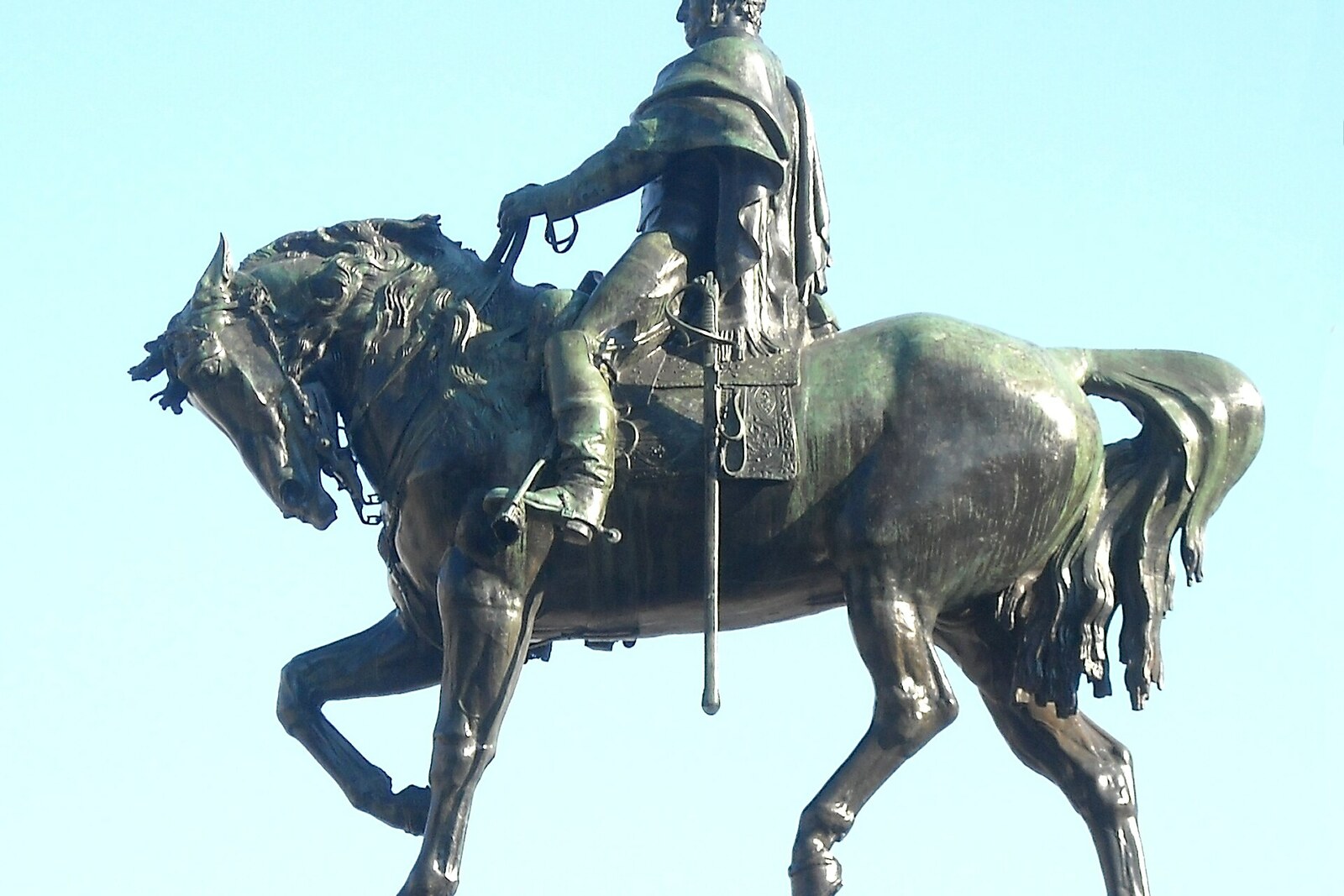
Look around first
What to notice
- Equestrian Statue of Artigas
- The inscription “Artigas”
- The bronze relief around the pedestal
- The staircases to the mausoleum
The story of the place
At the center of the square, a rider stands above his own tomb. A single word is inscribed on the granite pedestal: “Artigas.” Below it, between two staircases, is the mausoleum containing the urn of José Gervasio Artigas.
Urban planners assigned this site the role of the ceremonial entrance to the new Montevideo. After the colonial fortifications were dismantled, they laid out here the boundary between Ciudad Vieja and the neighborhoods beyond the former walls. Plaza Independencia appeared on the plan in eighteen thirty-seven. The Citadel of Montevideo itself, which occupied roughly half of today’s space, continued to serve as a market for several decades. When it was finally demolished, the route from Ciudad Vieja continued across the square into 18 de Julio Avenue. From the end of the nineteenth century, the main official ceremonies were held here, so the monument to the man recognized as the founder of Uruguayan statehood was placed here.
Artigas began as a captain in the Spanish border cavalry. Service in this corps was his profession: he patrolled rural areas, guarded the frontier, and pursued smugglers. In eighteen eleven, he left the Spanish garrison and joined the revolutionaries. In the event of victory, this gave him the chance to raise his native Banda Oriental against the Spanish Crown; in the event of defeat, it left him without rank and made him a traitor.
Returning with a small detachment, Artigas led the uprising, defeated the Spanish at the Battle of Las Piedras, and received from the inhabitants the title Chief of the Orientals. He sought a republican and federal union of provinces in which decisions would not be dictated from Buenos Aires. When the allies made a truce and ordered the siege of Montevideo lifted, thousands of families followed Artigas. This exodus is depicted in the bronze relief around the pedestal: carts, riders, and people leaving their homes together with their commander.
Artigas’s project survived for several years, a Portuguese invasion, and a war with former allies. In eighteen twenty, he was defeated and left for Paraguay. He never returned. Artigas died there thirty years later, and his remains were brought to Montevideo only in eighteen fifty-five. The Equestrian Statue of Artigas above the square was unveiled later still, in nineteen twenty-three.
There was no tomb beneath it at that time. In nineteen seventy-four, the civil-military dictatorship revoked the earlier decision to bury Artigas beneath the parliament building and announced a competition for a mausoleum beneath the equestrian monument. The architects Lucas Ríos and Alejandro Morón proposed carving Artigas’s words on the inner walls. Among them was a short phrase: “Mercy to the vanquished.”
The government struck out this phrase. It allowed the dates and names of events to remain—birth, the Battle of Las Piedras, the Eastern Exodus, exile, death—but removed the words in which Artigas formulated his own principles. On June nineteenth, nineteen seventy-seven, the regime’s president, Aparicio Méndez, inaugurated the mausoleum. At the ceremony, army commander Julio César Vadora stated that the regime’s democratic ideas derived from the thoughts and actions of Artigas. The urn was then lowered into the chamber beneath the pedestal.
The architects built a chamber without the rejected inscription, the military received the ceremony they had prepared, and the remains of the exile were placed beneath the rider installed here half a century earlier. Above remained the name “Artigas”; below, the urn and a list of dates. The phrase “Mercy to the vanquished” did not enter the walls of the mausoleum in nineteen seventy-seven.
Useful on site
The square is open around the clock. Artigas Mausoleum: Mon–Fri 10:00–12:00 and 14:30–16:00; Sat–Sun 10:00–16:00; admission is free.
Checked: date not specified. Check the official source before visiting.If the mausoleum is closed, view the monument from the level of the square: the contrast between the bronze rider and the memorial hidden underground can still be seen from outside.