 Guide On Map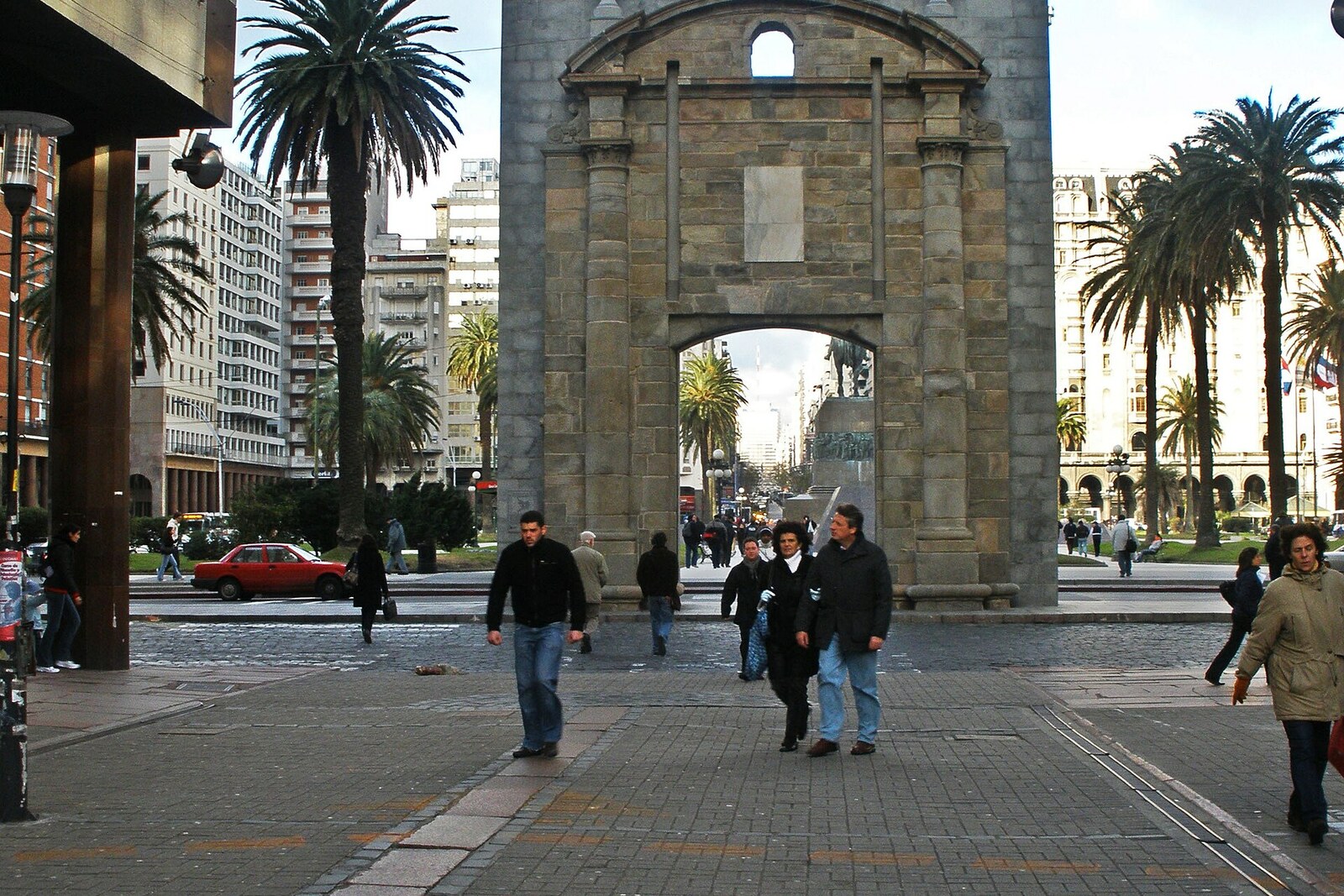
Look around first
What to notice
- Granite blocks
- Channels for the drawbridge chains
- Stone opening
- Empty space beyond the arch
The story of the place
The stone opening aligned with Sarandí Street marks the route to a separate fortification that stood at the edge of the city at that time. On this side, the street already lay within the city walls, while farther on began the last line, with a garrison, cannons, and a moat. The granite blocks preserve channels along which the drawbridge chains moved. Now the plaza opens beyond the arch, where the fortress walls once rose.
By the late eighteen seventies, workers were dismantling the Citadel of Montevideo and sending its granite to new barracks and into the foundations of city streets. The weathered fortress, previously turned into a market, was seen as an obstacle: it occupied nearly half of what is now Plaza Independencia. When they reached the gate, Colonel Lorenzo Latorre, head of the country and a career military officer, ordered it preserved.
It was the Citadel Gate, not the entire fortress. The stones were removed one by one and taken away. Under President Máximo Santos, they were reassembled on the rear façade of the School of Arts and Crafts. Thus, the gate through which the garrison had once passed became the entrance to an educational institution. The walls of the Citadel of Montevideo disappeared, some of the gate's decoration was lost, but Latorre's order left future Montevideo with the only authentic large fragment of this fortress.
In nineteen fifty-seven, Professor and archaeologist Luis Baucero proposed bringing the gate back here. For someone who worked professionally with ancient objects, authenticity was the main issue: the old stones, which had already survived one dismantling, were to be moved, and the losses were not to be filled in with a convincing modern imitation. His report appeared before modern international restoration rules were adopted, and the idea itself sparked debate.
The city authorities agreed nonetheless. Architect Enrique Monestier dismantled the gate at the school and, in nineteen fifty-nine, reassembled it almost at its original location, aligned with Sarandí Street. The form of the gate returned, but it was impossible to restore its surroundings.
This passage never served as an outer entrance to Montevideo. On the Sarandí side lay the city, already enclosed by walls, while ahead, on the site of the plaza, stood the separate Citadel of Montevideo—the last fortified line, with a garrison, cannons, and its own moat. A drawbridge led to it; the channels along which its chains moved are still visible in the stone.
Now there is no moat, no barracks, and no fortress yard beyond the arch. The surviving granite blocks stand where Baucero and Monestier returned them for the second time, and the empty space of the plaza begins precisely on the side where the Citadel of Montevideo once rose.
Useful on site
Open urban public space, around the clock and free of charge.
Checked: date not specified. Check the official source before visiting.Walk through the arch and look in both directions: this makes it easier to imagine the missing moat, bridge, and walls. Do not take the current position as the gate's exact original location.