 Guide On Map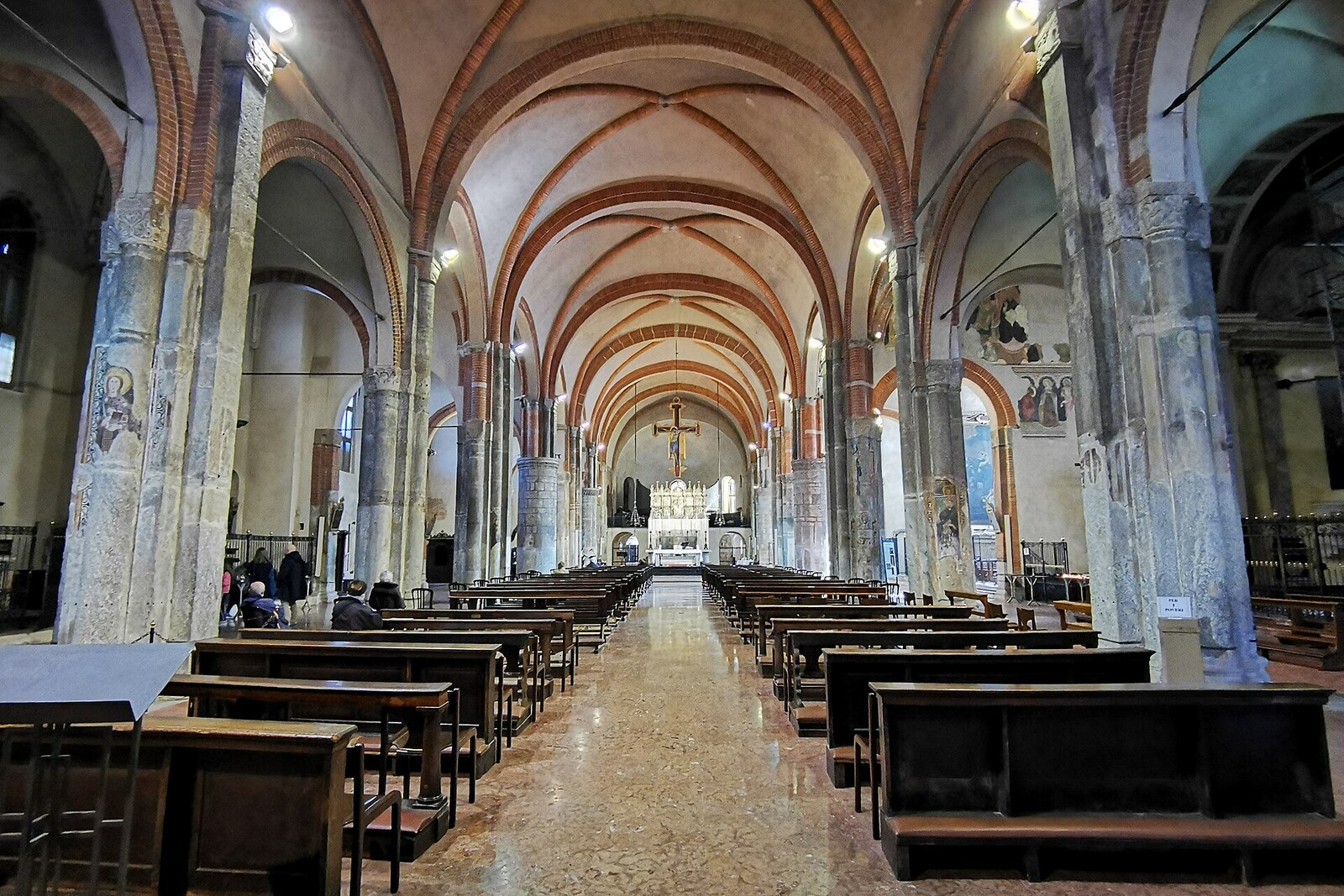
Look around first
What to notice
- The star on the bell tower
- The ancient marble sarcophagus
- The chapel's sixteen-part dome
- Peter of Verona's marble arch
The story of the place
A star stands on the bell tower of the Basilica of Sant'Eustorgio instead of a cross. It is connected with the man whose name the basilica bears. Eustorgius I, Milan's fourth-century bishop, according to church tradition, brought the remains of the Three Magi from Constantinople. Two oxen pulled the heavy marble sarcophagus. Near the city cemetery, the animals collapsed, and the bishop took this as a sign to build the church here.
This story belongs to tradition. Archaeologists did indeed find a Late Antique cemetery beneath the basilica, but the remains of the first church date to the sixth century, two centuries after Eustorgius. His name became attached to the church because the people of Milan associated him with the appearance of its most important relic.
The later fate of the relic is better known. After Milan was sacked, Rainald of Dassel, the imperial chancellor and Archbishop of Cologne, took the Magi's remains to Cologne in eleven sixty-four. An enormous stone sarcophagus remained at the Basilica of Sant'Eustorgio. For centuries, the people of Milan sought the relic's return; in nineteen oh three, Cardinal Andrea Carlo Ferrari received only a few bone fragments. On Epiphany the following year, they were placed above the Magi altar. The star on the bell tower, the nearly empty ancient sarcophagus, and the small reliquary containing the returned fragments belong to one story.
The desire to unite his own grave with venerated remains also brought Pigello Portinari here. Orphaned as a child, he grew up in the household of Cosimo de' Medici and served in the Medici Bank from his youth. In fourteen fifty-two, the Medici family sent him to Milan to open a new branch needed by Duke Francesco Sforza. Pigello's position rested on the trust of both families: he managed the bank's money, traded in Florentine textiles, and conveyed political assignments between Milan and Florence.
Around fourteen sixty-two, Pigello was associated with the commissioning of a chapel at the Basilica of Sant'Eustorgio. He intended it for the relic of Peter of Verona's head and for the burial of his family. Peter was a Dominican preacher and inquisitor, killed by opponents near Seveso in twelve fifty-two. The Dominican Order buried him in this basilica, and the pope canonized him less than a year later. The relic explains the choice of location: Pigello arranged his burial chapel beside the remains of a saint he especially venerated.
The square hall beneath a sixteen-part dome repeated the Florentine architecture familiar to the banker. Vincenzo Foppa painted Peter's preaching, miracles, and murder on the walls. In a separate altarpiece, Pigello kneels before the saint. Later tradition claimed that Peter appeared to the banker in a dream and ordered him to build the chapel; no documents confirm such a dream.
Pigello died on October eleventh, fourteen sixty-eight, as the work was being completed. According to the accepted museum version, he was buried in the center of the floor that same month. No direct construction contract or burial record contemporary with the burial has survived, so some historians dispute both the commission and the presence of his remains here. Pigello no longer has a separate grave slab either.
The marble arch occupying the center of the chapel belongs to Peter of Verona. The Dominican Order commissioned it as early as the thirteen thirties and originally placed it in the basilica's left nave. It was moved to the Portinari Chapel in seventeen thirty-six, and to its present location in eighteen seventy-five. The saint's sarcophagus came to stand above the banker's presumed grave, though it was for this saint's relic that Pigello had arranged the burial chapel. Pigello himself remained in the altarpiece, kneeling before Peter.
Useful on site
Museo di Sant'Eustorgio and the Portinari Chapel, according to the verified schedule, are open Tuesday through Sunday from 10:00 to 18:00, with the ticket office closing at 17:30; closed Monday. The main church is active; check its visits against the parish schedule and services.
Opening hours by day
The outdoor account works even when the museum is closed. The sarcophagus, museum rooms, and Portinari Chapel require accessible interior viewing; check the conditions in advance and take services into account.