 Guide On Map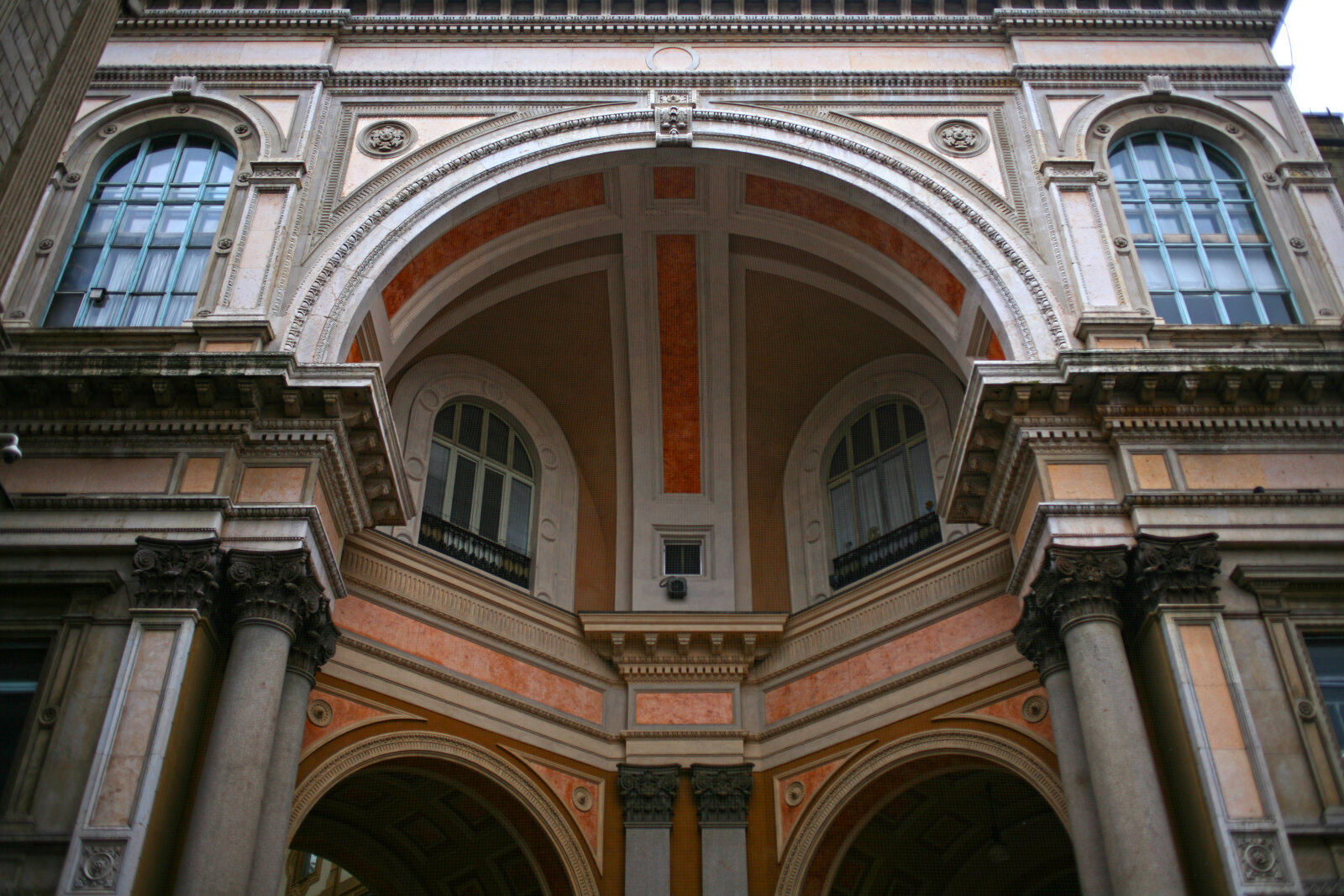
Look around first
What to notice
- Monumental arch on the Milan Cathedral side
- Glass dome
- Octagonal hall
- Mosaic floor
The story of the place
From beneath the monumental arch on the Milan Cathedral side begins a covered city street, linking Piazza del Duomo with the piazza by the La Scala theater. It ran through the former maze of narrow lanes, and a second passage crosses it beneath a glass dome, forming an octagonal hall with a mosaic floor. Shops and cafés have stood along this indoor crossroads from the very beginning: passersby walked between the two main piazzas, tenants received customers, and the city received income from the premises.
On December thirtieth, eighteen seventy-seven, forty-eight-year-old Giuseppe Mengoni, the architect and contractor of the monumental arch on the Milan Cathedral side, climbed the scaffolding for a final inspection. One day remained before the deadline stipulated by the contract. Mengoni fell and died on the spot.
It had taken him sixteen years to reach this arch. After the Austrian administration left, Milan officials turned their attention to the city center. Between Milan Cathedral and the recently laid-out piazza by La Scala stood a district of narrow streets. The municipality wanted to run a direct route through it and announced an architectural competition. Mengoni, a young engineer from Bologna, was seeking his first major city commission. His proposal was initially passed over for the top prize, but after further rounds, he was entrusted with the final design.
Mengoni laid out a covered street between the two piazzas and crossed it with a second passage. Beneath the central glass dome, this created an octagonal space, with shops and cafés along the sides. People could walk from the cathedral to the theater, meet, and shop under one roof. Commerce was built into the plan by the designers from the very beginning: tenants received a flow of passersby, and the city received income from the premises.
The name, too, belongs to the idea of the first years of a united Italy. Victor Emmanuel II was the first king of the new state and personally supported the costly construction, which was surrounded by controversy. On March seventh, eighteen sixty-five, he laid the first stone at the center of the future octagon. A lead box containing a record of the ceremony, drawings, photographs, and Italian and English coins was placed in the granite. Two years later, the king returned and signed the act opening the Galleria, which already bore his name.
The passage was opened to the public while the main entrance on the Milan Cathedral side was still unfinished. Then the English development company went bankrupt and transferred the property to the municipality. Mengoni was removed from management for several years. When he was brought back, he was responsible for the finishing arch in his own name and with his own money: in eighteen seventy-six, the architect himself took on the contract for this section.
After his death, Milan officials abandoned several parts of the overall plan: the Royal Loggia, the continuation of the porticos, and the Palace of Independence, which Mengoni intended to build opposite Milan Cathedral. The arch on the Milan Cathedral side was the final section he managed to complete. Beneath it begins the covered street of Victor Emmanuel II; opposite, the site for the palace from Mengoni's design has remained empty.
Useful on site
It is often crowded by the mosaic; do not block the passage, and view the floor from the edge if a queue has formed around it.