 Guide On Map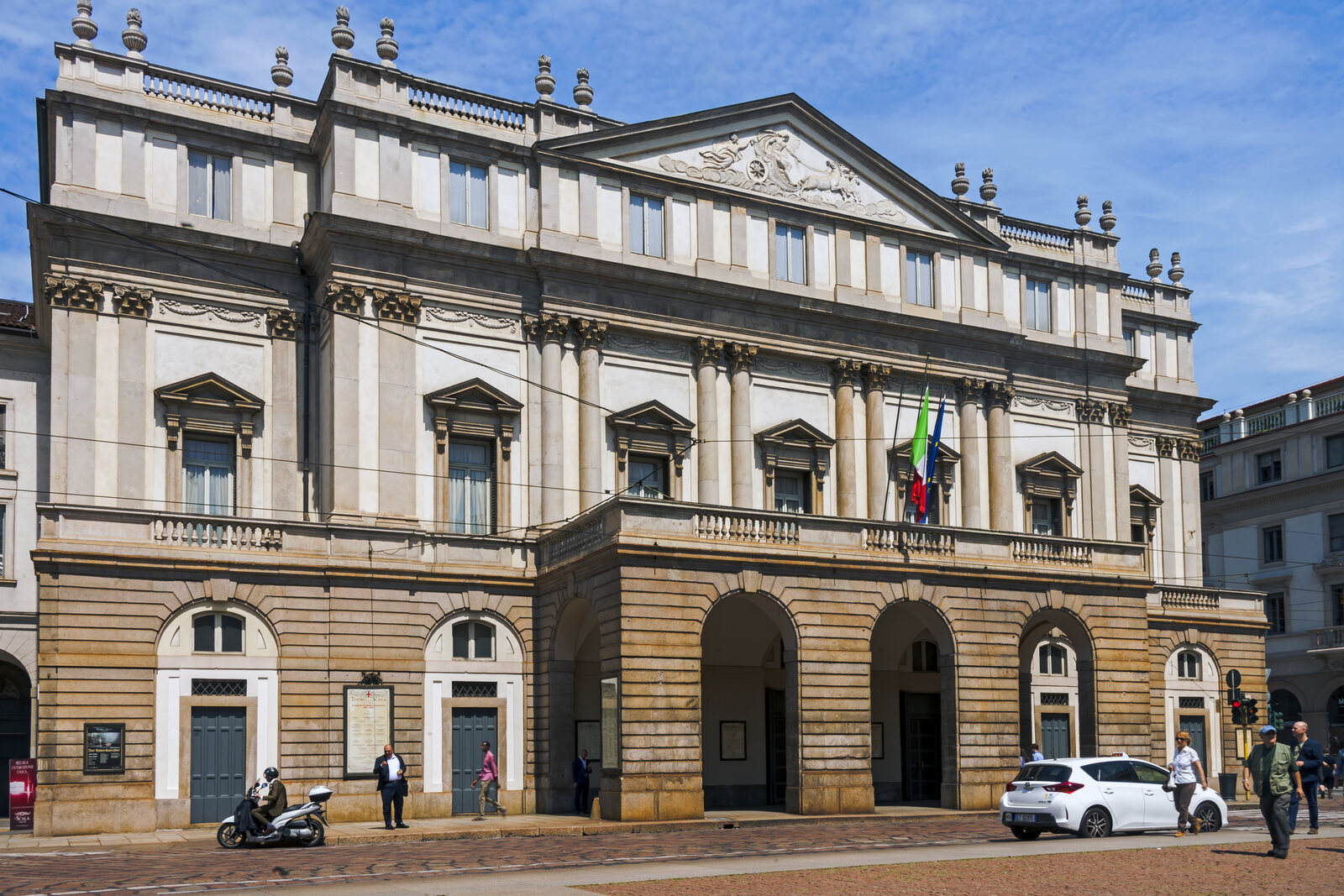
Look around first
What to notice
- La Scala facade
- Palazzo Marino
- Leonardo da Vinci monument
- Galleria arch
The story of the place
An open square lies between the theater facade and the city hall; at its center is a bronze group of a teacher with four pupils. It inherited its name from the court church where about twenty priests held services for living and deceased members of the Visconti family. The owners of theater boxes had property rights to their seats and paid for the construction of the new auditorium themselves, retaining those rights. Beatrice della Scala's surname remains on the theater's playbill and on the signs of the square.
From the Galleria Vittorio Emanuele II, you emerge at the facade of La Scala theater. Opposite stands Palazzo Marino, Milan's city hall, while at the center is Leonardo da Vinci with four pupils. This view appeared only in the middle of the nineteenth century. Before eighteen fifty-eight, there was no square here.
Its name is much older. In thirteen eighty-one, Beatrice della Scala, daughter of the ruler of Verona and wife of Milan's ruler Bernabò Visconti, decided to replace the small church that stood here with a larger church of the Assumption of the Virgin Mary. Scala was the surname of her Veronese family. The new church was first called Santa Maria alle Case Rotte, after the “ruined houses” around it, and then it came to bear its founder's name: Santa Maria della Scala.
Beatrice died when the walls had already been raised, but arrangements for the clergy's upkeep had not yet been made. Bernabò brought her plan to completion: the church acquired about twenty priests, required to hold services for living and deceased members of the Visconti family. Thus the woman's surname became the name of the court church and remained so for nearly four centuries.
In seventeen seventy-six, a fire destroyed Milan's former opera house at the ducal palace. The owners of its boxes lost not only their seats at performances: the boxes were considered their property. Empress Maria Theresa commissioned Giuseppe Piermarini to build a new theater here, on the site of the dilapidated Santa Maria della Scala. The costs were assigned to the box owners; in return, they were given the land of the former church and restored their property rights to boxes in the new auditorium. The church was dismantled, and in seventeen seventy-eight the theater opened, retaining its name.
A narrow street still ran in front of the theater. Old houses stood almost against the facade, and carriages clustered at the covered arcade where passengers got out. In eighteen fifty-six, the administration ordered the block opposite to be demolished; two years later, an open space had formed between the theater and Palazzo Marino. The name Piazza della Scala was established for it in eighteen sixty-five.
Later, city officials moved here a monument to Leonardo intended for another square. The sculptor Pietro Magni depicted the master above four pupils who had worked in Milan; the group was unveiled in eighteen seventy-two, when the Galleria and the city hall had already appeared nearby.
No walls of Beatrice's church remain: the theater stands in its place. Her surname has survived on the theater's playbill and on the signs of the square, which did not yet exist here during Beatrice's lifetime.
Useful on site
Walk around the monument to see the entire group; the facades are easier to compare from the central part of the square.