 Guide On Map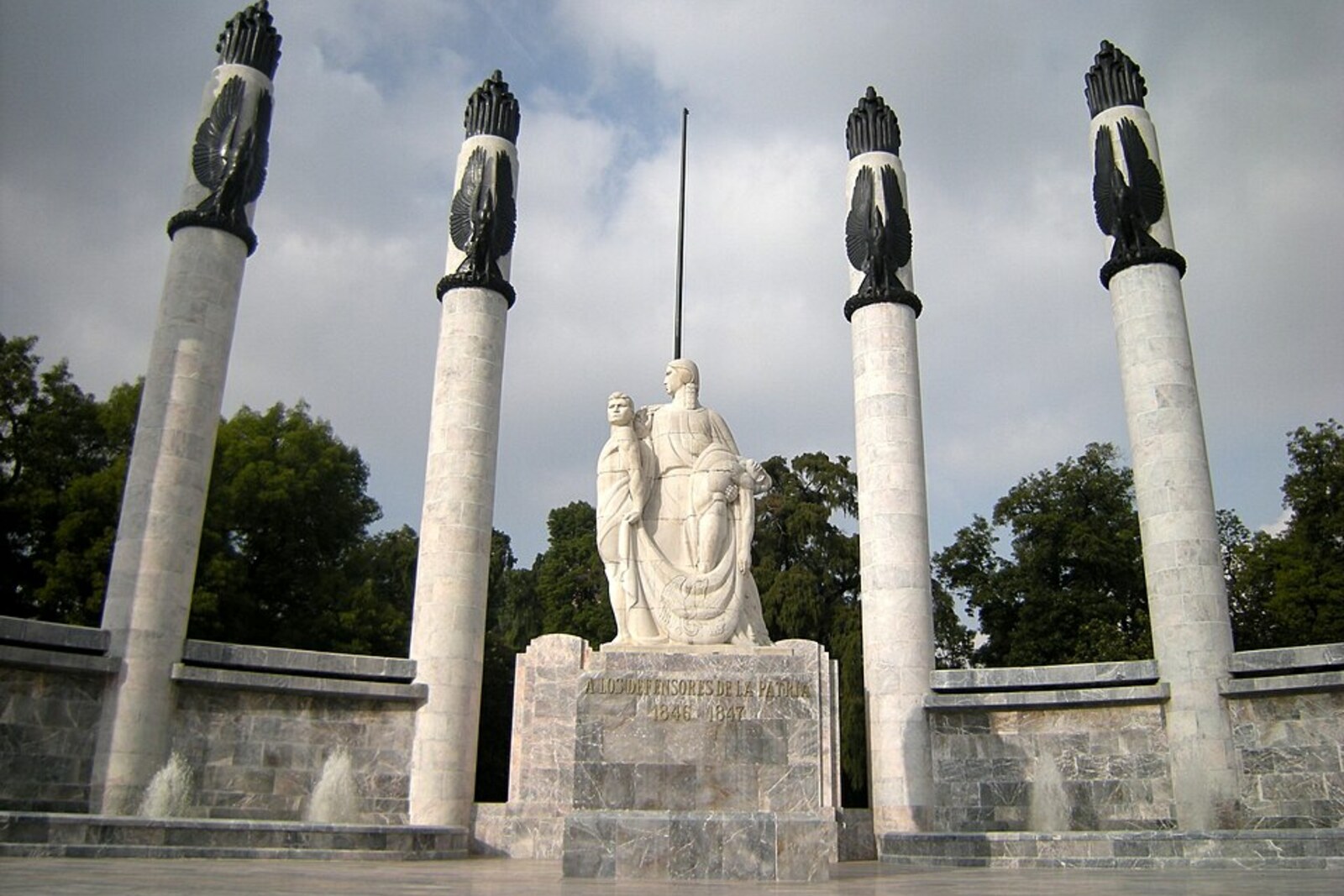
Look around first
What to notice
- Six white columns
- Central sculptural group
- Inscription to the defenders of the Fatherland
The story of the place
Six white columns are arranged around a central sculptural group, forming a mausoleum at the foot of Chapultepec Hill. Inside the columns stand urns containing remains officially attributed to six students of the Military College; the commander of the San Blas Battalion is buried beneath the sculpture. The monument was erected one hundred years after the battle as a place of state remembrance and annual military ceremonies. From here, the route to the castle, where it all happened, is visible in a straight line.
Six white columns mark six names. They are called the Niños Héroes—the Heroic Children. They are junior officer Juan de la Barrera and cadets Juan Escutia, Agustín Melgar, Francisco Márquez, Fernando Montes de Oca, and Vicente Suárez. They studied and lived at the Military College, which occupied the castle at the top of the hill. The youngest, Francisco Márquez, was thirteen years old; he submitted his application for admission only in January of eighteen forty-seven.
In September of that same year, the American army was already outside Mexico City. The castle protected the approach to the capital, and General Nicolás Bravo, who commanded its defense, wanted to hold the hill, although he repeatedly requested reinforcements and did not receive them. On September twelfth, artillery shelled Chapultepec from dawn until evening. The bombardment resumed the following morning.
At about six o’clock, Bravo ordered roughly one hundred cadets to leave the college: he understood that he would not be able to stop the assault with the forces available. Not all of them left. About fifty students decided to remain with the soldiers. When the American infantry began its ascent, they fired from the castle and from the fortifications on the slope.
The only reinforcements were brought by Colonel Felipe Santiago Xicoténcatl, commander of the San Blas Battalion. His men tried to hold back the attackers at the first ramp. Most of the battalion, and Xicoténcatl himself, were killed. Higher up, among the college’s last defenders, the six whose names appear on the monument were killed. The remaining defenders were thrown onto the rocks or taken prisoner. By ten o’clock, the castle had been captured.
The best-known scene in this story is Juan Escutia, who supposedly wrapped himself in the Mexican flag and threw himself from the wall so that the banner would not fall into enemy hands. This is a legend. Accounts from the time of the battle do not describe such an act; the story of the jump appeared later, and it was linked to Escutia’s name only decades afterward. What is certain is different: the six died during the defense of Chapultepec, but they fought here alongside dozens of other cadets, soldiers, and militia members.
One hundred years later, retired General Juan Manuel Torrea campaigned to have the remains of the fallen cadets found for the anniversary of the battle. He identified a place on the slope, relying on a chain of retold accounts and the words of an old park caretaker. Army engineers found six skeletons less than two meters below the surface. A commission that included Torrea himself declared them to be the remains of the Niños Héroes. The reliability of that identification is disputed: the commission could not establish identities from the bones found, and specialists from the National Institute of Anthropology and History did not take part in the investigation.
By presidential decree, the remains were nevertheless declared authentic, placed in six urns, and in nineteen fifty-two installed in the new Altar to the Fatherland. Inside the columns are urns officially attributed to the six cadets; Xicoténcatl is buried beneath the central sculpture. This is why the words “To the Defenders of the Fatherland, eighteen forty-six to eighteen forty-seven” are carved on the front. The Altar serves as a mausoleum and a site of annual military ceremonies. The six died higher up, by the castle and on the slope; their disputed remains rest here, on a straight line from Lions’ Gate to the battlefield.
Useful on site
Following the schedule of the first section: official sources differ between 06:00–17:00 and 05:00–19:00, extending to 20:00 in summer. Plan a daytime visit from Tuesday through Sunday and check notices at the entrance; Monday is usually unsuitable.
Checked: June 29, 2026. Check the official source before visiting.Read the names one by one, and keep the legend of the jump with the flag in the status of a legend, rather than an established episode.