 Guide On Map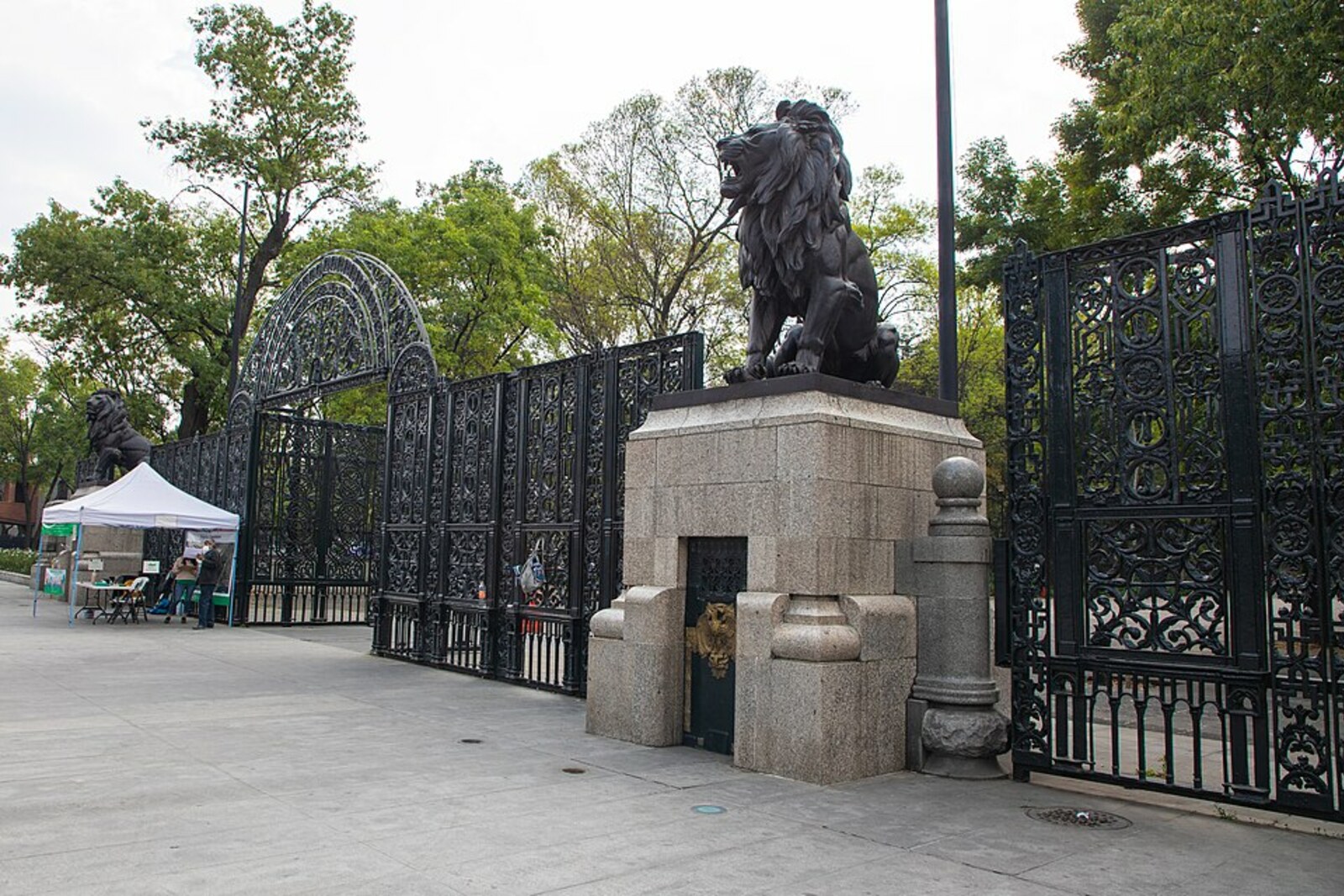
Look around first
What to notice
- Two bronze lions
- Granite pedestals
- Passage through the gate
The story of the place
From the main approach on the Paseo de la Reforma side, a passage between two bronze lions leads into Chapultepec. From outside, their tall granite bases look like pedestals, but inside each one there was once space for a guard. The park's first section begins beyond the gate, and the lions became a familiar meeting point for those entering here. The city gave the gate its current name precisely after this pair.
The two bronze lions at this gate arrived in Mexico City for a building that does not exist. They were intended for the ceremonial staircase of the Federal Legislative Palace—the future home of both chambers of the Mexican Congress.
President Porfirio Díaz conceived this palace, seeking to leave the capital with a grand state building. The French architect Émile Bénard signed a contract in nineteen oh four and commissioned the animal sculptor Georges Gardet to create two lions for the main entrance. On September twenty-third, nineteen ten, Díaz laid the palace's foundation stone during the celebrations of the centenary of independence. A few weeks later, the Mexican Revolution began.
In May nineteen eleven, Díaz resigned and left for France. The new government terminated Bénard's contract, work stopped, and the completed sculptures had already been delivered from France. The lions, designed for an immense parliamentary staircase, ended up in storage.
For many more years, Bénard tried to recover his main Mexican commission. In nineteen twenty-eight, already an elderly man, he returned to Mexico City to seek funds to continue construction. He received no money, returned to Europe, and soon died. The palace designed by him never appeared; its surviving central structure was later used for the Monument to the Revolution.
President Álvaro Obregón decided the lions' fate after coming to lead the country following a decade of coups and civil war. In June nineteen twenty-one, he ordered the sculptures taken from storage and placed at Chapultepec's main entrance on the Paseo de la Reforma side. Architect Antonio Muñoz García designed tall granite pedestals for them. A guard room was installed inside each one: the decorative pedestals acquired a literal function at the entrance.
On September seventeenth, nineteen twenty-one, the new entrance opened. The passage into the park's first section begins here, so people meet by the lions and enter Chapultepec between them. The place received its present name from the two sculptures—Lions' Gate.
The parliamentary staircase for them was never built. The bronze pair commissioned by Porfirio Díaz for the Mexican Congress now stands atop guard rooms by a public park.
Useful on site
According to the schedule of the first section: official sources differ between 06:00–17:00 and 05:00–19:00, extending to 20:00 in summer. Plan a daytime visit from Tuesday through Sunday and check notices at the entrance; Monday is usually unsuitable.
Checked: June 29, 2026. Check the official source before visiting.First view the gate from the city side, then enter the garden: the important layers of this stop are separated by a grille.