 Guide On Map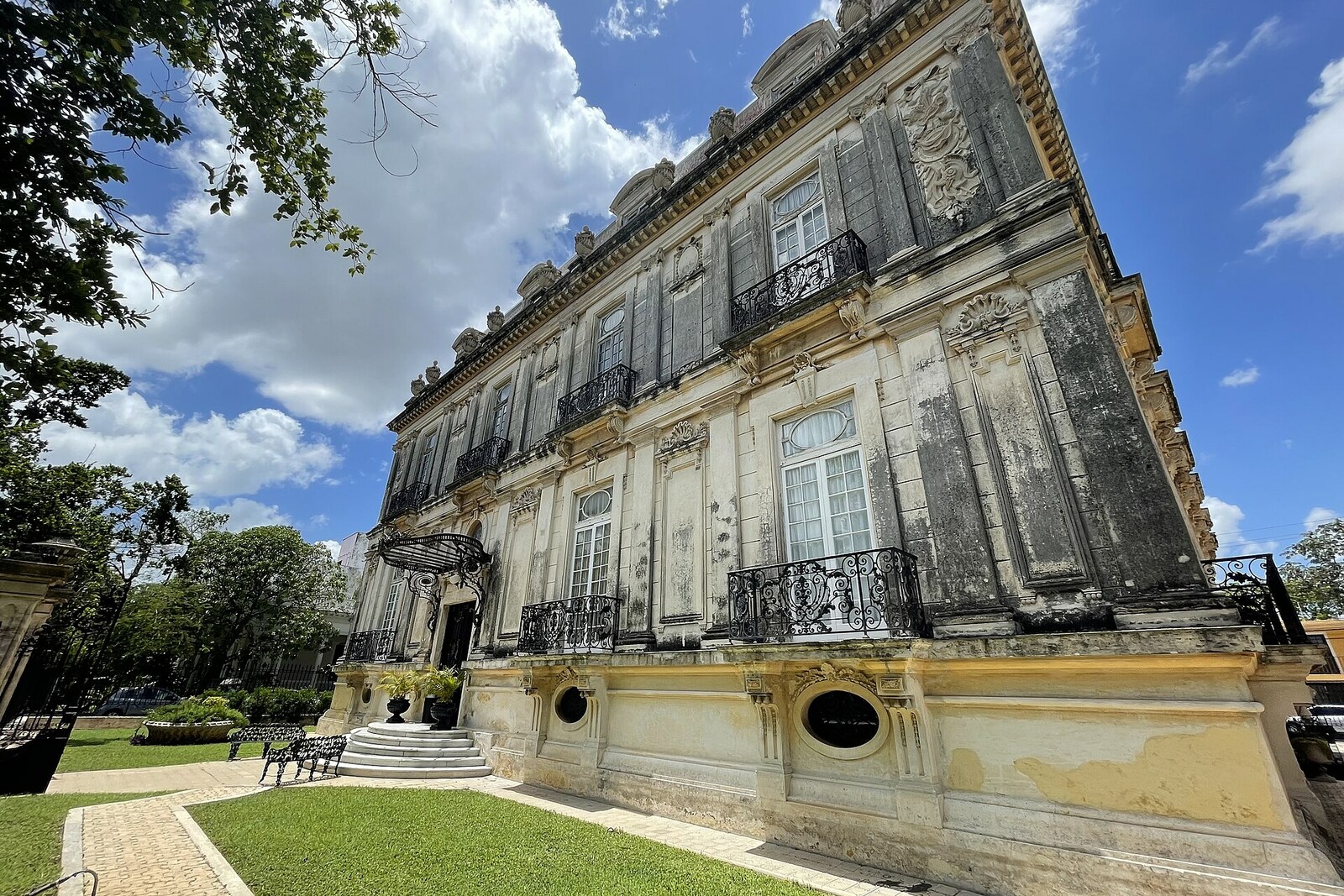
Look around first
What to notice
- Two similar façades
- The preserved room layout
- Family photographs
- Portraits of four sisters
The story of the place
Two almost identical façades at the corner of Forty-Fifth Street hold a pair of urban residences commissioned by two brothers who grew wealthy from henequen haciendas. They were designed simultaneously, so one house does not repeat the other, although the nickname The Twin Houses has stuck to both. From the beginning, the southern residence had wiring, plumbing, and telephone lines concealed in its walls; for Mérida at the time, such household technology was unusual. Behind its door, the old room layout has survived, while the northern twin still leads a private life today.
The southern of the two similar mansions at the corner of Forty-Fifth Street remained a private home for more than a century. The change began after its owner, Maruja Herrero García, died on May twentieth, two thousand twenty. Her eldest daughter, also Maruja, gathered all six children of the Barbachano family. They had to decide what to do with the house where they had grown up and where they continued to gather for family occasions. Maruja proposed letting in the public.
The family understood the cost of that decision: visitors would gain access to rooms connected with their childhood, while the heirs would lose some of the home's privacy. Everyone agreed on the condition that they would not change the layout or the old furnishings for the sake of the museum display. On January fifteenth, two thousand twenty-one, the house opened for tours. The name “Montejo 495” was taken directly from the address: this way, the museum did not belong entirely to either of the two families that had lived here.
The first was the Cámara Zavala family. Brothers Ernesto and Camilo made their money from henequen—an agave whose fiber was used to make ropes and burlap. They owned two henequen haciendas. At the beginning of the twentieth century, the brothers commissioned the French architect Gustave Umbdenstock to design two neighboring residences at once. Ernesto moved into the southern one with María Cámara Zavala, while Camilo occupied the northern one with his wife and children.
The houses are called The Twin Houses because of their similar façades, although they are not completely identical. A common story claimed that one brother first built his mansion and the other ordered his copied. The heirs checked the French archives and found that Umbdenstock designed both residences simultaneously. In the southern house, electrical wiring, plumbing, and telephone lines were concealed in the walls—an unusual arrangement for Mérida at the time. Ernesto and María moved here when they were already elderly; the money from the henequen estates allowed them to acquire an almost complete French interior on the new Paseo de Montejo.
In nineteen sixty-four, Fernando Barbachano Gómez Rul bought this house. His income already depended on a different industry: he ran a travel agency, hotels, and projects for travelers in Yucatán. Fernando saw the formal rooms as a suitable place to receive foreign guests. According to his daughters, the calculation was commercial: invited guests were meant to leave here and tell others about Yucatán and Maya cities. This is how a family business that sold travel entered the mansion paid for by henequen.
Fernando lived here until his death in two thousand six. His wife kept the house in the family for another fourteen years, and the children brought the decision made after her death to fruition. The rooms now contain belongings of the first owners and later objects from the Barbachano family, including family photographs and portraits of four sisters. The southern residence welcomes visitors, while behind the neighboring, almost identical façade, the northern twin still remains a private home.
Useful on site
According to the Cultural Information System: Tue–Sun 09:00–17:00; Mon closed. General admission 250 pesos; 150 for Mexican citizens; 100 for students, teachers, and INAPAM members; photography 50; free for children under 3.
Checked: date not specified. Check the official source before visiting.From the street, the pairing of the houses and their position on the avenue are easy to see. The interiors are accessible as a separate museum visit, and it is worth checking the conditions in advance.