 Guide On Map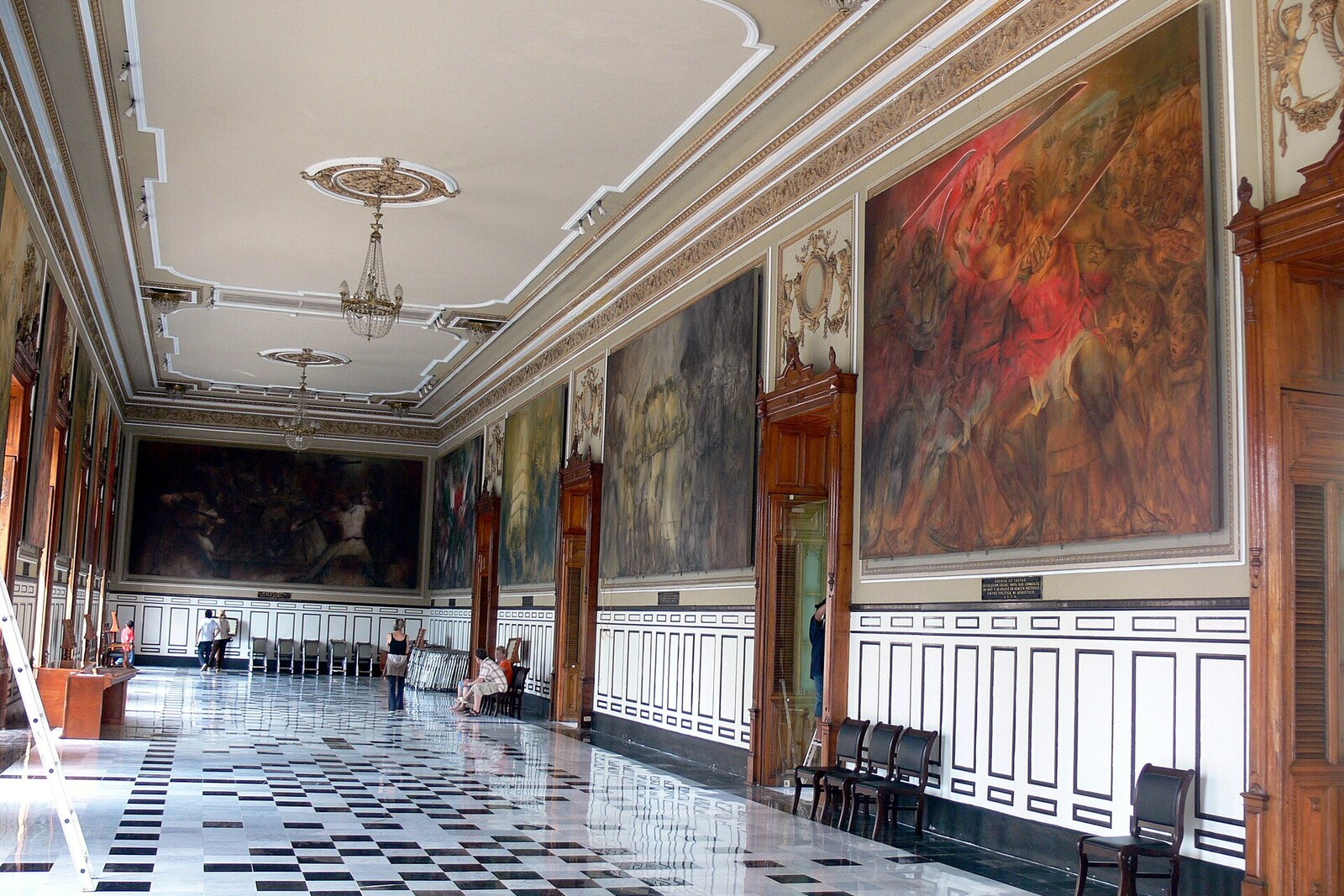
Look around first
What to notice
- The balcony above the square
- The governor’s office
- Historical paintings
- An image of Salvador Alvarado
The story of the place
Before the present palace, this site was occupied by the Casas Reales, where the royal governor lived and kept his chancery. The building, opened in eighteen ninety-two, inherited this function: the governor’s office and state institutions are still here. A balcony projects above the square, and inside are twenty-seven historical paintings by Yucatán artist Fernando Castro Pacheco.
On February tenth, nineteen fifteen, Abel Ortiz Argumedo, commander of Mérida’s garrison, stepped onto the balcony of this palace. A crowd had gathered below. The colonel announced that he was removing the appointed governor, Toribio de los Santos, creating his own government junta, and asking that it be recognized as legitimate.
Ortiz claimed that he was defending Yucatán’s autonomy. Behind the dispute was a very tangible commodity: henequen, a stiff fiber used for ropes and twine. Its export had enriched the owners of local haciendas. The Maya who lived there received advances and goods on credit; such debts were rarely paid off, and without the owner’s permission, a person could not leave. Venustiano Carranza, leader of the Constitutionalist Army, now intended to bring Yucatán under his government and carry out revolutionary reforms here. The owners of henequen estates gave Ortiz money to resist.
Carranza refused to recognize the junta. He sent General Salvador Alvarado to Yucatán, a military man who was to defeat the rebels and occupy the governor’s office. Ortiz raised an army with supporters’ money and funds from the state treasury, but Alvarado’s troops defeated it in three battles on the way to Mérida.
Ortiz did not wait for the enemy in the palace. He took a train to the coast, taking a substantial part of the treasury with him, hired a schooner in the port of El Cuyo, and fled to Cuba. On March nineteenth, Alvarado entered Mérida and settled into the very office Ortiz had vacated two days earlier.
One of the new governor’s first orders was the liberation of rural peons, most of them Maya. The decree itself had existed before, but had remained on paper. Alvarado ordered the cancellation of the debts that held workers on the haciendas, banned corporal punishment, and ordered compensation for those whom owners would drive out. Later, land, tax, and labor laws were drafted here. The cancellation of debts did not give former peons land of their own: many had to hire themselves out again to the same estates. But a debt record no longer gave an owner legal grounds to hold a person and that person’s family.
The present Palacio de Gobierno opened in eighteen ninety-two on the site where the Casas Reales had stood since Spanish times—the house and chancery of the royal governor. The governor’s office and state institutions are still housed in the building. Among the twenty-seven historical paintings created here by Yucatán artist Fernando Castro Pacheco is an image of Salvador Alvarado. From this palace balcony, Ortiz Argumedo asked that his government be recognized; inside now hangs a portrait of the man because of whom he abandoned the office and fled toward the sea.
Useful on site
An active government building; stable public-access hours for the murals have not been published, and entry may be restricted without notice.
Checked: date not specified. Check the official source before visiting.The palace remains a working building, so access may be restricted. If you cannot enter, listen to the story from the square and do not argue with security’s demands.