 Guide On Map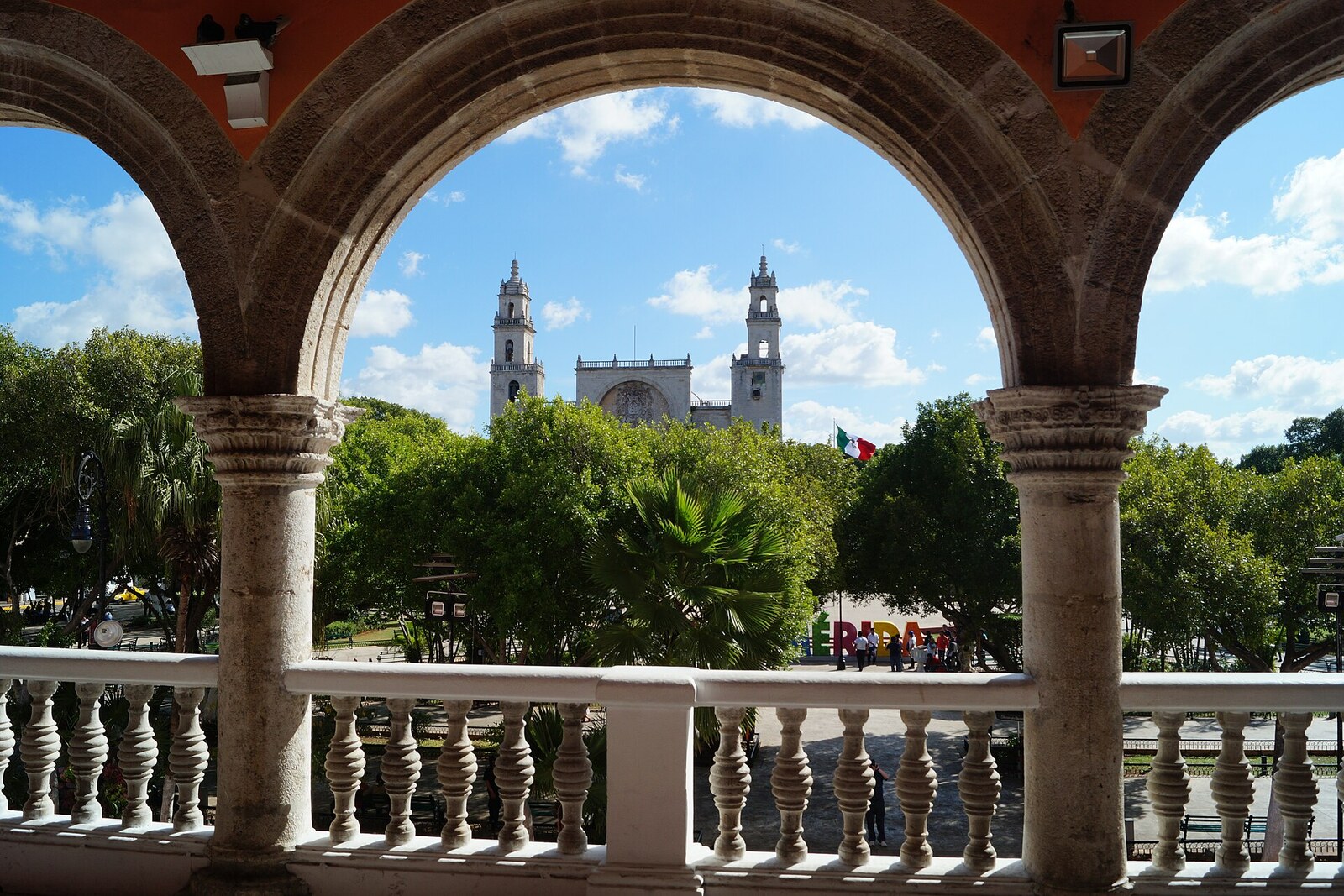
Look around first
What to notice
- The square’s rectangular garden
- The cathedral on the eastern side
- Casa de Montejo on the southern side
- Palacio de Gobierno on the northern side
The story of the place
Plaza Grande appeared before the palaces around it. On January sixth, fifteen forty-two, Francisco de Montejo the Younger, who led the conquest of Yucatán, gathered Spanish settlers here to formalize the founding of Mérida. The city was built on the site of the Maya city of T'ho, and the square itself was laid out over a large Maya structure known as Bakluum Cha'an.
Montejo brought a plan with straight streets and plots allocated in advance. Land to the east was set aside for the cathedral, to the north for the governor’s residence, to the west for the town hall, granary, and prison, and to the south for the Montejo family home. The open rectangle between them was called Plaza Mayor, the Great Square, or Plaza de Armas, the square for military musters. That is why city ceremonies, announcements, celebrations, and punishments were held here: the court, prison, governor, and spectators were all close together.
On December fourteenth, seventeen sixty-one, a scaffold was erected in the middle of the square for Jacinto Uc de los Santos, known as Canek. He was a thirty-year-old Maya widower from Campeche, unaffiliated with any settlement. During questioning, he named his occupation as mayordomo to the image of Jesus the Nazarene—a steward responsible for religious worship and festivities. Popular biographies later made him a baker and a student at a Franciscan monastery, but the record of the trial itself does not confirm this.
Shortly before the uprising, a priest ordered Jacinto to be publicly whipped for his sermons and ritual healings, and expelled him from Chikindzonot. Jacinto came to the settlement of Cisteil bearing marks of the beating. According to the testimony of those arrested, he compared his wounds to Christ’s wounds, promised the Maya freedom from the hated tribute, and promised the return of their lands. His followers proclaimed him king under the name Canek, linked to the rulers of the Itza people, who resisted the Spanish conquest longer than the other Maya.
On November nineteenth, the inhabitants of Cisteil supported Canek. People from neighboring settlements joined them, and the first group sent against them was defeated. José Crespo, the governor of Yucatán, assembled a much larger force. A week later, soldiers stormed Cisteil. More than six hundred of Canek’s followers and about forty Spaniards were killed. Canek left with several hundred survivors, but he was caught, taken prisoner, and paraded through the streets of Mérida.
Crespo pressed for a swift exemplary punishment. The court ordered Canek’s hands and feet to be crushed, that he be tortured to death on the platform, and that his body be left for three hours before those assembled. The remains were then taken outside the city, burned, and the ashes scattered. Seven more leaders of the uprising were executed with Canek; hundreds of participants received two hundred lashes each, while others were expelled from the province.
The garden in the square was not begun until eighteen forty-five. The scaffold has not survived, and its exact location among today’s paths is not marked. The square’s official name is Plaza de la Independencia, Independence Square: it was given in eighteen twenty-one after Yucatán separated from Spain. Residents, however, continue to call it Plaza Grande—the Great Square. Citywide ceremonies are still held here, and crowds gather in the same rectangle between the cathedral, the former town hall, and the governor’s residence where Canek’s body lay for three hours.
Useful on site
Open around the clock as a public square; individual areas may be closed off for events.
Checked: date not specified. Check the official source before visiting.This stop is entirely outdoors. Choose a spot from which several sides of the square are visible, and do not linger in the roadways.