 Guide On Map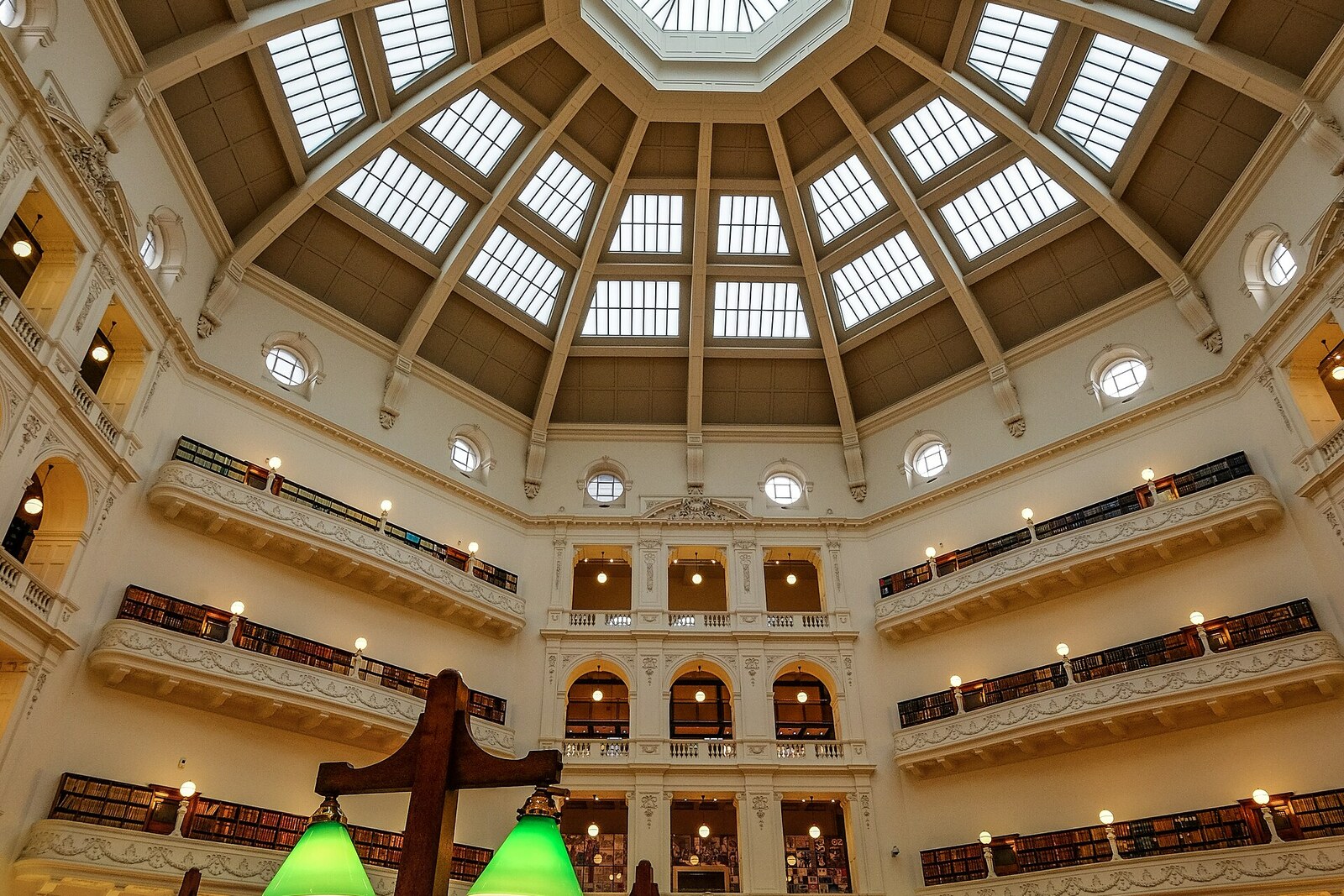
Look around first
What to notice
- Central staircase
- Bronze statue
- Domed reading room
- Tulk Building
The story of the place
Behind the stone facade and broad central staircase, an entire library complex has grown. The large domed reading room came later, when the collection had outgrown the earlier premises. Its holdings include books alongside manuscripts, maps, newspapers, and photographs from Victoria, and people work with these materials in the rooms. The bronze figure on the staircase recalls the man who worked to ensure that people could enter here without fees or recommendations.
In the spring of eighteen fifty-six, Augustus Henry Tulk was looking for a salary in Melbourne. Two years earlier, he had arrived from England with his wife and children: doctors had advised him to seek a warm, dry climate. Tulk bought a schooner, loaded it with mining equipment and goods for gold prospectors, and planned to establish a business of his own afterward. Several unsuccessful investments brought heavy losses. The man who had come to profit from the gold rush was left without work just as Swanston Street needed its first librarian.
Melbourne Public Library had opened only three months earlier. Its president, Judge Redmond Barry, had pressed for a free institution where men and women, residents of the Colony of Victoria and visitors, could enter without a letter of recommendation, a guarantor, a fee, recording their name, or even a library card. Until there was a permanent employee, Barry himself shelved and dusted the books and, when necessary, stood at the door in place of an attendant. Of forty-eight applicants, the trustees chose Tulk. After his commercial failure, he began living on a government librarian’s salary.
The collection then contained three thousand eight hundred forty-six volumes, selected by Barry. Tulk knew several European languages and major booksellers in London and on the Continent; these connections now proved useful here. He ordered publications, developed a subject classification, compiled catalogs, and sought donations. During his travels, Barry persuaded collectors to give Melbourne books, paintings, and sculpture, while Tulk turned parcels and crates into a collection that could be used.
He was offered positions in Sydney and even help in obtaining a post at the British royal court. Tulk refused: he called this library his own. Over seventeen years, the number of books exceeded eighty thousand, and an art gallery and scientific collections appeared alongside them, later growing into separate museums. Tulk continued working almost until his death, although he had diabetes. In eighteen seventy-three, the library closed for a day as a sign of mourning. He left behind a wife, children, and debts of about six hundred pounds.
Tulk did not live to see the domed reading room: it opened forty years later, when the collection needed much more space. Today, it holds not only books but also manuscripts, maps, newspapers, photographs, and other materials connected with the state of Victoria; they are studied here, in the reading rooms. A bronze Redmond Barry stands on the central staircase in front of the facade, and one of the halls bears his name. The first librarian’s name remains on the Tulk Building and at Mr Tulk café—in the part of the complex where books were once lent out.
Useful on site
Usually daily 10:00–18:00; closed on certain public holidays.
Opening hours by day
The facade can be viewed regardless of exhibitions. Inside, follow the reading-room rules and check the exhibition program in advance.