 Guide On Map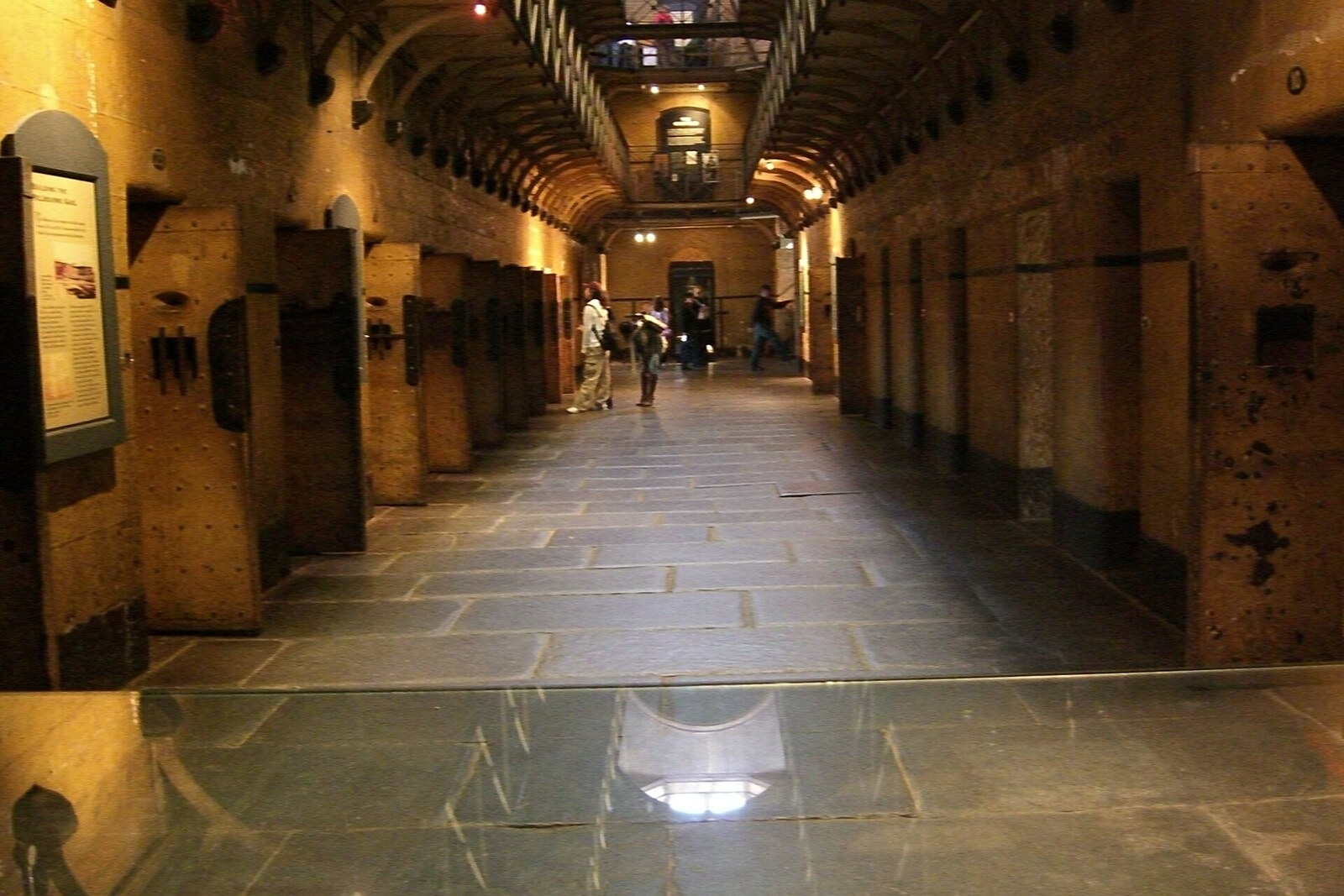
Look around first
What to notice
- Stone building
- Cells
- Gallows
- Death mask
The story of the place
Melbourne's main gaol contained cells, a hospital, exercise yards, and permanent gallows. One hundred thirty-three executed prisoners passed through it, and the prison yard long served as their nameless cemetery. Now only the stone building remains of the complex: inside, the cells and gallows survive, and the display includes the death mask of one of the prisoners.
In the surviving stone building of Old Melbourne Gaol, on November tenth, eighteen eighty, Ned Kelly dictated his final petition to the Governor of Victoria from the condemned cell. After the shootout at Glenrowan, he was so badly wounded that he could not write, and he made a cross instead of a signature. Kelly asked for his mother to be released before his execution and for his body to be given to friends so they could bury him in consecrated ground.
Kelly led a gang of mounted robbers who lived by stealing horses and robbing banks. For nearly two years, they had been in hiding after three police officers were killed at Stringybark Creek. Kelly was tried for the murder of one of them, Constable Thomas Lonigan, found guilty, and sentenced to the then-mandatory punishment of hanging.
He was brought here, to Melbourne's main gaol, for the sentence to be carried out. The word “gaol” in its English name means “prison.” This complex contained cells, a hospital, exercise yards, and permanent gallows. Kelly was to become the one hundred first of one hundred thirty-three people executed here. At the same time, his mother Ellen was serving a three-year sentence in the women's division of this same prison.
The Executive Council and the Governor considered three times whether the death sentence should be commuted. On November tenth, officials read Kelly's final letter and refused again. His mother was not released, and they decided not to hand the body over to the family: prison rules did not allow it.
The next morning, at about ten o'clock, Kelly was taken out to the gallows. The words attributed to him, “Such is life,” rest on a single later report and are considered a legend. Most of the journalists and officials present recorded different words: “Well, I suppose,” or “I suppose it has come to this.” Then the executioner opened the trapdoor.
Half an hour later, prison warders took down the body and brought it to the morgue. There, they shaved his hair and beard, covered his face and head with plaster, and made a death mask. This was standard procedure for the prison: at the time, people tried to determine a criminal's innate traits from the shape of the skull, and the casts were displayed to the public. As early as the next day, a wax representation of Kelly's head was being shown at an establishment on Bourke Street.
The body was buried without a headstone in the prison yard. When the yard was opened up for construction work in nineteen twenty-nine, the remains of those executed were moved to a common grave at Pentridge Prison. Records were kept poorly, some of the bones were carried off, and the skull long thought to be Kelly's later proved to belong to someone else.
Only in two thousand eleven did researchers compare genetic material from the recovered bones with a sample from the great-grandson of Kelly's sister. Bullet damage received at Glenrowan remained on the leg and arm. It confirmed the identity of the prisoner who, a day before his death, signed his request with a cross. In January two thousand thirteen, relatives buried his remains in consecrated ground at Greta Cemetery, beside the family.
There is no longer a prison cemetery here. In the surviving stone building of eighteen fifty-eight, the cells and gallows remain, and Kelly's death mask is displayed on the first floor. His final petition was fulfilled one hundred thirty-two years after officials read it in this prison.
Useful on site
Usually daily 10:00–17:00; check tours and exceptions before entering.
Opening hours by day
You can listen to the story by the outer walls. The cells and museum materials require a separate visit; do not count on entering without checking access.