 Guide On Map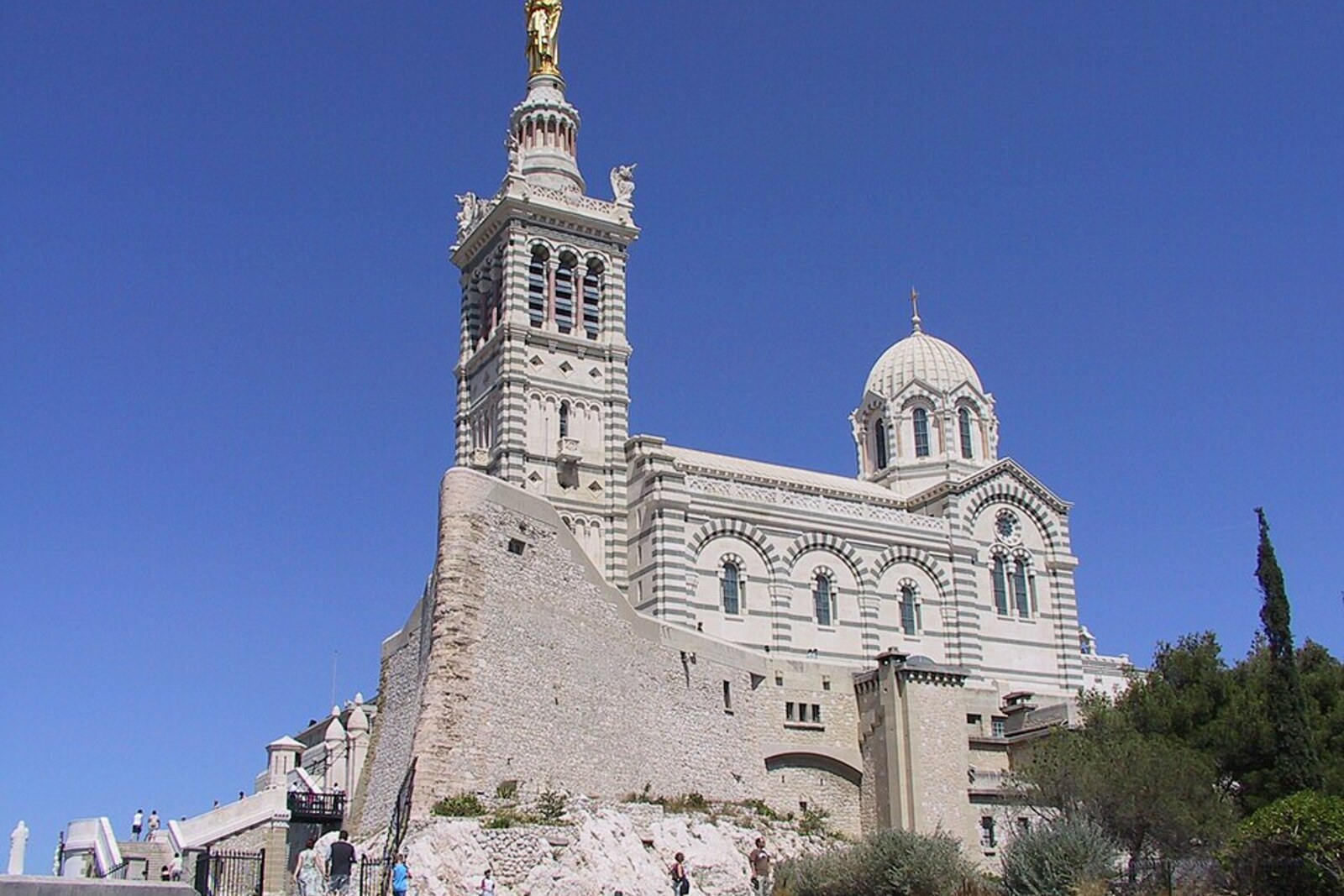
Look around first
What to notice
- Models of ships
- Walls of the old fort
- Holes in the basilica walls
- The tank “Jeanne d'Arc”
The story of the place
On the Watchtower Hill above Marseille, a nineteenth-century basilica rises directly on the walls of an older fortress. Before it, there was a chapel here, enlarged as the number of pilgrims grew. King Francis I ordered the fortifications built to defend the city from the summit. Their military past is not concealed: below the basilica stands a burned-out tank with a plaque naming the three tank crewmen who died.
Models of ships hang beneath the vaults of the upper church. They were brought by sailors who returned after a storm or shipwreck: a fulfilled vow became a painting, a marble plaque, a medal, or an exact replica of the vessel that had been saved. Such gifts are still brought today. Here they explain the name by which people of Marseille call the Virgin Mary—the Good Mother, protector of those who go to sea and those who wait for them on shore.
The first small chapel appeared at this height in twelve fourteen. The hill was already called La Garde—the Watchtower: from here, people watched the sea and the approaches to the port. More and more pilgrims came, the chapel was enlarged, and in the middle of the nineteenth century Eugène de Mazenod, Bishop of Marseille, secured the construction of the present basilica. That is why this ornate church stands on the walls of a real fort. King Francis I ordered it built in fifteen thirty-six to protect the city from this height.
On August twenty-fifth, nineteen forty-four, this old union of sanctuary and fortress determined the course of the battle for Marseille. German soldiers set up concrete firing positions in the rock, mined the approaches, installed anti-tank guns and electric flamethrowers, and placed observers in the bell tower to direct artillery fire. From the summit, the port, streets, and approaches to the city could be seen.
General Joseph de Monsabert, commander of the 3rd Algerian Infantry Division and seeking the surrender of the Marseille garrison, ordered the hill taken. An assault platoon of the 7th Algerian Tirailleurs Regiment, commanded by junior officer Roger Audibert, advanced up the northern slope. Of the forty-five men with whom the platoon had landed in Provence nine days earlier, thirty-two remained by that morning.
The tirailleurs made their way through gardens. Jean Delay, Bishop of Marseille, gave them a ladder to get over the wall of his residence, then dressed the wounded in the kitchen together with Canon Lucien Gros. Two tanks tried to climb up after them. “Jourdan” hit a mine and continued firing from where it stood. “Jeanne d'Arc” emerged onto Place Sainte-Marie (now Place du Colonel Edon). Shells pierced the tank, it caught fire, and it reversed into the wall of the bishop's garden. Two tank crewmen managed to escape; three died inside.
At around three in the afternoon, flamethrowers struck from the rock. When the flames died down and the shooting briefly slackened, Audibert decided to storm the position. He told the soldiers to shield their faces with rifle stocks and entrenching shovels: above all, they feared another blast of fire in their eyes. The advance party reached the wooden gate. One young tirailleur threw down his rifle and kit bag, climbed over one of the gate leaves, saw a key on the inside, and opened the way for his comrades.
Twenty-three defenders from two concrete shelters surrendered. Audibert's men then climbed concealed stairways to the eastern terrace and captured nine German artillery observers. Monsignor Borel, rector of the basilica, who had refused to leave the sanctuary during the occupation, helped the soldiers raise the French flag over it. German batteries continued shelling and punched huge holes in the basilica walls, but they could no longer retake the summit.
About fifty soldiers and officers still remained beneath the esplanade. Audibert sent them three prisoners whom his men had managed to bandage and feed. An hour later, the envoys returned at the head of the entire underground group. By evening, the shooting on the hill had died down; three days later, the commander of the German garrison in Marseille signed the surrender.
The Ministry of War handed the burned-out tank “Jeanne d'Arc” over to Marseille in nineteen forty-six. It stands below the basilica, where it was knocked out. The plaque preserves the names of the three tank crewmen who died, and the stele beside it bears the name of the 7th Algerian Tirailleurs Regiment.
Useful on site
Free admission daily 07:00–18:00; interior visits are interrupted during services and celebrations.
Checked: date not specified. Check the official source before visiting.It can be windy at the summit. Keep quiet inside and do not disturb services; the tank and defensive walls can be seen from outside.