 Guide On Map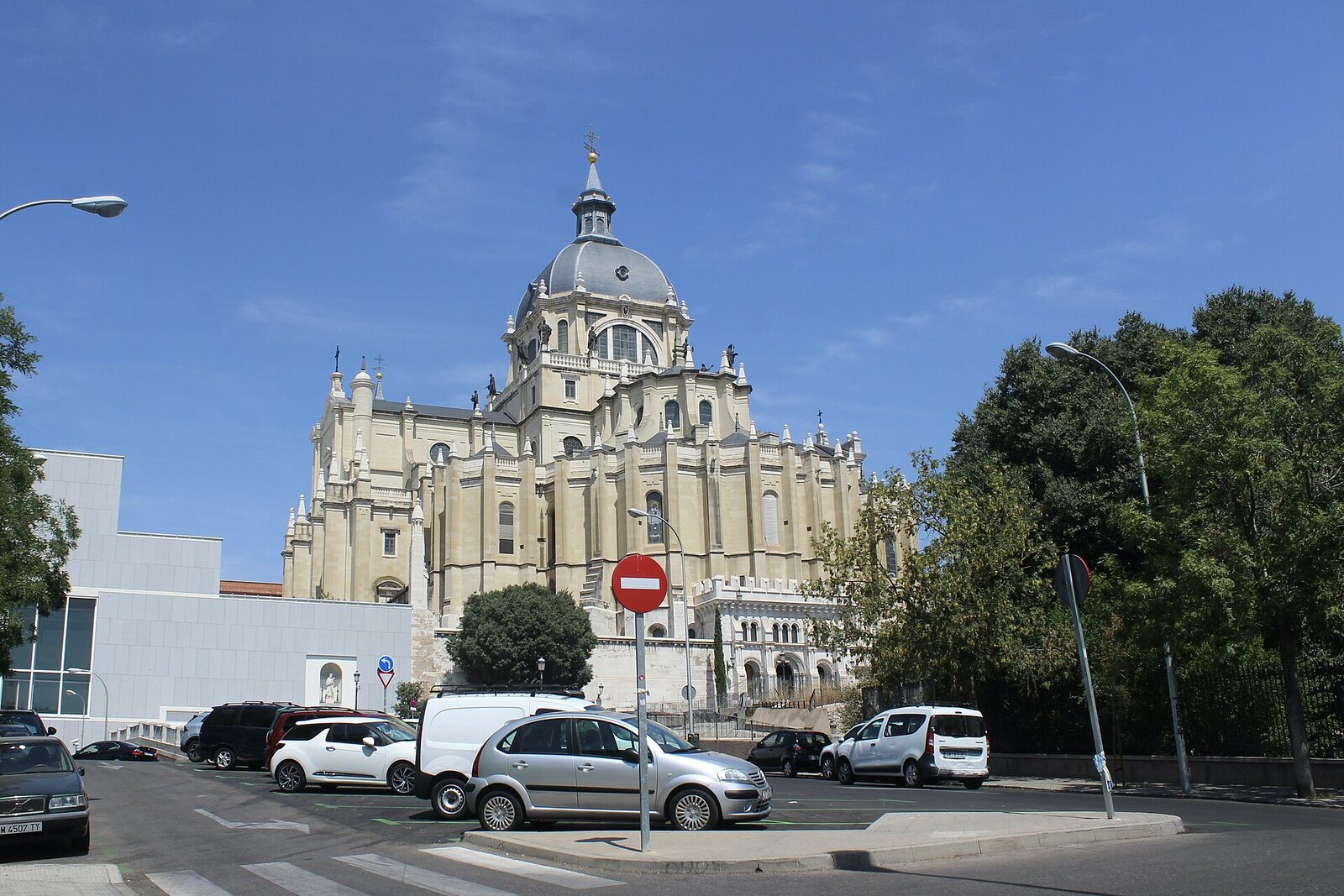
Look around first
What to notice
- The image of Our Lady of Almudena
- The white marble slab behind the main altar
- The cathedral's north façade
- The Neo-Gothic crypt
The story of the place
La Almudena Cathedral serves as the principal church of the Archdiocese of Madrid. It began as a parish church; with the establishment of a separate diocese, the church under construction was given the role of cathedral. Its name recalls Almudena, the medieval fortified citadel in this part of the city, and the venerated image of Our Lady. Below is a Neo-Gothic crypt, and behind the main altar stands a wooden statue, painted and gilded.
Seventeen-year-old Queen María de las Mercedes managed to do the most important thing for the future church: secure a site opposite the Royal Palace. The Church of Santa María la Real de la Almudena, where the image of Madrid's patroness was kept, was demolished in eighteen sixty-eight. Devotees of Our Lady of Almudena asked for a new church to be built for her, and the queen supported their request. On April twenty-third, eighteen seventy-eight, she and her husband, King Alfonso XII, handed the land over to the parish priest.
Two months later, María de las Mercedes died suddenly. She had only just turned eighteen. Construction had not yet begun, so her body was taken to the Monastery of El Escorial. Alfonso decided that the new church should become the place of her final burial.
Architect Francisco de Cubas learned of his own appointment from a newspaper: no one had yet asked whether he agreed to design the church. After the queen's death, Alfonso summoned him to the Monastery of El Escorial. Their conversation lasted four hours. The king demanded Cubas's honest word as a gentleman that he would not abandon María de las Mercedes's plan. The architect agreed, although, by his own admission, he expected expense, hostility, and constant resistance. In the first design, he set aside the right side of the church for a tall Gothic mausoleum: the queen was to lie below, while above she was depicted praying.
Then the building's purpose changed. In eighteen eighty-five, Pope Leo XIII created the separate Diocese of Madrid-Alcalá—a church territory headed by a bishop. The parish church under construction was to become its principal church, that is, a cathedral. Cubas enlarged the design, and the separate mausoleum of María de las Mercedes disappeared from the drawings. Alfonso XII and Francisco de Cubas died without seeing the work completed. Even the crypt was completed after their deaths.
The cathedral's name refers to the image of Our Lady of Almudena. The word “Almudena” comes from the Arabic “al-mudayna”—the fortified citadel that stood in this part of medieval Madrid. According to legend, Christians hid a statue of the Virgin Mary in the city wall before the Muslim conquest. When King Alfonso VI walked along the wall with a procession in ten eighty-five, the stones collapsed and revealed a niche containing the statue and two burning candles. This is specifically a legend. The present pinewood figure, painted and gilded, was made in the late fifteenth or early sixteenth century and cannot be that ancient statue from the story.
In nineteen ninety-three, the image was moved into the completed cathedral, consecrated by Pope John Paul II. Seven years later, the remains of María de las Mercedes were brought from the Monastery of El Escorial. Her intended mausoleum is not here. Behind the main altar, beneath the image of Our Lady of Almudena, lies a white marble slab with the inscription: “María de las Mercedes, the tenderest wife of Alfonso XII.”
Useful on site
Accessible from outside as an urban space; checked 2026-06-30. The cathedral is usually open to visitors, but tourist visits stop during services; the museum operates separately.
Checked: June 30, 2026. Check the official source before visiting.The main details of the story can be seen from outside. Treat entry inside as a separate part of the visit: access may change because of services and church events.