 Guide On Map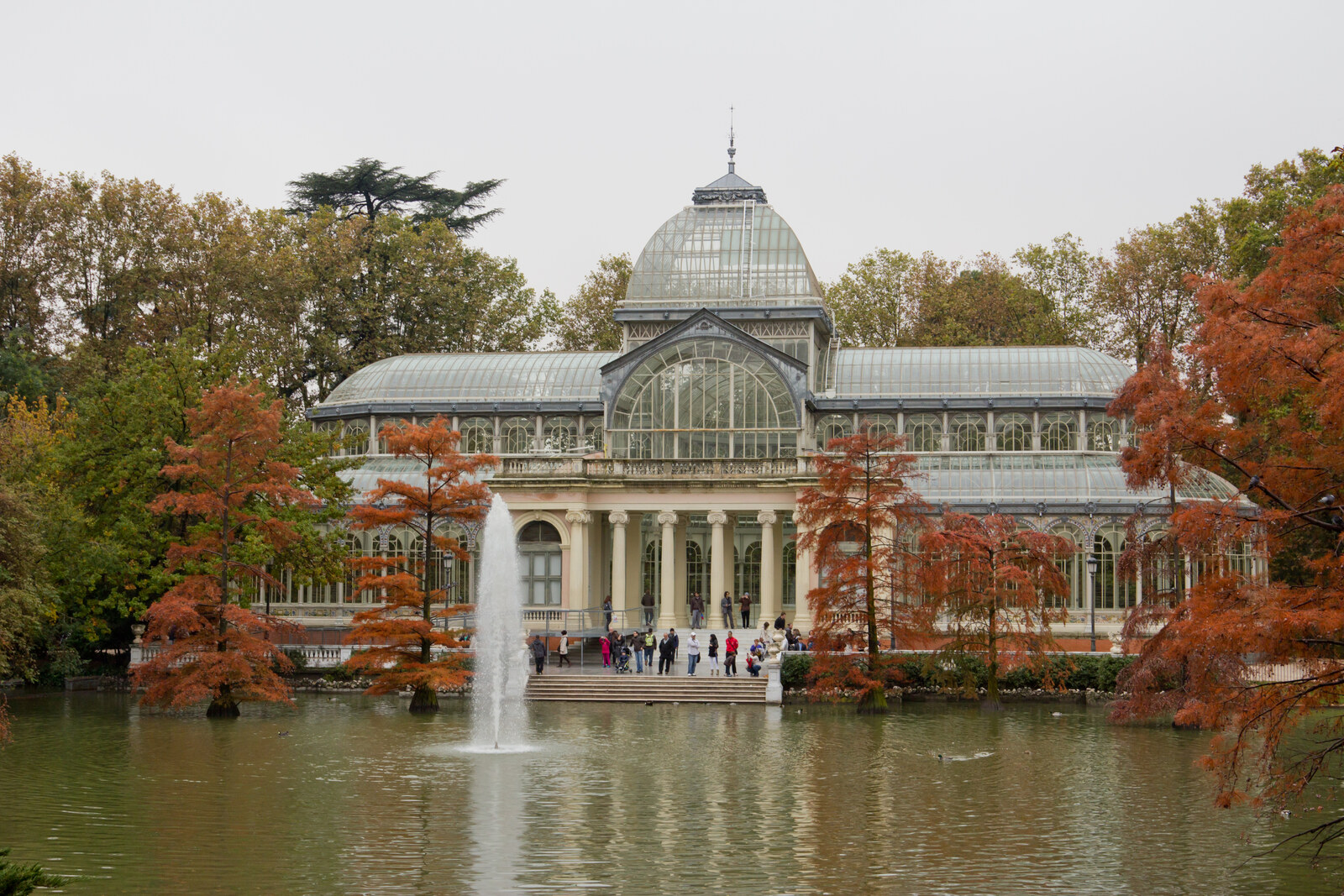
Look around first
What to notice
- Glass dome
- Iron framework
- Artificial pond
The story of the place
The Glass Palace stands beside the artificial pond; its glass dome rests on an iron framework. A large greenhouse once stood beneath this dome, and the palace was later transferred to the Reina Sofía Museum for modern art. Nothing remains of the buildings that once surrounded it; the pond survived, and Philippine boats once plied its waters. The building is now closed off by scaffolding: restorers are reinforcing the rusted metal and replacing damaged glass.
In eighteen eighty-seven, Víctor Balaguer, Minister of Overseas Territories, conceived of showing Madrid the Philippines, which at the time remained a Spanish colony. He hoped to revive trade with the archipelago and strengthen its connection with the mother country. Tropical plants required an enormous greenhouse. In five months, the architect Ricardo Velázquez Bosco assembled it from prefabricated iron parts and glass panels. Glass enclosed the walls, vaults, and twenty-four-meter dome—hence the name Glass Palace.
Plants alone seemed too little to the organizers. They brought forty-three inhabitants of the Philippines to Madrid. All received wages, but they were assigned different roles. Weavers and cigar makers worked before the public as hired craftswomen. Representatives of peoples whom the Spanish considered wild were housed in huts built near the palace. They shot bows, prepared food, and spent their days in view of visitors. Such a display of people is now called a human zoo.
Among those brought over was thirty-year-old Basalia, a Muslim woman from the island of Jolo. She did not demonstrate a craft at the exhibition: the organizers intended to exhibit her clothing, appearance, and everyday life. Basalia fell ill during the long sea crossing. In a Madrid barrack, her cold developed into pneumonia. At the end of May, still before the exhibition's official opening, she died.
Publicist Evaristo Aguirre, a native of the Philippines, tried to challenge the image of the archipelago created by the organizers. In the Madrid weekly España en Filipinas, he anonymously published an article about the circumstances of Basalia's illness and dedicated a sonnet to her. Anonymity did not save the publication: politicians connected with the colonial administration accused the editorial staff of separatism. The journal depended on money from wealthy conservative subscribers; after the scandal, support dried up, and it soon closed for lack of funds.
Basalia was one of three adult participants who died in Madrid; a newborn child also died there. After the exhibition ended, Queen Regent Maria Christina received the others at the palace, and they were then sent home by sea.
Nothing remains of the exhibition huts. The artificial pond, where Philippine boats were displayed, survived, as did the greenhouse, which was later transferred to the Reina Sofía Museum for modern art. Since late twenty twenty-three, the palace has been closed: restorers are reinforcing its rusted metal framework and replacing damaged glazing. The scaffolding is covered with an artistic textile by Andrea Canepa, and the building is expected to reopen in twenty twenty-seven.
Useful on site
The pavilion is closed to visitors until 2027. It can be viewed from outside during park hours: 06:00–22:00 (October–March) and 06:00–00:00 (April–September); part of the façade is covered with restoration fabric until January 1, 2027.
Checked: June 27, 2026. Check the official source before visiting.If the pavilion is closed or fenced off, view it from the opposite shore: the structure and the building's connection to the exhibition display are visible from outside.