 Guide On Map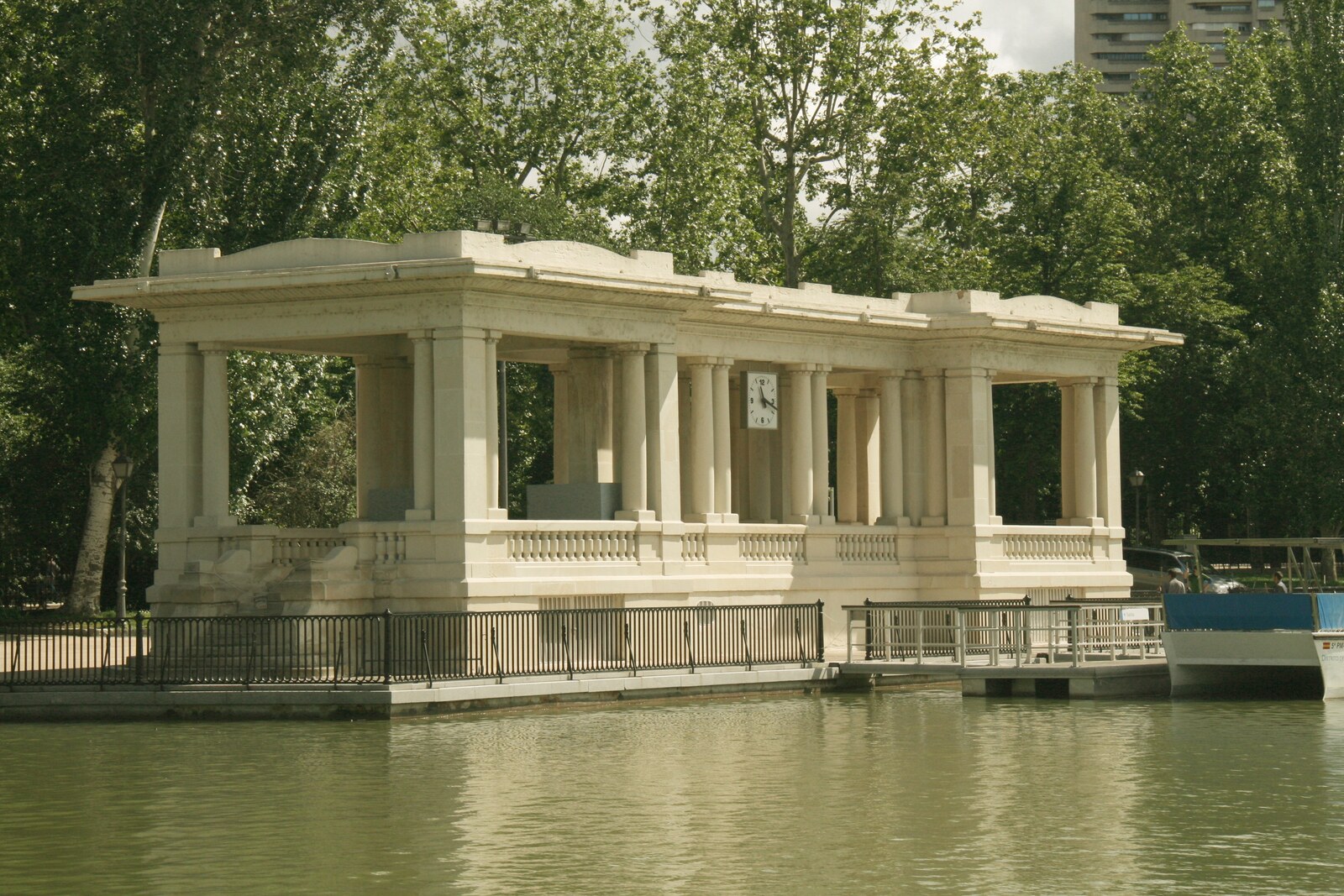
Look around first
What to notice
- Equestrian statue of Alfonso XII
- Semicircular colonnade
- Steps to the water
- Inscription “To Alfonso XII, the Peacemaker”
The story of the place
The Great Pond was dug in the sixteen thirties, when the Count-Duke of Olivares was creating a country residence for King Philip IV. The site was chosen on the high side of the gardens: from here, water could flow by gravity to the plantings. Courtly outings, fishing, theatrical performances, and naval battles with miniature ships were also held on it. At its center stood an oval island with stage structures. The island is now gone, while rental boats travel across the rectangular body of water and rowers train there.
At first, people descended to the boats from the eastern shore. In eighteen nineteen, King Ferdinand VII commissioned the construction of a royal landing stage here. In eighteen sixty-seven, boating was opened to the public. This very landing stage later gave way to the colonnade and equestrian statue, which took up the entire shore.
Alfonso XII was the king under whom the House of Bourbon monarchy was restored after the First Republic and the Third Carlist War ended. He died in eighteen eighty-five, before reaching the age of twenty-eight. Two years later, the Spanish Parliament resolved to erect a monument to him with the full dedication: “To the Spanish Fatherland, embodied in King Alfonso XII.” The resolution, however, remained on paper.
The project was taken up again by former minister Francisco Romero Robledo. He wanted to unveil the monument in nineteen oh two, for the coming of age of Alfonso XIII, the dead king’s son. The commission was immediately given to the sculptor Mariano Benlliure. The Central Society of Architects and the Royal Academy of Fine Arts objected: the money had been raised through a nationwide subscription, yet the author had received the work without a competition. For the professional associations, this concerned the authorship of one of the country’s largest state commissions. Under their pressure, Benlliure withdrew from the overall project.
Architect José Grases Riera won the open competition. He placed the monument on the site of the dilapidated royal landing stage: this choice made it possible not to cut down a tree beside the pond. The landing stage was demolished, and Grases turned a semicircular square toward the water, with colonnades, stairways, and a high pedestal. Benlliure nevertheless became the author of the equestrian figure—the sculptor lost the entire commission but received its main statue.
Alfonso XIII laid the first stone on the day after his coronation. They did not manage to unveil the monument by his coming of age: construction and decoration stretched over twenty years. Grases died three years before the ceremony, and architect Teodoro de Anasagasti completed the work to his design. In nineteen twenty-two, Alfonso XIII returned here and unveiled the monument to his father, whose first stone he had laid on the first day of his reign.
On the side of the pedestal facing the water is carved: “To Alfonso XII, the Peacemaker.” This is what the king’s supporters called him for ending the Carlist War and for the period of political calm during his reign; the sculptural group facing the pond depicts Peace. The current boat-rental pavilion stands on the northern shore. On the eastern shore, where royal boats once docked, the monument’s steps now descend to the very water’s edge.
Useful on site
El Retiro Park is open daily: 06:00–22:00 (October–March) and 06:00–00:00 (April–September). Boat rental operates 10:00–14:00 and 15:15–until closing (depending on the season, between 17:15 and 20:30). The service is unavailable on 24, 25, and 31 December and 1 January.
Checked: June 27, 2026. Check the official source before visiting.The story is easy to listen to from the shore. A boat ride is a separate activity, without which the point of this stop is not lost.