 Guide On Map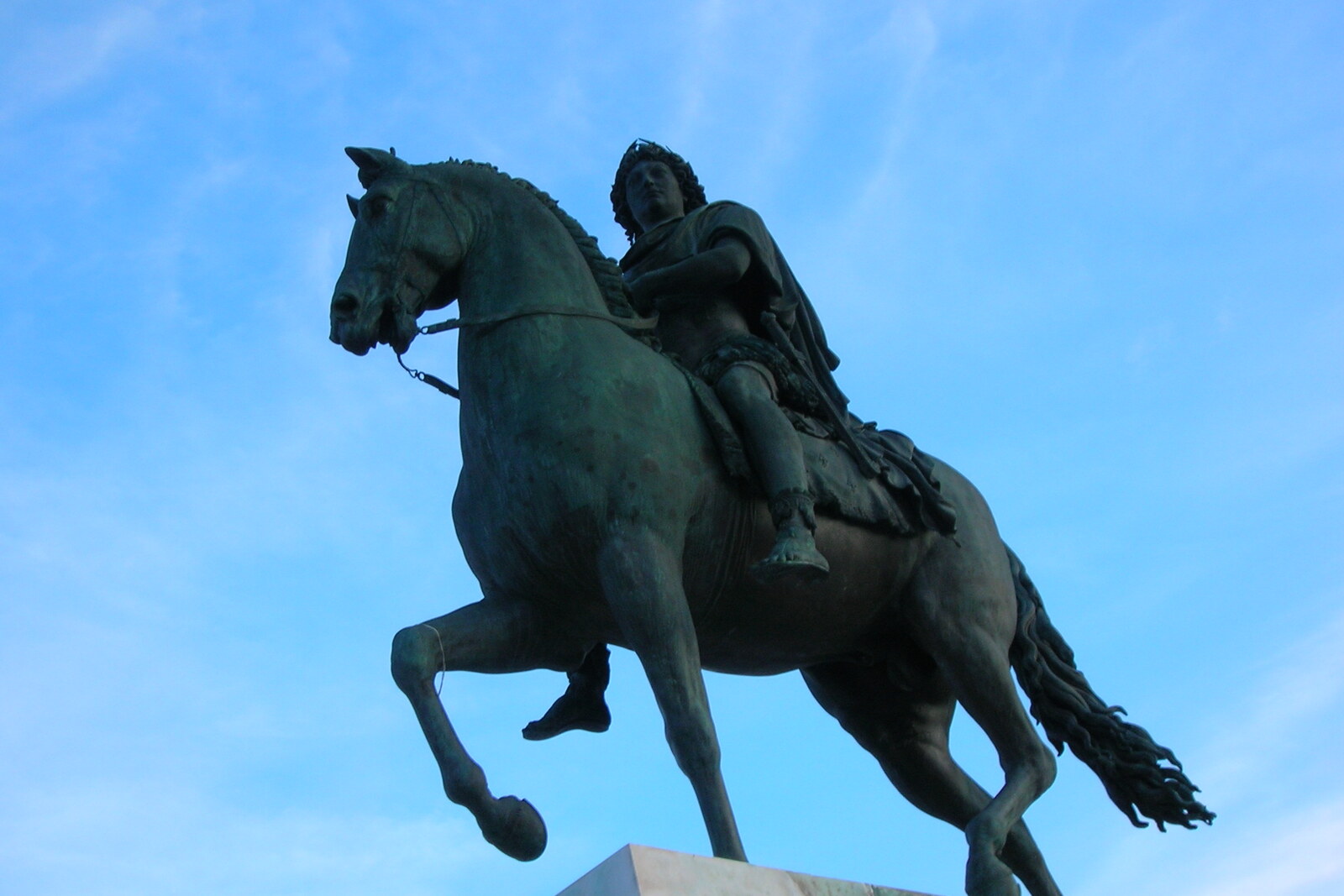
Look around first
What to notice
- Equestrian statue of Louis XIV
- Long eastern facade
- Long western facade
- Open field of the square
The story of the place
Place Bellecour occupies an open space rare for the city center. Long, uniform facades stand along its edges, while an equestrian figure of Louis XIV rises in the middle. At first, this was a vineyard belonging to the Archbishop of Lyon, then it was replaced by a meadow called Place Bellecour. When the site became royal, the city was deprived of the right to divide this land among developers, and aristocrats and wealthy townspeople settled around it.
The northern part of Place Bellecour remains open for citywide ceremonies, festivals, and temporary sports grounds. Pavilions are put up here for a few days, then taken down. The possibility of clearing an enormous level field in the very center of Lyon came from a decision made long before all these events.
The name Place Bellecour is traced to “bella curtis,” the name given in the late twelfth century to a vineyard belonging to the Archbishop of Lyon; the expression was translated as “beautiful garden.” Later, the site became a meadow called Place Bellecour. In sixteen fifty-eight, Louis XIV declared it a royal square and prohibited the city from selling its plots or occupying them with buildings. By the beginning of the eighteenth century, identical facades had been built on the eastern and western sides, and an equestrian statue of the king had been placed in the center. Aristocrats and wealthy townspeople settled around it.
That is precisely why the destruction of Lyon began at Place Bellecour in the autumn of seventeen ninety-three. After the already familiar events at Place des Terreaux, the city resisted the troops of the National Convention and capitulated. The National Convention, the assembly governing France at the time, decreed that Lyon’s very name be erased, the homes of the rich demolished, the dwellings of the poor preserved, and a commemorative column erected among the ruins.
Place Bellecour was better suited than any other address to a public act of reprisal: a bronze king in the middle of the square, expensive houses at the sides, a unified ceremonial facade. On October twenty-sixth, officials began dismantling the eastern and western sides. Masons, carpenters, and joiners were requisitioned every day for this work. The stone, wood, and metal obtained from the dismantling were declared state property. The first statue of Louis XIV was smashed, and its bronze was melted down for cannons.
The demolition stopped before the plan could be carried through. There were not enough workers, and then there was nothing to pay those who were still sent out to dismantle the buildings. In February seventeen ninety-five, the National Convention repealed the decree of destruction and restored Lyon’s name. The owners of the damaged houses were left with heaps of rubble: they were required to clear away the debris and secure the surviving parts of the buildings. The column bearing the sentence against the city never appeared.
Five years later, Napoleon Bonaparte came to Place Bellecour—the general victorious at Marengo and First Consul of France, seeking to restore trade in devastated cities. On his way back to Paris, he stopped in Lyon specifically to lay the first stone of the new houses. Bonaparte expected the facades to be restored within two years and, with them, Lyon’s trade to revive, above all silk production, on which thousands of townspeople depended.
For Bonaparte himself, the gesture immediately brought public recognition. A medal struck for the ceremony called him the restorer of Lyon, and in eighteen oh one Place Bellecour was officially renamed Place Bonaparte. The owners of the demolished houses received tax breaks, but petitions, disputes, and the search for money continued for years. The eastern and western buildings were not erected until between eighteen oh seven and eighteen thirteen.
Bonaparte’s name later disappeared, and the square was again called Place Bellecour—after the medieval vineyard. The equestrian figure of Louis XIV in the center is also new: it was installed in eighteen twenty-five in place of the one that had been melted down. And the long facades along the eastern and western sides stand where, in October seventeen ninety-three, requisitioned masons began dismantling the houses.
Useful on site
The square is open around the clock; during fairs, concerts, works, and city events, passageways may change temporarily.
Checked: June 29, 2026. Check the official source before visiting.Do not stand only by the monument: move toward the edge to feel the scale of the empty space and see the rider between the city facades.