 Guide On Map
Presqu'île: Who Ran Central Lyon
From Place des Terreaux to Place Bellecour via Opéra de Lyon and the monastic quarters
Guide On Map on your phone
Open the walk like a regular app
It takes about 10 seconds to install. No app store needed.
The whole path
Route map
About the walk
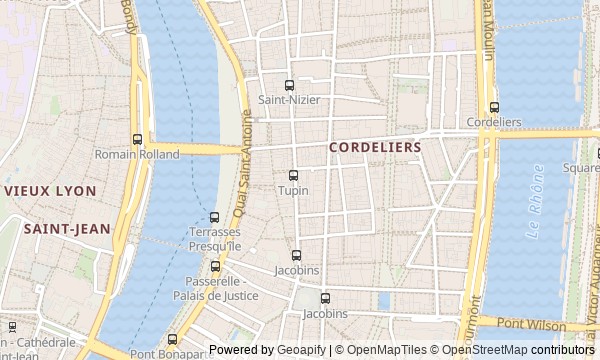
You will cross Presqu'île from north to south, from Place des Terreaux to Place Bellecour. The way links the City Hall quarter, a museum in a former abbey, Opéra de Lyon, a church where merchants once gathered, and two squares on former monastic land.
At first, everything will seem long settled. Towers will stand where they belong, theaters will welcome audiences, and white fountains will remain at the center of their squares. But this story follows people’s decisions. It will ask why looms were removed from a museum gallery. You will find out how street dancers reached the main stage. And outside a former monastery, one question will remain: why did choosing a pope require bars?
These stories come without ceremonial grandeur. There will be deals, refusals to swear an oath, shortages of money, and rights that had to be fought for. At Place Bellecour, you will recall all these decisions. And you will read central Lyon through who was allowed to gather here, judge, build, and begin again.
Why this order
Place des Terreaux sets up the conflict between Lyon City Hall and revolutionary power; the museum on the same square immediately shows how former church property became a municipal institution. Behind Lyon City Hall, Opéra de Lyon brings the question of access to the city’s stage into the present. Then Church of Saint-Nizier returns to the origins of the city council itself: from today’s cultural institution, the route moves to the place where townspeople gathered before Lyon City Hall existed. Farther south, Place des Jacobins shows the reverse situation—not townspeople fighting for the right to assemble, but cardinals forced to make a decision. Théâtre des Célestins follows as a second monastic site transformed into commercial property and a public stage. Place Bellecour ends the walk on the largest scale: after individual buildings and plots, you will see how authorities tried to remake an entire ceremonial square, and how townspeople gave its façades back to it.
First-time visitors to central Lyon Lovers of urban history without a list of architectural styles Anyone interested in the human decisions behind ceremonial façades
Those looking for a walk through Old Lyon and its traboules Those wanting a route with long visits to museum galleries Those who prefer a light overview without arguments about power
Before you go
The route works on its own from the outside, though several stops can become separate visits. Allow extra time for the museum galleries; access to Opéra de Lyon and Théâtre des Célestins is best checked and booked separately, rather than expecting to enter as you walk. Church of Saint-Nizier remains an active church: during a service, listen from outside or visit the interior briefly and quietly. The squares offer little shelter from sun, rain, or wind, so choose your clothes for the weather rather than the ceremonial look of the center.
When to go
For an uninterrupted walk, stay with the exterior details and do not turn the museum into an unplanned major visit. If you want to see the former refectory, chapel, or theater interiors, decide in advance which one stop will be the long one; otherwise, the route’s rhythm will break into lines, access checks, and separate tours.
Backup plan
Closed doors do not cancel the main story here. At the museum, work with the austere façade and the former abbey’s proximity to Lyon City Hall; at Opéra de Lyon, compare the preserved stone base with the glass dome; at Théâtre des Célestins, focus on the façade and the memory of buildings that once stood on this site. If a service is underway at Church of Saint-Nizier, find the memorial plaque outside and continue without disturbing the congregation. In bad weather, reduce stops on the open squares to a few key details, saving longer listening for shelter.
Route conditions
Surface. Paved — 998 m (data covers 73% of the route)
Facilities. Drinking water — 4
Elevation. Ascent — 10 m; descent — 16 m
OpenStreetMap extract of June 18, 2026: database data, not a check on the ground. Data © OpenStreetMap contributors, ODbL licence
Walk plan
Open in maps ↗- 1
Place des Terreaux
Here, the route begins a conversation about who had the right to act on the city’s behalf. - 2
Museum of Fine Arts of Lyon
Here it will become clear why the city museum began alongside looms. - 3
Opéra de Lyon
A contemporary episode will test whom the city is prepared to consider a real artist. - 4
Church of Saint-Nizier
Here, the dispute over power will move from the revolutionary city hall to the origins of the city council. - 5
Place des Jacobins
This stop will show how a church election turned into a problem of locked doors. - 6
Théâtre des Célestins
Here, monastic land will become a test for a commercial project that needed a theater. - 7
Place Bellecour
The finale will show why the restored facades matter more than their unified ceremonial appearance.
Route features
Everything you need stays in the browser
Progress, saves and your trip plan are stored on this device.
Add Guide On Map to your home screen so the walk opens outside the browser.
How we handle sources, maps and corrections: our editorial standards