 Guide On Map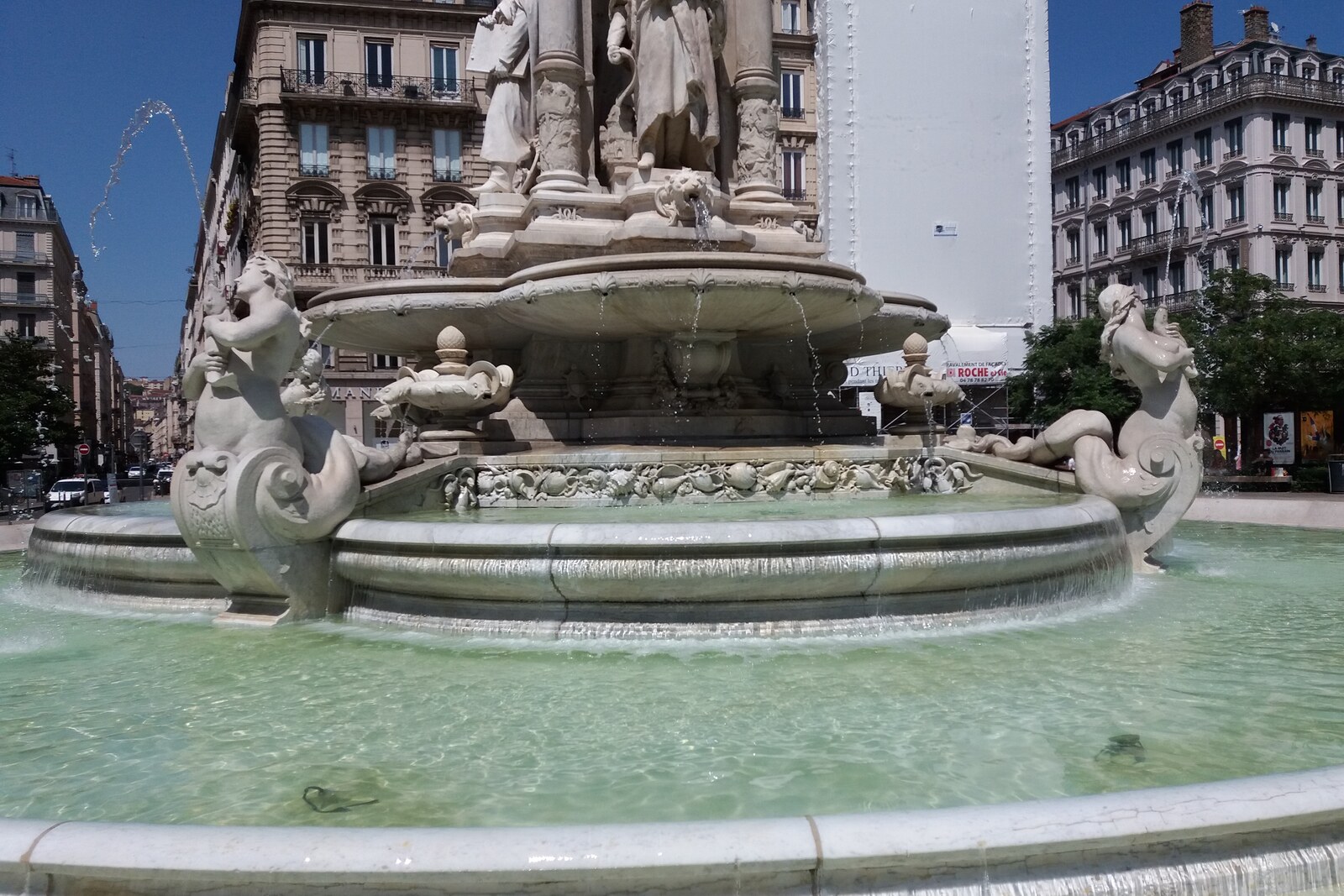
Look around first
What to notice
- White marble fountain
- Four male figures beneath the arches
- The fountain’s arches
- Twelve converging streets
The story of the place
The square grew on the land of the Dominican quarter that occupied its southern side: Church of Notre-Dame-de-Confort, the monastic buildings, and a cemetery for townspeople stood here. The preaching brothers came here in the thirteenth century, to the fair district, lived on donations, and received money for burials, with a place inside the church costing more. The white marble fountain in the middle of the open space appeared much later than the graves and walls. When the church and monastery were demolished, the square’s name and Rue Confort at its edge preserved their memory.
Twelve streets converge on a white marble fountain. The four men beneath its arches are Lyon’s architect, sculptor, engraver, and painter. There are no Jacobins among them: the fountain was installed only in eighteen eighty-five.
The square’s name appeared before the famous revolutionary club. In France, Dominicans, the preaching brothers, were called Jacobins: the nickname came from their Paris monastery on Rue Saint-Jacques. In the thirteenth century, the Dominicans chose this busy trading district of Lyon for preaching and meeting people who came to the fairs. The order had no income from land and lived on donations. Books for training the brothers were expensive, so the monks established a cemetery for laypeople here: they charged for burials, and a place inside the church cost more. Graves occupied a substantial part of the present square; Church of Notre-Dame-de-Confort and the monastic buildings enclosed it on the south.
In the summer of thirteen sixteen, twenty-three cardinals were locked inside one of these buildings. After the death of Pope Clement V, they had been unable to elect a successor for more than two years. Gascon, Italian, and French cardinals supported different candidates; none received the required two-thirds of the votes. In Carpentras, their followers had already come to blows, the Italians had to flee the besieged palace, and the papal throne remained vacant.
Philip, Count of Poitiers, brother of the French king, was tasked with bringing the cardinals together in Lyon. He pressed for an election and swore that no one would be held by force. The cardinals arrived, but the negotiations again reached a deadlock.
Then Philip’s brother, King Louis X, died. His widow was pregnant. If she gave birth to a son, Philip could hope only for a regency; if there was no heir, he could hope for the crown. He needed to leave for Paris at once, and he did not want to leave the princes of the Church to argue for several more years.
Philip broke his oath. He ordered the monastery’s doors and windows barred with grilles, posted guards, and announced that the cardinals would leave after electing a pope. He then departed to seek the regency.
The cardinals spent forty days in confinement. On August seventh, thirteen sixteen, they unanimously elected the seventy-two-year-old cardinal and jurist Jacques Duèze—a compromise candidate who took the name Pope John XXII. His age suggested a short pontificate, yet he governed the Church from Avignon for more than eighteen years. Philip, meanwhile, became regent. The boy born to the queen lived for five days, after which the Count of Poitiers received the crown as Philip V.
The hall where the cardinals were held no longer exists. It was in the monastic complex by the southern side of the present square. The church was demolished in the nineteenth century, and the monastic buildings disappeared afterward. Two addresses remain from them: the square bears the Dominicans’ nickname, and Rue Confort, which opens onto it, bears the name of their lost church.
Useful on site
The square is accessible around the clock.
Checked: June 29, 2026. Check the official source before visiting.Walk around the fountain in a circle: the figures stand on different sides, and from one point you cannot take in the entire civic pantheon.