 Guide On Map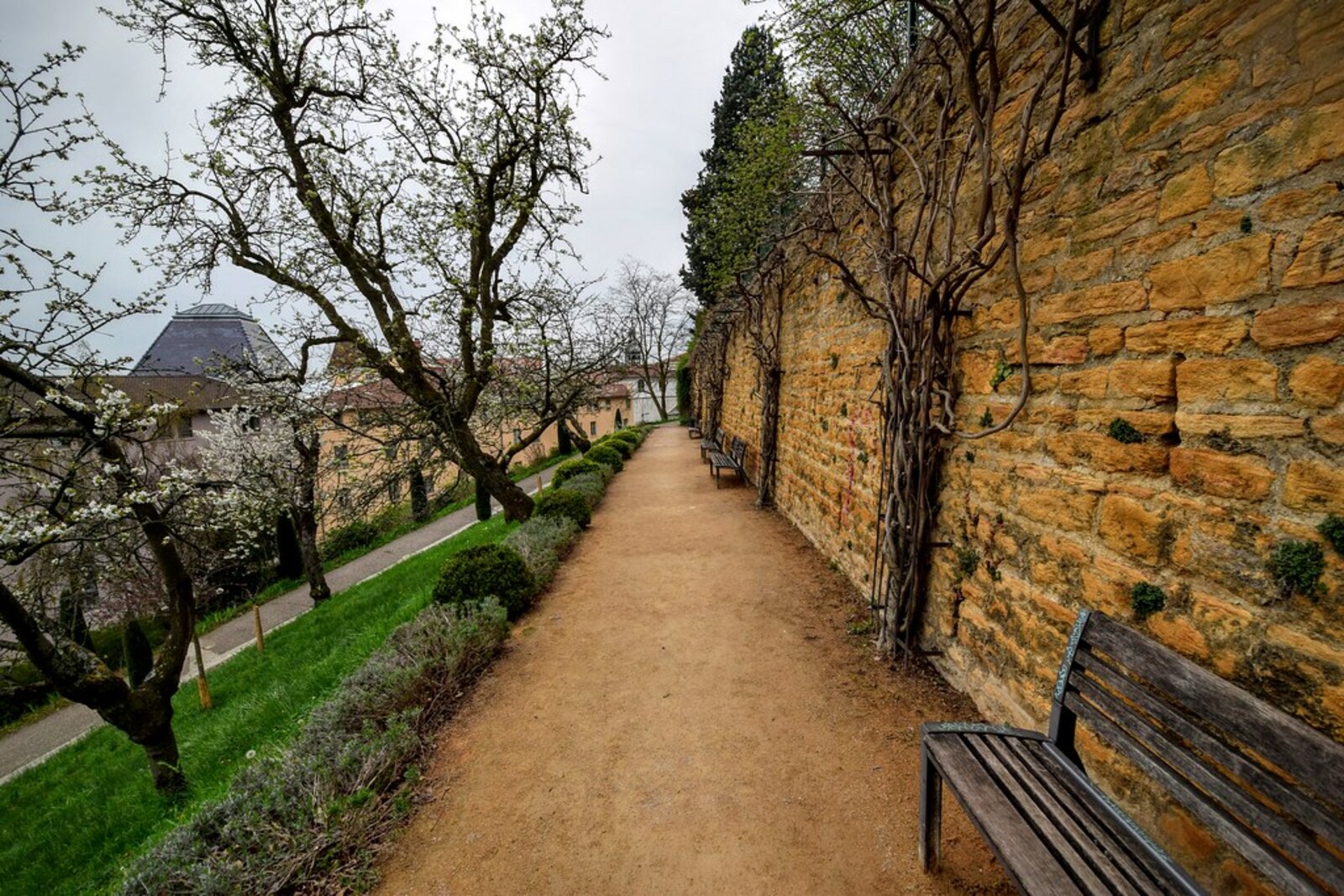
Look around first
What to notice
- Lorette House
- Jaricot's Staircase
- Bronze roses in the pavement
- Winding path
The story of the place
The slope below Fourvière is cut by a winding pedestrian path, and small bronze roses are embedded in the pavement here. They mark the former fifteen prayer scenes, distributed along the slope for meditation on the three cycles of the Catholic rosary. The sculptor Joseph Fabisch made these scenes in terracotta, but they quickly deteriorated and disappeared. Lorette House and the old staircase remain among the paths: this was once a private estate, and later the two neighboring passages were joined into one garden.
The paths on this slope appeared because of two people who wanted to lead pilgrims to one chapel, but ultimately became rivals.
Pauline Jaricot was the first to create her own passage—a Lyon Catholic activist who lived in Lorette House, in the middle of what is now the garden. The headquarters of The Living Rosary, which she founded, were here: participants divided the parts of the prayer among themselves so that together they could recite it in full every day. Jaricot was born into the family of a wealthy silk merchant, but by the middle of the nineteenth century, all that remained of the family fortune was a mortgaged house. She invested her fortune in a metalworking enterprise, where she intended to provide workers with decent wages and family living conditions. Trusted managers embezzled the money. Then small shareholders invested in the enterprise. Jaricot was not obliged to answer to them with her own property, but she promised to return everything they had lost.
This slope became her last hope. Through Lorette House, a short staircase could be laid from Montée Saint-Barthélemy to the Chapel of the Virgin of Fourvière at the hilltop. Jaricot set a toll of five centimes for the passage: calculations showed that several years of pilgrimages would cover the debts. Construction cost about ten thousand francs. When the steps were already complete, a neighbor filed a complaint over the railings and demanded that they be redone. The contractor was about to leave, but Jaricot's daughter-in-law gave her another loan.
On December eighth, eighteen fifty-two, the staircase opened. In its first twenty-five days, Jaricot received nine hundred francs. These takings persuaded most creditors to agree to gradual repayments.
A few months later, the Fourvière Commission appeared—an association acquiring land around the chapel for a future great shrine. The Commission laid its own path nearby, one more convenient for pilgrims. To bring it to the summit, workers broke through the wall of Jaricot's property while she was away. The Commission then offered to buy Lorette House. Jaricot refused: the proposed sum was not enough to settle with the people who had entrusted her with their savings.
Court cases continued until the end of her life. The income from the staircase proved insufficient. Jaricot was entered on the city's list of destitute people, and on January ninth, eighteen sixty-two, she died in Lorette House, never having escaped her debts.
Meanwhile, the Commission turned its path into Chemin du Rosaire. The rosary is a Catholic prayer in which people meditate on events from the lives of Jesus Christ and the Virgin Mary. The architect Pierre Bossan placed fifteen small structures along the slope: five each for the joyful, sorrowful, and glorious events. The sculptor Joseph Fabisch made the figures in terracotta. On October second, eighteen sixty-four, a procession went along the winding path for the first time. The garden received its name from it; a collection of real roses was planted much later.
A year after the opening, the Commission also bought Jaricot's former property at auction. The two passages, which had once drawn pilgrims away from one another, became part of one garden. The terracotta scenes quickly faded, then deteriorated and disappeared. They were replaced along the path by small bronze roses set into the pavement. Lorette House and the staircase remain among the paths, and Pauline Jaricot once charged five centimes for each passage along it.
Useful on site
Open urban space; choose a viewing point that does not obstruct pedestrian traffic.
Checked: date not specified. Check the official source before visiting.Descend without rushing: the steps and stone pavement can be slippery. Go around closed or repaired sections only by the marked route.