 Guide On Map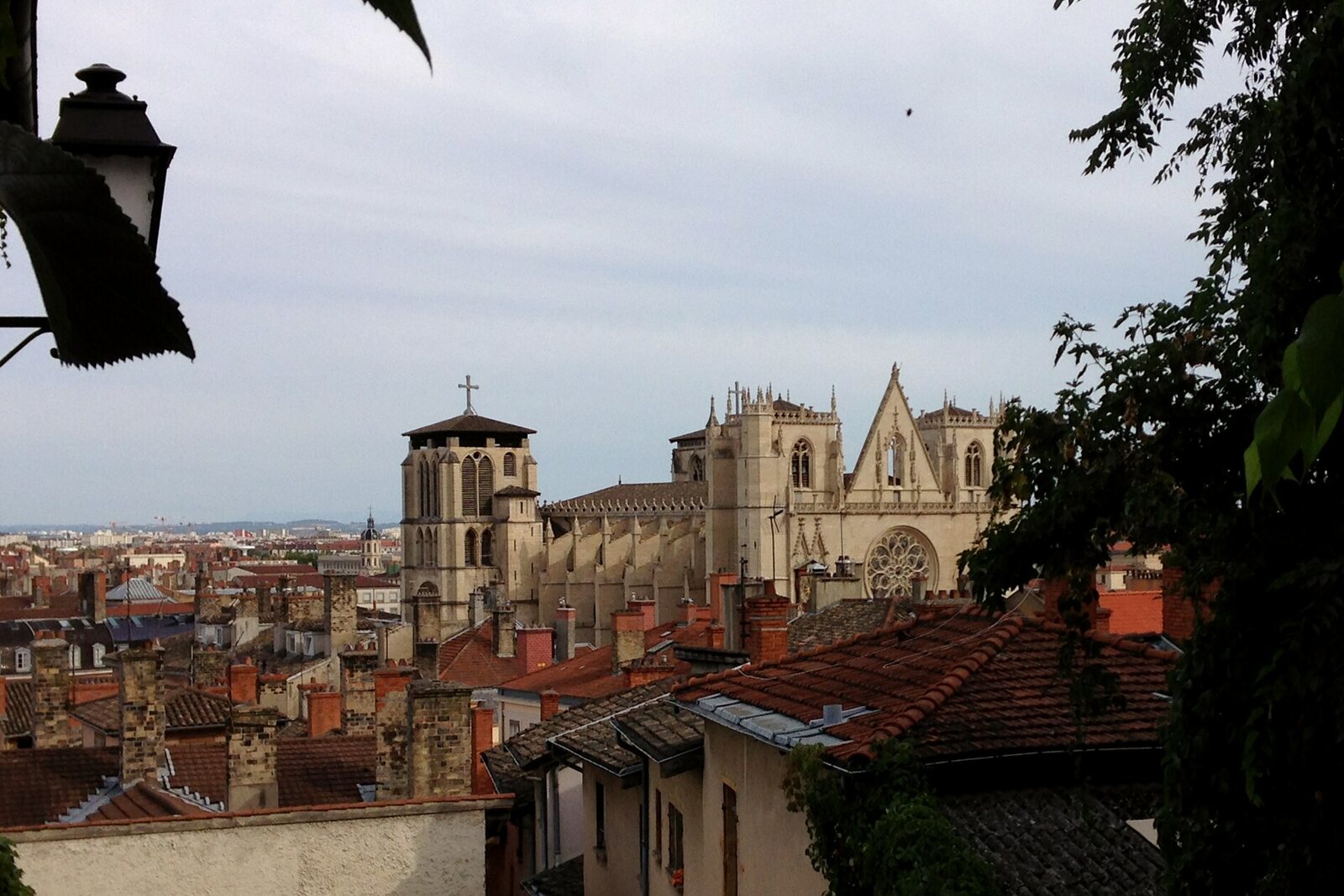
Look around first
What to notice
- The basilica’s four towers
- The low chapel
- Parish names on the walls
- A panorama of the Saône and the Presqu'île
The story of the place
The names of parishes can still be read on the basilica’s walls: it is managed by the private Fourvière Foundation, which still collects donations for the upkeep of the complex. Next door, the chapel was founded as early as the twelfth century, destroyed during the Wars of Religion, and then rebuilt; on its main altar, the statue of Our Lady from the middle of the eighteenth century has been preserved. From the esplanade above these churches, Vieux Lyon, the Saône, and the Presqu'île peninsula between the two rivers open out before you.
Two different churches stand side by side. The low chapel is the old sanctuary of Our Lady of Fourvière. The enormous church with four towers was built much later. In the autumn of eighteen seventy, there was still an open plot of land on its site.
France was losing the war with Prussia. Napoleon III had been taken prisoner, the French army was retreating, and Prussian units had entered Burgundy. About one hundred women from Lyon came to the Chapel of the Virgin of Fourvière to see Jacques Ginoulhiac, the new Archbishop of Lyon. They wanted to link the city’s salvation to a commitment that could not be forgotten after the war.
On October eighth, the archbishop made a vow before the altar statue of Our Lady: if the enemy did not occupy Lyon and its archdiocese, Catholics would raise money for a new church in Fourvière. It was a matter of their own donations. The text of the promise was printed on separate sheets; they were returned with thousands of signatures.
Prussian units did not enter Lyon, and the war then ended. The faithful considered the condition fulfilled. This is a religious interpretation of the military outcome, not proof that prayer stopped the army. A verifiable consequence began after the war: those who had signed started to pay.
A project already existed. The Lyon architect Pierre Bossan had proposed building a large church here as early as eighteen fifty-six, but he faced opposition for fourteen years. The vow gave his plans a commission and funding. The first stone was laid in eighteen seventy-two.
Bossan designed the building as a church of gratitude to Our Lady—hence its full name: Basilica of Notre-Dame de Fourvière, Our Lady of Fourvière. The architect did not live to see construction completed. After his death, his assistant Louis Sainte-Marie Perrin continued the work. The church was consecrated twenty-four years after the first stone was laid, and a year later Pope Leo XIII granted it the honorary title of basilica. Saint-Jean Cathedral below remained Lyon’s cathedral church.
The subscription also determined the building’s fate. The basilica belongs neither to the Archdiocese of Lyon nor to the state: it is owned by the private Fourvière Foundation, which continues to collect donations for the upkeep of the complex. The names of the parishes that took part in the construction remain on the walls.
The chapel, meanwhile, was not replaced by the new church. The Marian sanctuary was founded here as early as the twelfth century; after being destroyed during the Wars of Religion, it was rebuilt. The statue of Our Lady, installed in the middle of the eighteenth century, remains on the main altar. It was before this statue that Ginoulhiac made the vow.
From the esplanade, you can see Vieux Lyon, the Saône, the Presqu'île peninsula between the two rivers, and the neighborhoods beyond the Rhône. Below lies the city named in the promise of eighteen seventy. Beside the panorama stands the basilica built with donations, while in the small chapel the exact place where those donations were promised has been preserved.
Useful on site
Open urban space; choose a viewing point that does not obstruct pedestrian flow.
Checked: date not specified. Check the official source before visiting.Keep quiet inside and do not disturb services; if access is limited, focus on the exterior ensemble and the view from the esplanade.