 Guide On Map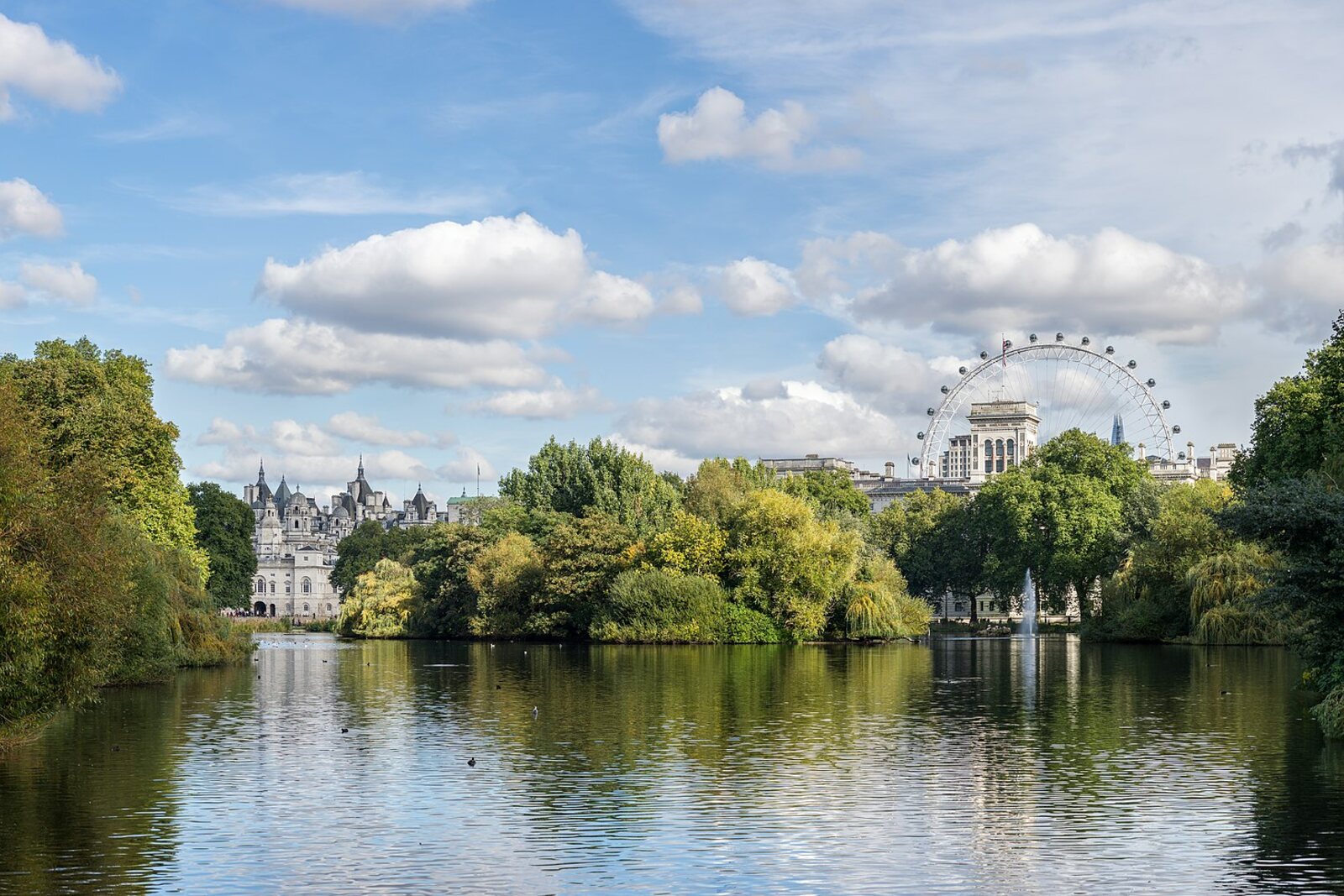
Look around first
What to notice
- Blue metal railings
- Low concrete span
- St James's Park Lake
The story of the place
The blue paint on the metal railings gave this crossing its name: Blue Bridge. The low concrete structure was built in nineteen fifty-seven. It became the third bridge on this site.
The first was built for a single celebration. On August first, eighteen fourteen, Prince Regent George, the future King George IV, held festivities in London's parks to mark the peace with France after the long Napoleonic Wars. His personal architect, John Nash, threw a wooden bridge across the then-straight canal and erected a seven-tier pagoda about twenty-four meters high in the middle. It was painted yellow, with blue roofs.
Gas and oil lamps burned on every tier. Boxes of fireworks were set along the bridge: the pagoda was to become the center of the nighttime spectacle. Near midnight, the pyrotechnics set the wooden tower alight. At first, spectators took the fire for a planned part of the show. They understood what had happened only when cries came from the pagoda.
Two people died. One was a carpenter who earned his living building temporary structures for the festivities. He tried to descend the stairs through the fire, suffered severe burns, and died the next day. Accounts differ about the second victim: he is described either as another worker or as a spectator who went up out of curiosity. The fire cut off his way down, and he was killed when he jumped from the tower.
The five upper tiers burned down, and the remains of the pagoda collapsed into the water. Firefighters managed to save the wooden bridge itself, and Londoners used it for about another ten years. Nothing remains here of the tower or of that crossing.
In eighteen fifty-seven, an iron suspension bridge was built across the lake. Almost a century later, it needed major repairs: during large crowds, the structure was already being supported from below, and the repairs were estimated at about ten thousand pounds.
Then the will of an unknown benefactor was discovered. He left twenty thousand pounds exclusively for a new bridge; the terms of the will prohibited spending the money on repairing the old one. With interest, the sum grew to twenty-three thousand, but it had to be accepted by April tenth, nineteen fifty-six, or the funds would go to another, also unnamed purpose.
The Minister of Works, John Buchan-Hepburn, placed a model of a concrete bridge in the tea room of the House of Commons and asked members of Parliament to give their views. The Royal Fine Art Commission advised keeping the existing crossing despite the expense. The minister accepted the money anyway. When members of the House of Lords demanded an explanation for the demolition the following year, the iron bridge was already being dismantled quickly.
The bridge designed by Eric Bedford was completed in nineteen fifty-seven. Its blue railings gave it its name; the name of the person who paid for its construction under the will is not here.
Useful on site
The pedestrian gates of St James's Park are listed as open from 5:00 until midnight. Blue Bridge and the adjacent views may change because of the Elizabeth II National Memorial project, which provides for a new bridge in place of the current one. Checked 2026-06-28.
Checked: June 28, 2026. Check the official source before visiting.Do not feed the birds, and keep your distance, especially near the water. The bridge can be crowded, so after looking around, it is better to step to the edge of the path to listen.