 Guide On Map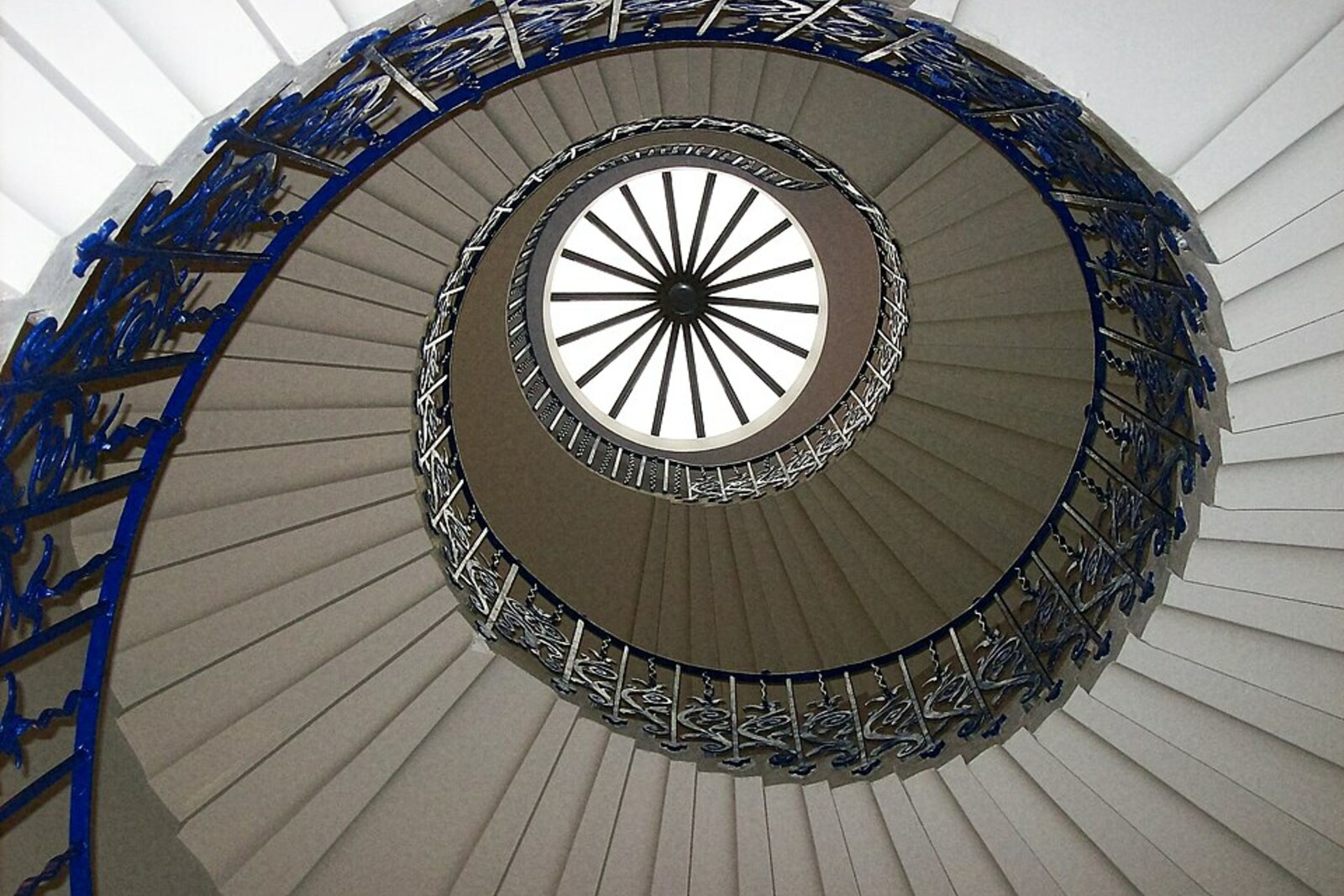
Look around first
What to notice
- The white cubic façade
- Colonnades on either side of the house
- The tapestry with the burning Royal James
The story of the place
The white Queen's House was built for Anne of Denmark, the wife of James I. The queen had her own courtly circle. She staged performances with music, dance, poetry, and elaborate sets, designed by Inigo Jones. In sixteen sixteen, Anne asked the same man to design a country pavilion for her in Greenwich.
The site was determined by a road. A public route from Deptford to Woolwich ran between the old palace by the Thames and the royal hunting grounds. Jones placed the house across it: the queen's rooms were to connect the palace with the park, while the road passed beneath the central part of the building. It was moved later; the present colonnades preserve its former direction.
Anne died in sixteen nineteen, when the builders had completed only the ground floor. She never lived here. Ten years later, her son Charles I gave Greenwich to his wife, Henrietta Maria. She too gathered artists and wanted a finished residence for receptions and works of art. At her order, Jones returned to the work. Thus, the house named for one queen acquired its final form thanks to another.
Henrietta Maria used it only briefly. After the Civil War began, she left for France, Charles I was executed, and the royal collection was sold off. When the monarchy was restored, Henrietta Maria's son Charles II repaired the house for his mother's return. She spent about two months in Greenwich and moved to another residence. The Queen's House was never again a permanent home for queens.
Charles II gave the vacant rooms to people who changed the building's later fate. In the winter of sixteen seventy-two to sixteen seventy-three, a father and son with the same name—Willem van de Velde—arrived from the Dutch Republic. Willem van de Velde the Elder earned his living by drawing ships and naval battles, while Willem van de Velde the Younger painted seascapes in oil. The family had a successful studio in Amsterdam, but the war with England and France brought an economic crisis to the republic. The English king offered each artist one hundred pounds a year and workrooms here in the Queen's House.
The offer was generous and awkward. A few months before the move, Willem van de Velde the Elder was with the Dutch fleet during the Battle of Solebay. He drew among the warships from a small vessel, risking coming under fire along with the sailors. The Dutch fought the combined English and French fleet. Both sides declared themselves victorious, although the battle had no clear outcome.
Now Charles II commissioned the same eyewitness to create six enormous tapestries that were to present Solebay as a success for the English fleet. Van de Velde had to rework his own sketches from life: the ships remained the same, but the events had to be shown from the English side. On the upper floor of the Queen's House, he spread out the cartoons—full-size paper drawings from which weavers would then transfer the scene into wool and silk. One scene depicted the destruction of the English flagship Royal James and the people in the water around the burning ship.
Father and son worked in the studio here for almost twenty years. The Elder ensured the accuracy of the vessels and maneuvers, while the Younger turned his drawings into paintings. When the royal salary ceased after a change of monarch, the family moved to Westminster, but British patrons had already become used to seeing the sea through the eyes of the Van de Veldes.
Today, an art gallery is once again open in the Queen's House, and one of its rooms bears the name Van de Velde Studio. The paper cartoons from it have been lost. The tapestry made from them, with the burning Royal James, has returned to the building and hangs where it was once spread out before being sent to the weavers.
Useful on site
Daily 10:00–17:00, free; closed 24–26 December. Advance booking may be required in high season.
Checked: June 22, 2026. Check the official source before visiting.Even without going inside, step back from the façade and see how the house structures the entire surrounding ensemble. The Tulip Stairs, Great Hall, and Armada Portrait require a visit inside; check in advance which rooms and works are accessible.