 Guide On Map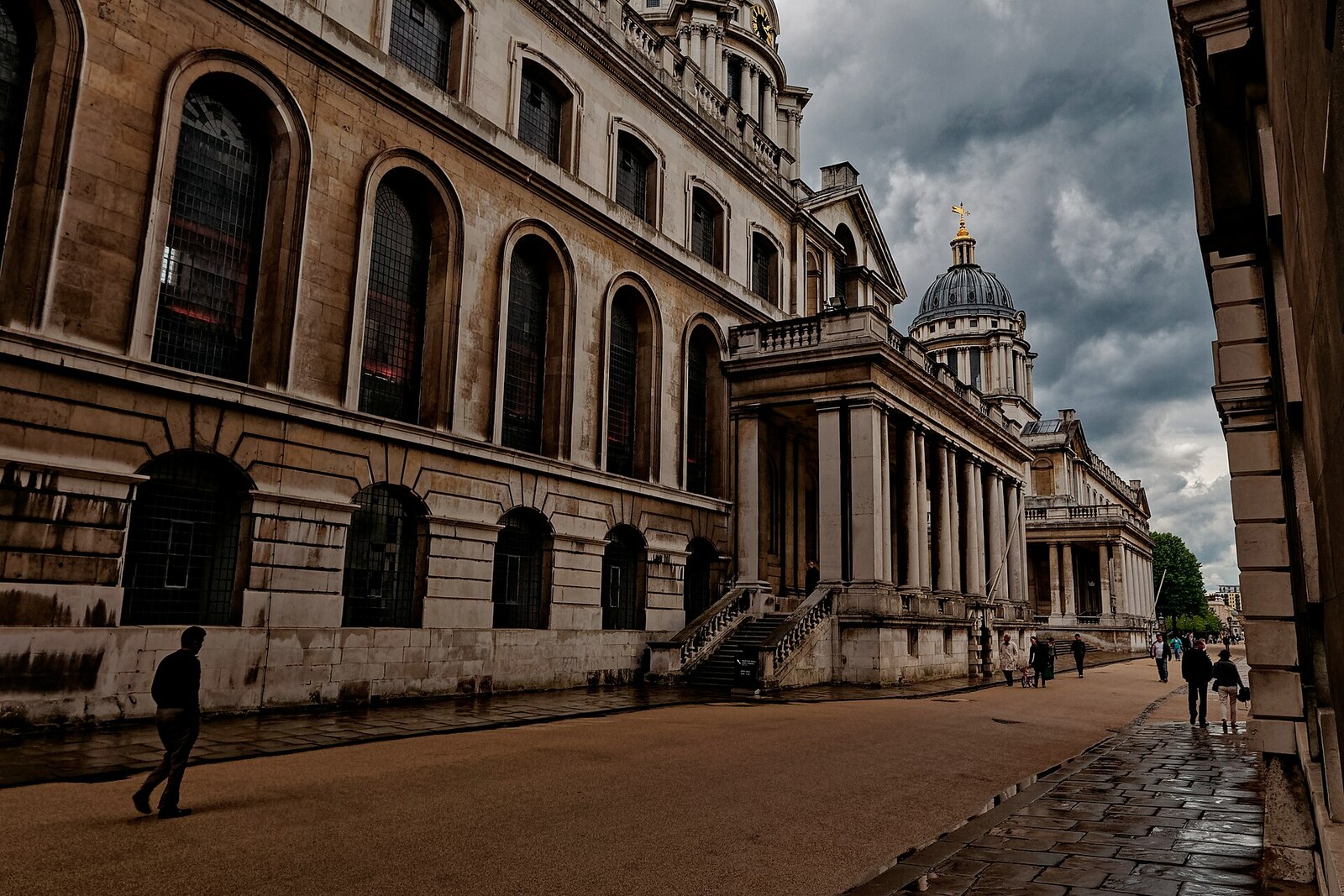
Look around first
What to notice
- Two domes
- The open gap between the buildings
- Stone colonnades
- Painted Hall
The story of the place
Two long stone wings with colonnades and domes face the Thames, and a broad gap was deliberately left between them. A palace of English monarchs had once fallen into decay on this site; sailors who had grown old or been disabled by service, and had lost their income, were then housed here. The buildings were arranged so that the river would still be visible from the Queen’s House. Later, the former refuge became a school for naval officers, and students now study within these walls.
On May fifteenth, seventeen eighty-two, the sailor Henry George was brought to the gates of this complex on a small service vessel from Plymouth. In four years in the Royal Navy, he had suffered severe wounds and lost both feet. George was married and could no longer work; now he could not even leave the gates on his own. The naval lieutenant who had brought him left.
The staff had to decide whether they had the right to admit George. While they waited for an answer, the officers supported him with contributions from their own pockets. A doctor examined the injured man, and the secretary attached to the request a list of ships on which George said he had served. The sailor’s past was checked because behind these gates stood Greenwich Hospital. At the time, the word “hospital” here meant, above all, a refuge. It was intended for people who were old or disabled by service and could no longer support themselves; major operations were often carried out in other London hospitals.
Queen Mary II, who ruled together with her husband William III, had ordered such an institution to be created. After the Battle of La Hogue in May sixteen ninety-two, news reached England of many mutilated sailors. Mary sent doctors to them in Portsmouth and ordered the transfer of Crown land in Greenwich for a permanent refuge to be accelerated. A decaying royal palace had stood here before.
Mary died of smallpox without seeing the new buildings. William carried out her plan, and the founding charter was issued in the names of both monarchs. The first veterans settled here in seventeen oh five. Under Mary’s condition, the architect Christopher Wren was not to block the view from the Queen’s House to the Thames. The buildings were therefore set apart on either side, while the middle of the complex remained open.
Henry George was admitted to the hospital after all. He lived here for exactly six months and died on November fifteenth, seventeen eighty-two. For him, the decision at the gates meant six months of shelter and support instead of returning to shore without both feet.
The last veterans left the buildings in eighteen sixty-nine. Four years later, the Admiralty opened the Royal Naval College here, a higher school where officers studied navigation, mathematics, and new naval technologies. The Navy left Greenwich in nineteen ninety-eight; that was when the college became Old. Today, students of the University of Greenwich and Trinity Laban Conservatoire of Music and Dance study in the former hospital buildings, while the Painted Hall and the chapel are open to visitors.
The archival letter does not specify which of today’s passageways was the gate where Henry George was left. There is no monument to him here: what remain are the admission record and the buildings of the refuge itself, which now bear the name of the college that appeared later.
Useful on site
The grounds are open daily 8:00–23:00. Painted Hall, the chapel, and the visitor center are open 10:00–17:00 (last admission 16:30); individual halls may close for events.
Checked: June 22, 2026. Check the official source before visiting.The ensemble tells much of its story from the outside, but this stop’s story is fully revealed in the Painted Hall. If you plan to enter, check access separately; inside, give your eyes time to adjust and look in turn at the ceiling and the floor.