 Guide On Map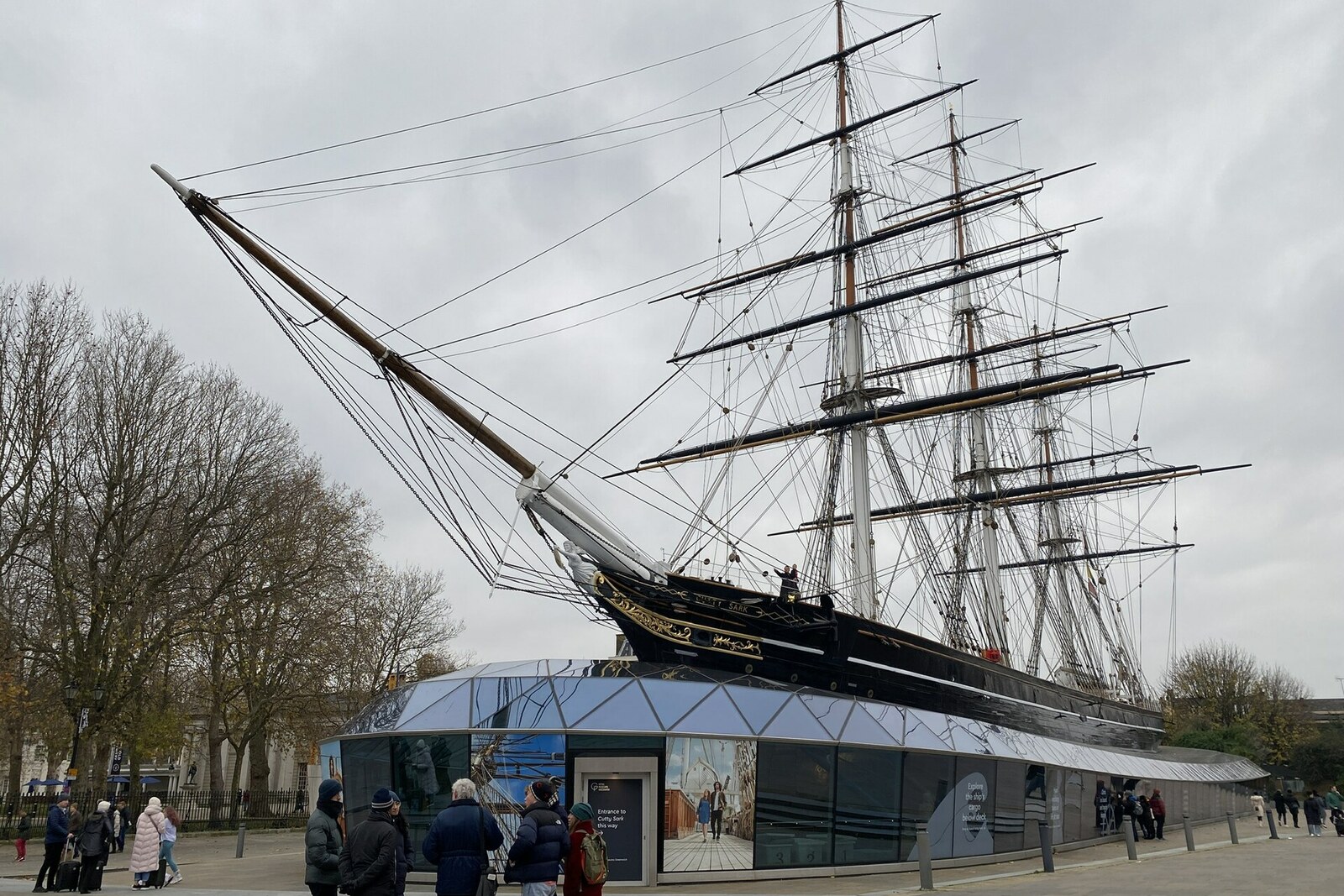
Look around first
What to notice
- The raised hull of the clipper
- Nannie's figurehead with a horse's tail
- The teak rudder beneath the stern
The story of the place
In the dry dock at Greenwich, the hull of the Cutty Sark is raised above the ground on a steel support. This is a real cargo vessel, not a model: more than ninety percent of the hull's structure dates back to eighteen sixty-nine. The clipper was registered in London, returned to London docks with cargo, and in nineteen fifty-four it was placed here and turned into a museum.
The white woman at the bow is the witch Nannie. She holds a horse's tail in her outstretched hand. Shipowner John Willis took the ship's name from Robert Burns's poem Tam o' Shanter. In the story, the farmer Tam came upon witches dancing and carelessly called out to Nannie. She rushed after him. Tam rode toward a river that the witch could not cross, but just before the water Nannie managed to tear off his horse's tail. She wore a short shirt—"cutty sark" in old Scots. Documents do not explain why Willis chose this particular name. The present-day Nannie was carved in twenty twenty-one from drawings by the ship's first designer; she still holds the same tail in her hand.
Willis commissioned the vessel for the China tea trade. Buyers particularly valued the first shipment of the new harvest to arrive in London, and whoever unloaded before their rivals could sell the cargo for more. For speed, the designer Hercules Linton made the hull narrow, the bow sharp, and the sail area enormous for a vessel of this size. Capacity was sacrificed: the clipper was meant to earn money not through the number of chests, but through time.
On June eighteenth, eighteen seventy-two, the Cutty Sark and its main rival, the clipper Thermopylae, left Shanghai with tea almost simultaneously. In the Indian Ocean, the Cutty Sark was about four hundred nautical miles ahead of its rival. Then, during a storm, the sea tore away the rudder. Without it, the captain could not hold course, and the previous advantage disappeared with every passing day.
Robert Willis, the owner's brother and holder of twenty shares in the vessel, was on board. He demanded that they go to Cape Town: his property, together with the cargo, was at stake. Captain George Moodie was responsible for the people and the voyage and wanted to bring the clipper to London without putting into port. Moodie refused to obey the passenger and ordered the ship's carpenter, Henry Henderson, to make a new rudder at sea.
Henderson had known this hull since the slipway: during its construction, he served as senior carpenter and selected the timber, then joined the Cutty Sark as shipwright. Now whether the ship could continue the voyage at all depended on his craft. From spare beams and iron parts, he designed a temporary rudder. For six days, the crew sawed, fastened, and forged metal on deck. The portable forge tipped over in the rolling sea and burned the captain's son, who was helping with the work. The rudder was fitted behind the stern, then later hauled aboard again and reinforced.
Thermopylae arrived in London first. The Cutty Sark entered the port on October eighteenth—one hundred twenty-two days after leaving Shanghai and only a week later than its rival. Henry Henderson received a bonus of fifty pounds for the temporary rudder. The captain and crew were praised for bringing the loaded vessel home, but the dispute did not end there. Robert Willis filed a complaint, and Moodie left the Cutty Sark and for the next nineteen years commanded steamships on Atlantic routes.
Henderson's rudder has not survived. The large teak rudder now visible beneath the stern appeared later: during its long service, the clipper lost its rudder blade several times. From the eighteen seventy-two voyage, a photograph remains—Henderson stands beside the temporary rudder he assembled at sea after returning to London.
Useful on site
Daily 10:00–17:00; last entry 45 minutes before closing. Closed 24–26 December and on days of special events.
Checked: June 22, 2026. Check the official source before visiting.Outside, it is convenient to walk around the ship first and examine the shape of the hull. Going aboard and visiting the interior spaces are part of a separate visit—check the access conditions if you want to see more of the deck and structure.