 Guide On Map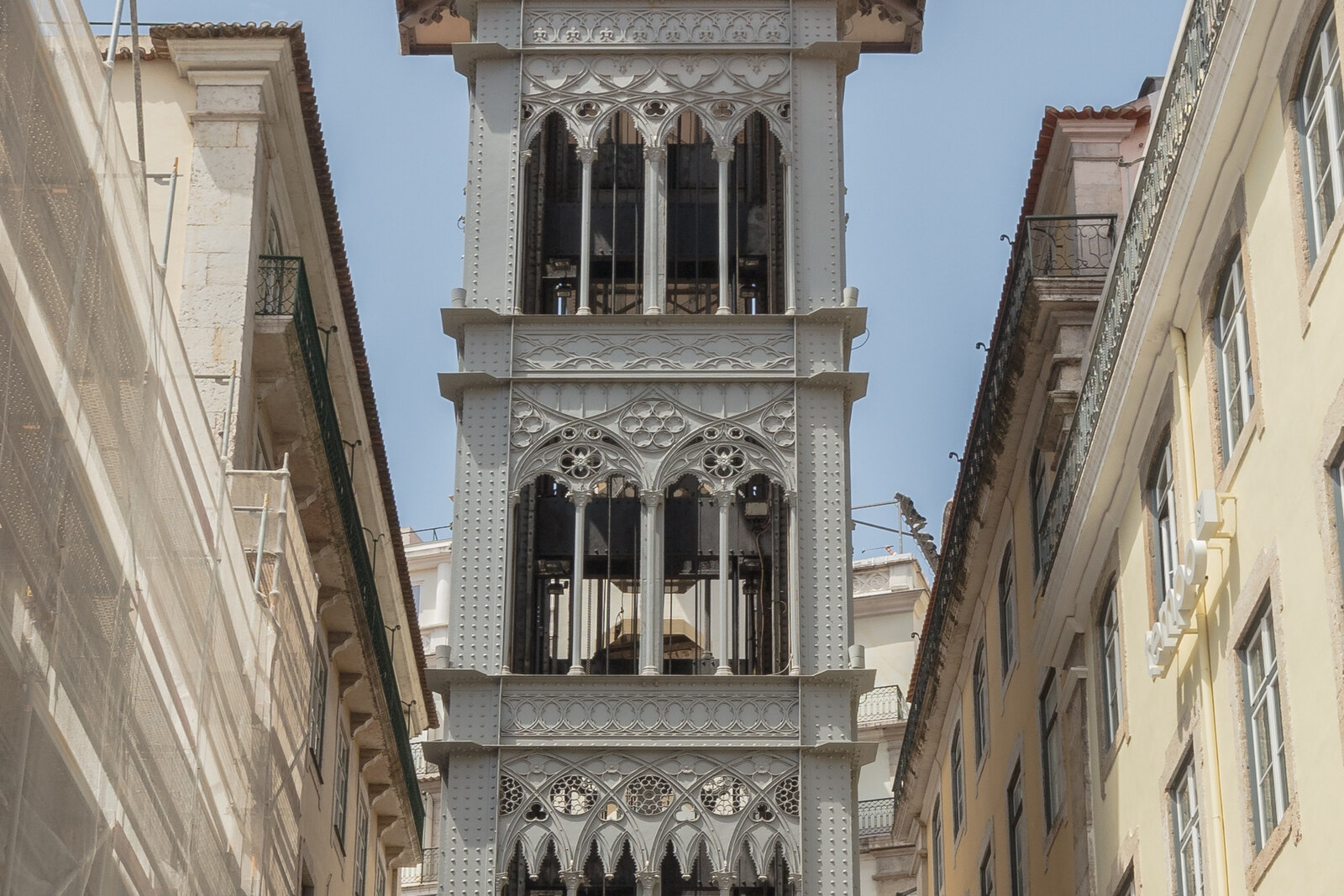
Look around first
What to notice
- Metal tower
- Two wooden cabins
- Upper bridge
- Spiral staircase
The story of the place
Above the end of the street rises an openwork iron structure with two cabins inside and a passage thrown over the houses toward Largo do Carmo. The lower door is the starting point, while the upper platform leads out about thirty-two meters higher; a spiral staircase rises beside it. This route made it possible to get from cramped Baixa to the upper district with luggage, without cutting a road into the slope. The name Santa Justa came from the lower street and the long-vanished Church of Saint Justa, which once stood nearby.
Raoul Mesnier de Ponsard conceived not a viewing tower here, but a toll route. He made his living designing and operating mechanical lifts. In the early eighteen nineties, the engineer proposed running one of them from Baixa to Largo do Carmo.
On a map, these places are almost neighbors. In elevation, they are about thirty-two meters apart. An inclined funicular required a clear strip on the slope, which did not exist among the houses. Mesnier proposed placing a metal tower with two vertical cabins at the end of the street and linking the upper platform to Carmo by a bridge above the rooftops. Passengers and their luggage were to rise inside the tower, cross the bridge, and emerge on the upper street.
To charge for this route, the engineer needed a municipal concession. He received it in eighteen ninety-six, but waited another three years for building permission. Mesnier then brought in two partners: the surgeon João Silvestre de Almeida, who undertook to manage the enterprise, and the Marquis of Praia e Monforte, who had money for construction. The engineer's own contribution was one-third of the capital: the concession right was valued at nine contos, and he contributed another sixteen in cash. A conto meant one million Portuguese reis of the time. Mesnier was risking both his savings and the principal asset of his trade—the right to collect fares from future passengers.
The most difficult part proved to be the metal gallery visible above. Municipal engineers prohibited supporting it on the walls of the neighboring building and obstructing busy Rua do Carmo with scaffolding. Workers from the firm of Manuel Cardoso, a professional maker of metal structures, assembled the twenty-five-meter bridge almost vertically beside the tower. On August thirty-first, nineteen oh one, the builders used levers to rotate the bridge and its central support simultaneously. They began at around two in the afternoon; by six, the gallery had come to rest across the street and linked the tower to the rooftop terrace.
On July tenth, nineteen oh two, the two wooden cabins received their first passengers. A steam engine above turned drums with steel cables; each cabin held twenty-four people. Musicians played on the terrace, company representatives received congratulations, and Mesnier himself was absent: an attack of sciatica prevented him from coming to the opening of the route for which he had sought permission for almost ten years.
The partners' investments began to be returned through ticket sales. Just three years later, they leased the lift to a large transport company for an annual sum equal to the enterprise's projected net profit, and provided for a subsequent sale. The buyer exercised that right in nineteen thirteen. By then, the steam engine had already been replaced by electric motors.
The lift inherited the name “Santa Justa” from the lower street and staircase. The street was named after the Church of Saint Justa—a martyr from Seville venerated as the patron saint of potters. The church stood farther on, at the intersection with Rua dos Fanqueiros; the fire after the earthquake of seventeen fifty-five left it in ruins. The second name, “Elevador do Carmo,” points to the other end of the route—Largo do Carmo above.
The lower entrance, the two wooden cabins, and the metal bridge preserve the original layout of Mesnier's enterprise: people bought a ticket here and emerged thirty-two meters higher, beyond the rooftops of neighboring houses.
Useful on site
The lift operates as a Carris urban transport facility, but its schedule and the queue can noticeably alter the actual experience. At the time of checking, the onboard ticket for Santa Justa Lift cost 6,20 € and covered up to 2 rides; check the current schedule on the day of your visit.
Checked: June 16, 2026. Check the official source before visiting.Examine the structure from the street before deciding whether to ride; if the queue is long, do not wait for the sake of the route—Carmo can be reached on foot.