 Guide On Map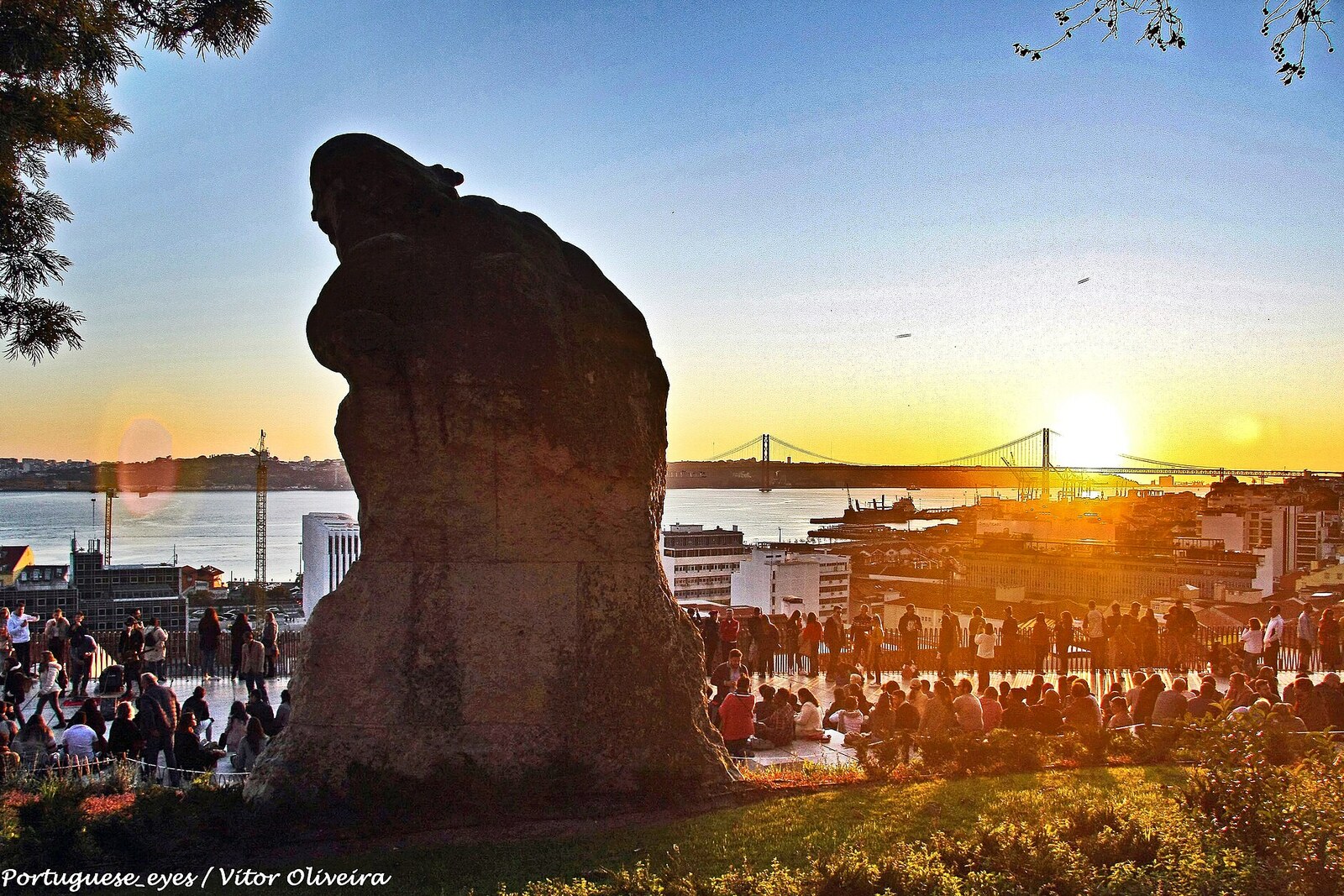
Look around first
What to notice
- The mansion housing Museu da Farmácia
- The stone figure of Adamastor
- The small bronze figure of the sculptor
- The Tagus
The story of the place
The garden lies on a steep edge of the hill above the Tagus: before paths and a terrace could be laid out here, city engineers had to reinforce the slope with a retaining wall. The side open to the river had long served residents as a lookout point—where they watched ships entering the port and traveling along the river. At the end of the nineteenth century, the city turned this place into a public garden, preserving the old habit of coming here for the water and the ships. Above the terrace rises a stone figure whose head and hands are made of bluish marble, while a small bronze man hides at its foot.
At the garden's upper edge stands a city mansion that now houses Museu da Farmácia. It occupies the site of the church that gave its name to the entire hill.
In fifteen fifty-seven, Queen Catarina de Áustria, the wife of João the Third, ordered a church of Saint Catherine of Alexandria to be founded here. This early Christian martyr was considered the patron saint of students, philosophers, and people involved with books. The church was therefore run by Lisbon's brotherhood of booksellers—an association of people whose livelihood depended on selling books. The church served as their church, meeting place, and common property.
After the earthquake of seventeen fifty-five, the booksellers restored the damaged building. In February eighteen thirty-five, the church burned down. The parish was transferred to Santa Catarina Church on Calçada do Combro, a former monastic church that has borne that name ever since. The burned-out walls on the hill remained with the brotherhood.
Five years later, officials added the ruins to the list of state property intended for sale. The brotherhood's president, the Count of Sampaio, sought to have the property returned to the booksellers. They acted together and won the case: in eighteen forty-four, the government gave them the church ruins.
Now money had to be found for restoration. The brotherhood's members approved loans and a fundraising drive, but they did not raise the required sum. In eighteen fifty-six, they themselves asked for permission to sell. The state agreed on the condition that the proceeds be invested in government securities. A few years later, the walls were demolished, and the industrialist José Pedro Colares built the present mansion on the church site. The brotherhood left, the church disappeared, but the name Santa Catarina remained with the hill and the lookout.
For a long time, residents had used the hill's open edge to watch ships on the Tagus and activity in the port. Municipal engineers reinforced the slope with a retaining wall, and in eighteen eighty-three the city created a public garden here. It preserved the site's old use: people still come here to look at the river and the ships.
The stone giant appeared later. Luís de Camões invented Adamastor for The Lusiads. In the poem, he appears before Vasco da Gama's fleet as the guardian of the dangerous waters near the Cape of Storms and tries to stop the sailors bound for India with threats. The ships continue on their way. Adamastor remains the cape they managed to pass, embodied in human form.
Lisbon City Council commissioned the monument from the sculptor Júlio Vaz Júnior and opened it on June tenth, nineteen twenty-seven, Camões Day. The sculptor carved the giant's head and hands from bluish marble and placed a tiny bronze figure of himself beside it. He called the composition A Visão do Estatuário: a man found himself beneath the stone mass of his own conception.
After the monument was installed, residents began calling the garden Jardim do Adamastor. The official name preserves the vanished church of the booksellers, while the everyday name preserves Camões's marble character. Júlio Vaz Júnior himself still stands here in bronze, at the foot of his giant.
Useful on site
The terrace is open daily 7:30–23:30; it closes at night.
Checked: June 17, 2026. Check the official source before visiting.At sunset, the lookout can be crowded; choose a spot away from groups and do not sit where you block the way.