 Guide On Map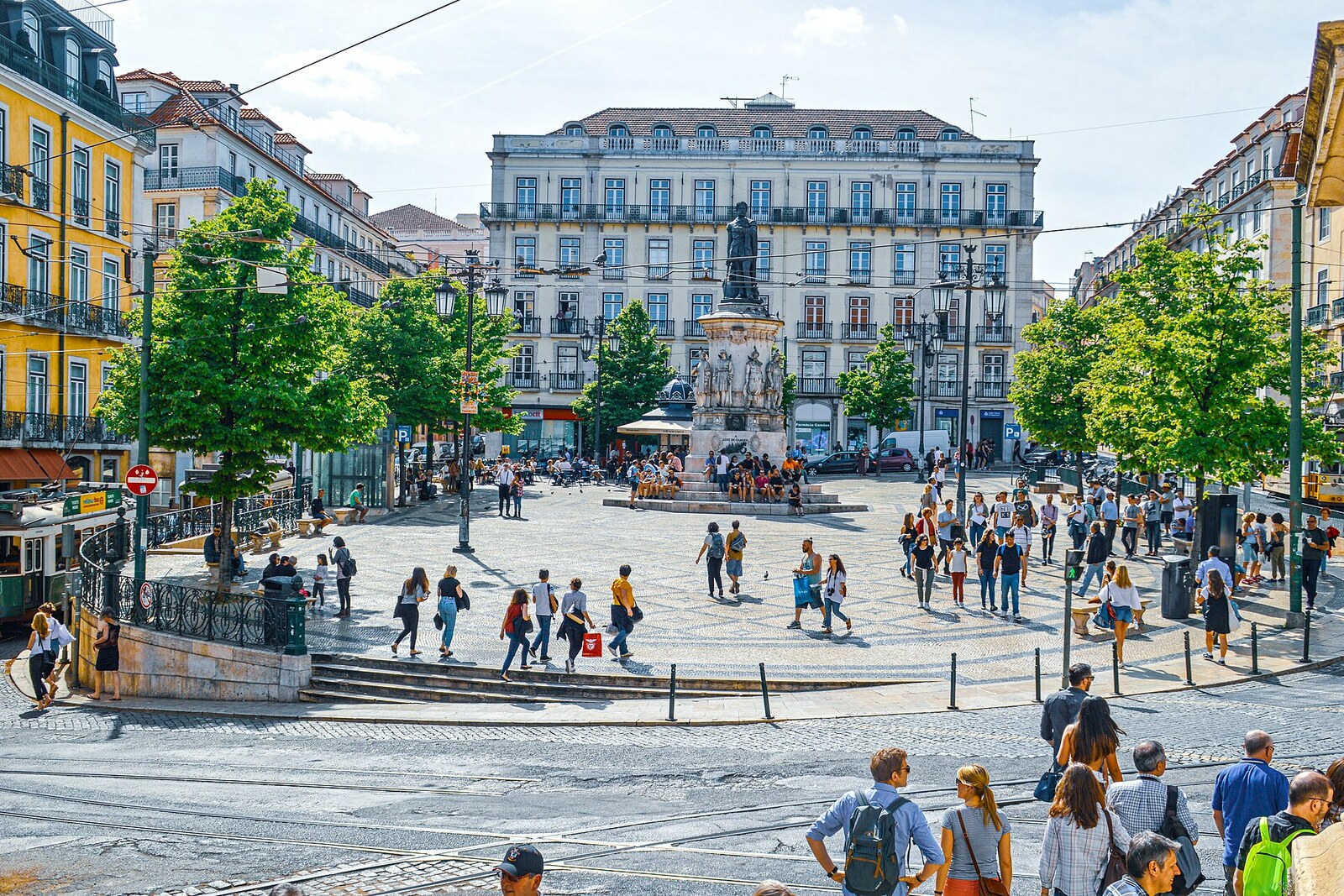
Look around first
What to notice
- The bronze figure of Camões
- The book in the poet’s hand
- The sword
- Eight figures at the pedestal
The story of the place
At the junction of Chiado, Bairro Alto, and Bica, a broad square brings together the routes of three neighborhoods, and stone steps surround the pedestal. Houses and the Palace of the Marquesses of Marialva once stood here; the earthquake destroyed the palace, and the site was cleared for a monument to a Portuguese poet. The commission collecting money for the monument secured the new place’s name in his honor before the statue appeared. Today, people meet on these steps before dispersing into the neighboring streets.
The bronze Luís de Camões holds The Lusiads against his chest and rests a sword on the ground with his other hand. The sculptor Vítor Bastos placed the poet above eight figures: historians, poets, and a scholar. Camões served as a soldier and wrote an epic poem about Vasco da Gama’s voyage, naval expeditions, and the cost of Portugal’s conquests. By the nineteenth century, he was considered the country’s leading poet.
The square itself was created for this monument. In eighteen sixty, officials cleared a site between Rua do Loreto, Rua da Misericórdia, and Rua da Horta Seca—houses and the Palace of the Marquesses of Marialva, destroyed by the earthquake of seventeen fifty-five, had previously stood here. The commission collecting donations for the statue asked for the new space to be given Camões’s name in advance. The name had already been entered in a city decree when the bronze statue did not yet exist. The monument was unveiled seven years later in the presence of King Luís the First.
Thirteen years later, the same king refused to go to the statue as part of a huge procession. It was conceived by Teófilo Braga—a republican, meaning a supporter of replacing the monarchy with a republic, a literature professor who lived on a professor’s salary and work on books. In eighteen eighty, it was three hundred years since Camões’s death. Braga pressed for the anniversary to be organized by journalists, writers, city associations, and professional associations. For the scattered republican circles, it was a test: could they bring people together around a national name without passing off a party rally as a literary celebration?
The government also joined the celebrations, commissioning pavilions, illuminations, and parades, but the king and ministers saw the procession as too overtly political a demonstration and kept their distance from it. Their absence immediately became part of the event. The caricaturist Rafael Bordalo Pinheiro drew Camões in a republican cap: in the caricature, the poet thanked the king for helping to “republicanize” him through his refusal.
On June tenth, around noon, the column set out from Praça do Comércio. Journalists, students, craft associations, and city associations marched in it, while allegorical floats of agriculture, education, and trade moved along. The procession climbed through Chiado and filled this square. Participants carrying branches and wreaths left them on the steps of the Monument to Luís de Camões, went around the pedestal, and continued along Rua do Alecrim toward Cais do Sodré. Contemporaries were struck that a ceremonial column had passed through the city without clergy or a military escort: people honored the poet on their own behalf.
The celebration gave the republicans experience in mass organization and accelerated the unification of their previously disputing groups. Three years later, they created their party’s first nationwide leadership; Teófilo Braga joined it. After the proclamation of the republic in nineteen ten, the former anniversary organizer headed the provisional government.
The statue and the steps on which wreaths were laid remained in the same place. Routes from Chiado, Bairro Alto, and Bica converge here, so today people arrange to meet at Camões before dispersing into the neighboring streets. In eighteen eighty, people also gathered there—and then took the same turn downhill along Rua do Alecrim.
Useful on site
Open city square accessible around the clock.
Checked: June 17, 2026. Check the official source before visiting.View the monument from the edge of the square: there are many pedestrians and vehicles in the center. Visiting cafés is not included in the route.