 Guide On Map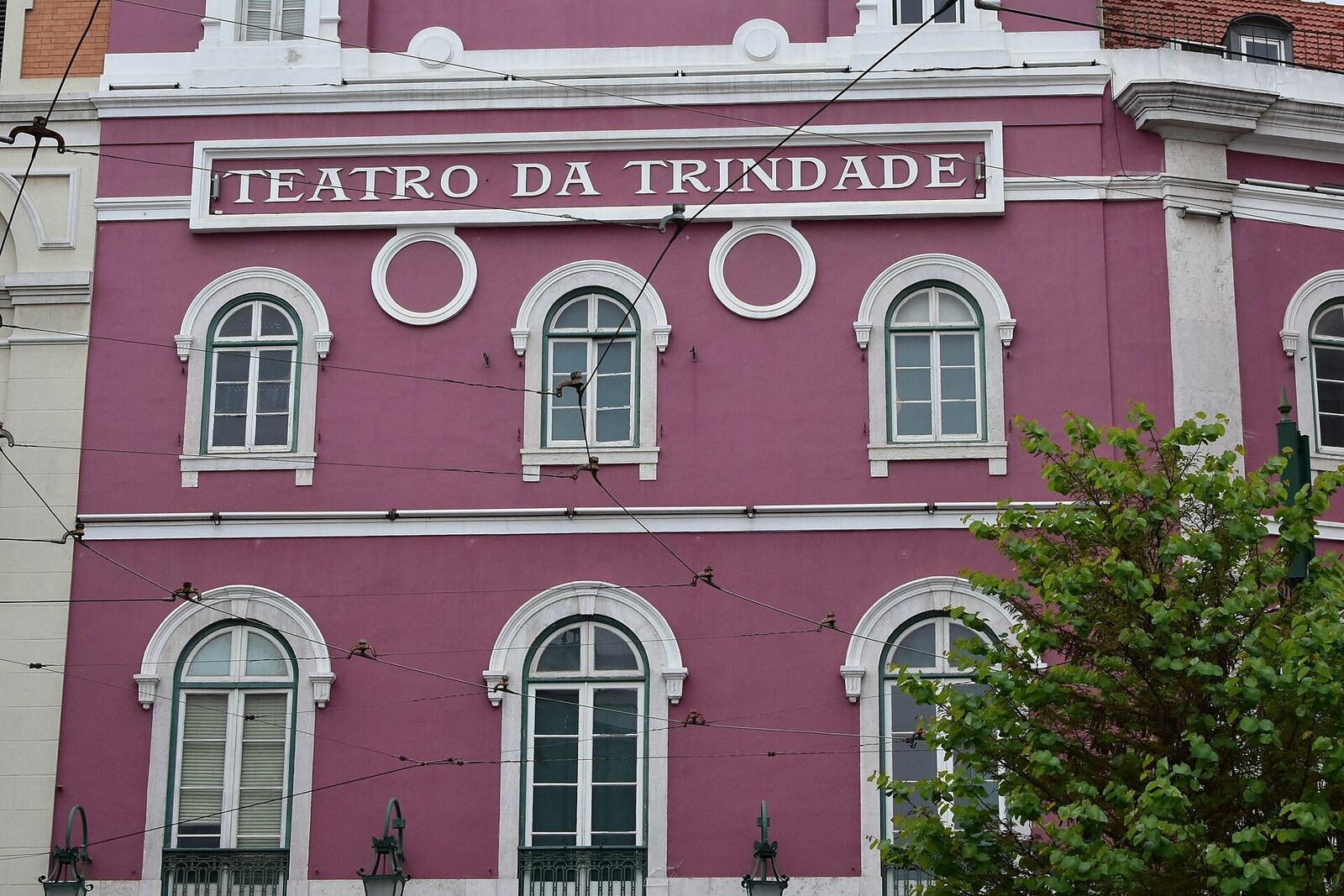
Look around first
What to notice
- Theater sign
- Theater facade
- Entrance doors
The story of the place
The theater sign on the facade leads into an old city auditorium designed for a long evening, not a single performance. The seating rows curve around the stage; a café and a separate room for music, meetings, and balls once operated nearby, and the stalls floor could be raised level with the stage, clearing space for dancing. Hooks for hats were provided on the backs of the chairs, the auditorium was equipped with ventilation, and the curtain was given over to advertisements. The side hall disappeared long ago, but tickets are still sold in the main one.
The word “Trindade” appears both in the square’s name and on the theater sign. In Portuguese, it means Trinity. In twelve eighteen, King Afonso II set aside land here for the Order of the Most Holy Trinity. The order’s monks collected money to ransom Portuguese people captured in the cities of Morocco and Algeria. Their monastery occupied a significant part of today’s neighborhood and gave its name to the square and neighboring streets. After the earthquake of seventeen fifty-five, the monastery was rebuilt for decades; in eighteen thirty-four, the order was dissolved and the plots were sold off. The vaults and columns of the monastery refectory remain inside the neighboring brewery. The theater inherited its name from the square.
Its creator, Francisco Palha, came here after a successful spell at Lisbon’s main drama theater, the Dona Maria II National Theatre. In eighteen sixty-two, Palha was appointed royal commissioner—a manager tasked with bringing audiences back to the nearly empty theater. He assembled a strong troupe, spent money on productions, and filled the auditorium. But every change had to be approved by officials. Four years later, Palha decided to build his own stage, where he himself would determine the repertoire and the building’s layout.
Palha was a playwright and theater entrepreneur: his idea was tested not by a report, but by tickets sold. On October tenth, eighteen sixty-six, he formed a joint-stock company. The Duke of Palmela became its chairman, and wealthy acquaintances contributed eighty contos—eighty million reis. By the time the work was completed, expenses had risen to one hundred twenty contos.
Palha commissioned architect Miguel Evaristo to create an entire entertainment complex. Alongside a horseshoe-shaped auditorium with a large mechanized platform, it included a café and a separate hall of about two hundred square meters—for concerts, conferences, and balls. The stalls could be raised to stage level, creating another dance floor. A wide balcony, new to Portugal, held many spectators, although its seats cost as much as boxes. The backs of the chairs had hooks for hats, the room was ventilated by modern ventilation, and advertisements were placed on the curtain. Palha expected audiences to come here for more than one play and spend the whole evening in the building.
While construction was under way, he leased a theater on Rua dos Condes, drew several of the best actors away from the Dona Maria II National Theatre, and began staging his own repertoire. That gave the future Teatro da Trindade an audience even before it opened. The hall began operating first: during Carnival in eighteen sixty-seven, balls were already held there, although builders continued working in the rest of the building.
On November thirtieth of that same year, the curtain rose in the main auditorium. First came Ernesto Biester’s drama A Mãe dos Pobres, followed by the Spanish comedy O Xerez da Viscondessa, which Palha himself translated and adapted. The drama received a cool reception, but the comedy was successful. Palha read the audience’s taste even more precisely the following summer, when he staged Jacques Offenbach’s Bluebeard. The production ran for months, and for decades French operettas and Spanish zarzuelas—musical comedies with spoken scenes—became Teatro da Trindade’s main product. Palha directed his theater until his death in eighteen ninety.
The complex he created has not survived intact to the present day. In nineteen twenty-one, its owner sold the building to the Anglo-Portuguese Telephone Company for three hundred fifty contos. Telephone workers set up offices here, the theater’s property was sold at auction, and the separate hall was demolished. Two years later, entrepreneur José Loureiro, who worked in Portugal and Brazil, bought the former theater and redecorated the auditorium. In nineteen twenty-four, he reopened it for performances.
The very theater for which Palha left behind approvals and gathered shareholders operates under its present sign. Its auditorium has been rebuilt, but tickets are still sold there. And the place of the first Carnival hall, where Palha began receiving audiences amid unfinished work, was destroyed by the telephone company more than a hundred years ago.
Useful on site
The square is always open; check the theater and brewery schedules in advance.
Checked: June 17, 2026. Check the official source before visiting.The audio story is designed for viewing from outside. A performance or an interior visit must be planned separately.