 Guide On Map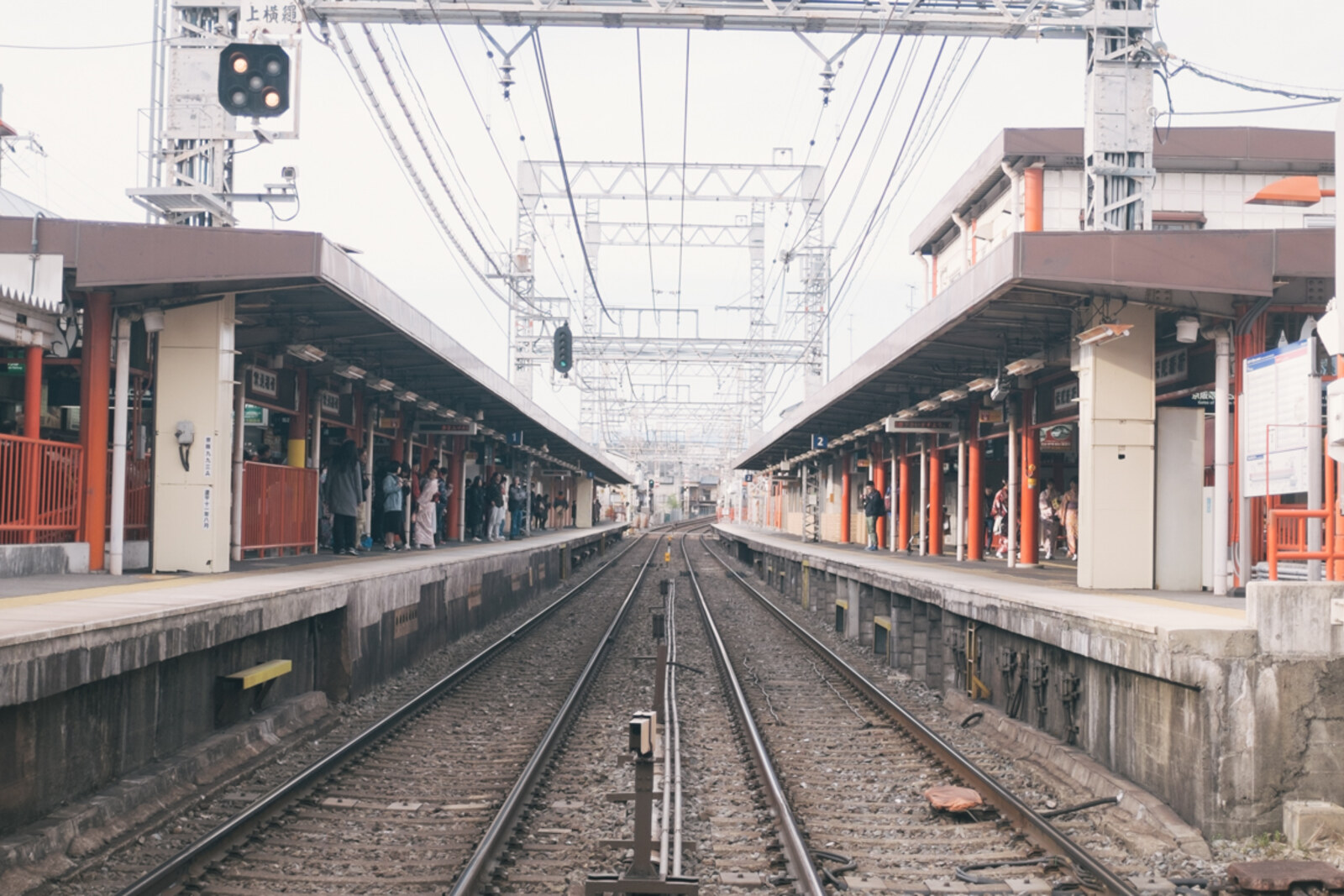
Look around first
What to notice
- Vermilion platform pillars
- Large shrine torii across the street
- Brick hut at the southern end of the platform
The story of the place
The vermilion pillars of Inari Station continue across the street in a large shrine torii. The station took its name from Fushimi Inari Taisha, reached by the straight road from the exit. Its main purpose is clear today: trains bring pilgrims and tourists here from central Kyoto. But this line was built for another route.
In August eighteen seventy-nine, Inari opened as a station on the Tokaido Line—the future main railway between Kyoto and the east of the country. Construction was overseen by Inoue Masaru, head of the government railway bureau, who wanted Japanese engineers to be able to lay lines without the constant direction of expensive foreign specialists. For an official responsible for expanding the network, this section was a test of his professional reputation: failure would have shown that his department still lacked sufficient expertise of its own.
At the time, the builders could not run tracks directly from Kyoto to Lake Biwa. The short route required a long tunnel beneath the Higashiyama mountains, and steam locomotives struggled with steep climbs. The engineers took the railway far south, along the foot of Inariyama, then turned east and only after that headed for Otsu. That is how the country's main line came to be here, beside the old shrine.
In eighteen eighty, trains began running along the entire Kyoto–Otsu railway. It was the first major Japanese railway section built under the direction of Japanese engineers. After its successful completion, they began to be entrusted with new lines. At the station itself, workers maintained dozens of kerosene lamps every day: they lit rooms and carriages, served as locomotive headlights, and as tail and signal lights.
At the southern end of the platform, a brick hut of about eight square meters survives. Lamps and fuel were kept there, so railway workers moved the storehouse out of the wooden station building and built its walls of brick. For a long time, the hut was thought to date from eighteen seventy-nine itself. Later research into property records showed that the present building was most likely erected around nineteen hundred, replacing an earlier wooden storehouse. It still dates from the time when the Tokaido Line passed through Inari.
By nineteen twenty-one, the successors of the first engineers already knew how to bore long tunnels. They laid a direct railway beneath Higashiyama, and on August first Tokaido Line trains moved onto the new route. The old tracks east of Inari were dismantled, and the railway bureau transferred the section from Kyoto to the Nara Line. That is why the small station survived, even though it stopped receiving the country's main trains. From its former service, the brick hut remains, where workers prepared lamps for trains leaving here for Otsu.
Useful on site
Outdoor stop by the station; access to the shrine is free. Check train schedules separately. Checked 2026-06-29.
Checked: June 29, 2026. Check the official source before visiting.First look around from the publicly accessible passage, and do not approach the tracks for a closer look at the old building.