 Guide On Map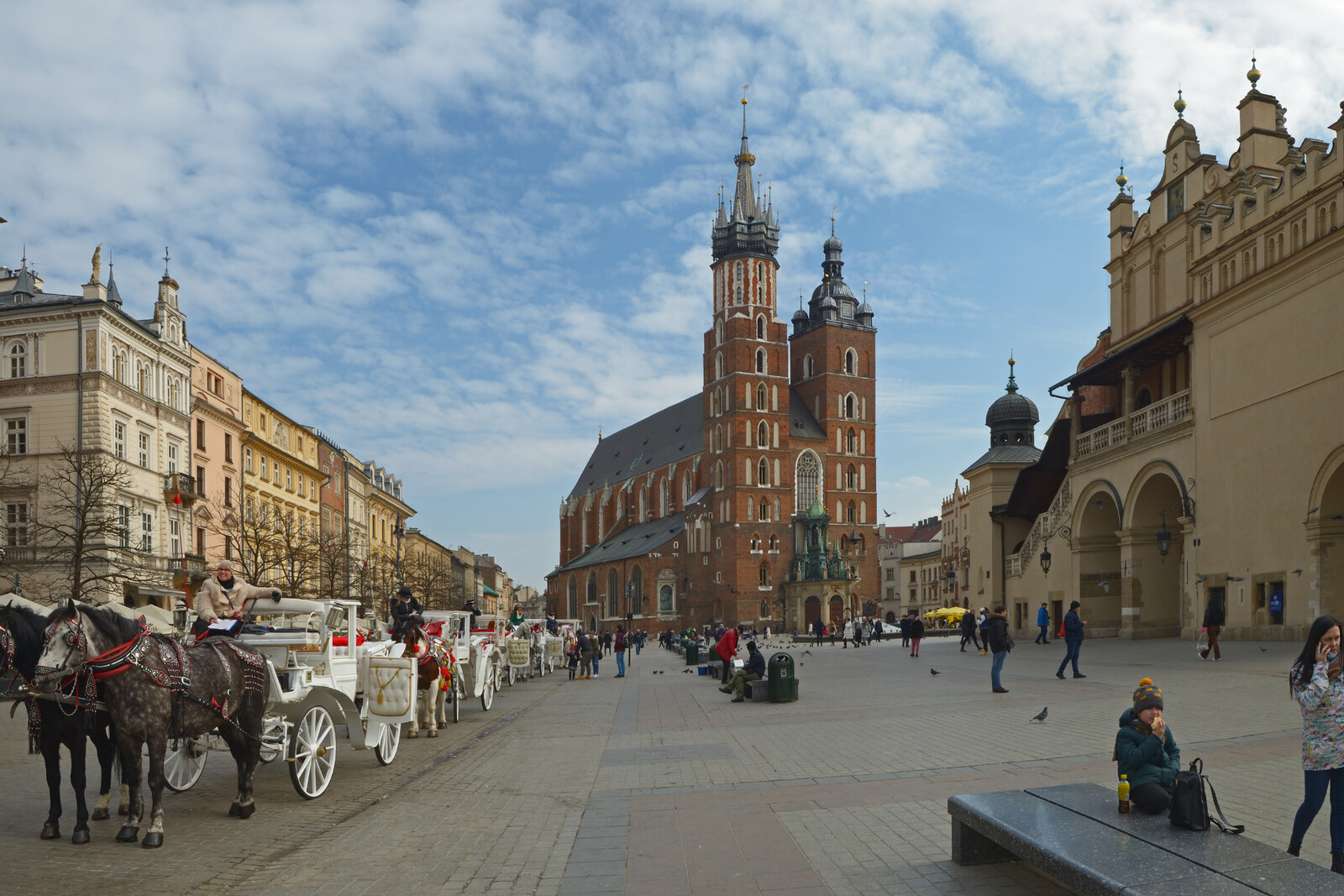
Look around first
What to notice
- Town Hall Tower
- Exit of Bracka Street
- Dark slab “Prussian Homage, 1525”
- Cloth Hall
The story of the place
In the middle of the thirteenth century, a market was laid out here at the junction of the main trade routes, and its name then referred to the square's everyday function. The space was much more cramped than it is today: it was filled with trading rows, weighing houses, shops, and extensions. A free space was left between Town Hall Tower and the exit of Bracka Street for important city business. Today this section is marked by a dark slab in the pavement, and the Cloth Hall recalls what the square lived by.
On April tenth, fifteen twenty-five, Albrecht Hohenzollern knelt here before the Polish king Zygmunt I Stary. Albrecht was the last Grand Master in Prussia—the head of the Teutonic Order, a Catholic military brotherhood that owned lands by the Baltic Sea. He came to Main Market Square to give up his former title and receive a country in return for himself and his heirs.
A lost war brought him to this decision. The peace treaty of fourteen sixty-six required Grand Masters to swear allegiance to the Polish king. Albrecht refused and began a new war with Poland in fifteen nineteen. Two years later, he had to conclude a truce. He received no help from the emperor or the German princes, the Prussian estates threatened to stop obeying him, and the term of the truce was nearing its end. Renewing the war could have left Albrecht without either his office or his lands.
The head of the Order had another weakness: the knight-brothers elected him, so he could not pass the office on to his son. Albrecht adopted Lutheranism and agreed to dissolve the Order's rule in Prussia. Zygmunt I Stary, who sought an end to the war and recognition of Polish supremacy, allowed these lands to be turned into a secular duchy. Albrecht received it as a hereditary fief—a possession for which a prince swore allegiance to a higher ruler and owed that ruler loyalty and military assistance.
The treaty was signed two days before the ceremony. At the market, it remained to show the residents and ambassadors exactly what had changed. The square was much more cramped then: it was occupied by trading rows, weighing houses, shops, and extensions. Main Market Square had been laid out in twelve fifty-seven at the intersection of trade routes, so the word “market” was literal here. But a free section was kept between the town hall and the exit of Bracka Street. Krakow's residents called it “na golde”—a place for taking oaths and confirming the city's privileges.
A platform was set up on this section. Zygmunt sat above those gathered, Albrecht swore to him on the Bible, and received the title of duke in Prussia. The king ended the war and gained a vassal. Albrecht lost the office of Grand Master, but until his death in fifteen sixty-eight he ruled the duchy, which he could leave to his son. The state of the Order in Prussia ceased to exist after the treaty they concluded.
The platform was dismantled, and the market structures later disappeared, so the former free section has now dissolved into the vast square. It is marked by a dark slab in the pavement between Town Hall Tower and Bracka Street. It bears just three words and a date: “Prussian Homage, fifteen twenty-five.” Albrecht came here as the elected head of a knightly order, rose from his knees as a hereditary prince, and retained Prussia.
Useful on site
The square is freely accessible at any time. On site, light, weather, and the density of the crowds matter more than the schedule.
Checked: June 16, 2026. Check the official source before visiting.First, stop at the edge of the square and take it in as a whole. Approach the slab carefully: it lies underfoot in the general flow of people.