 Guide On Map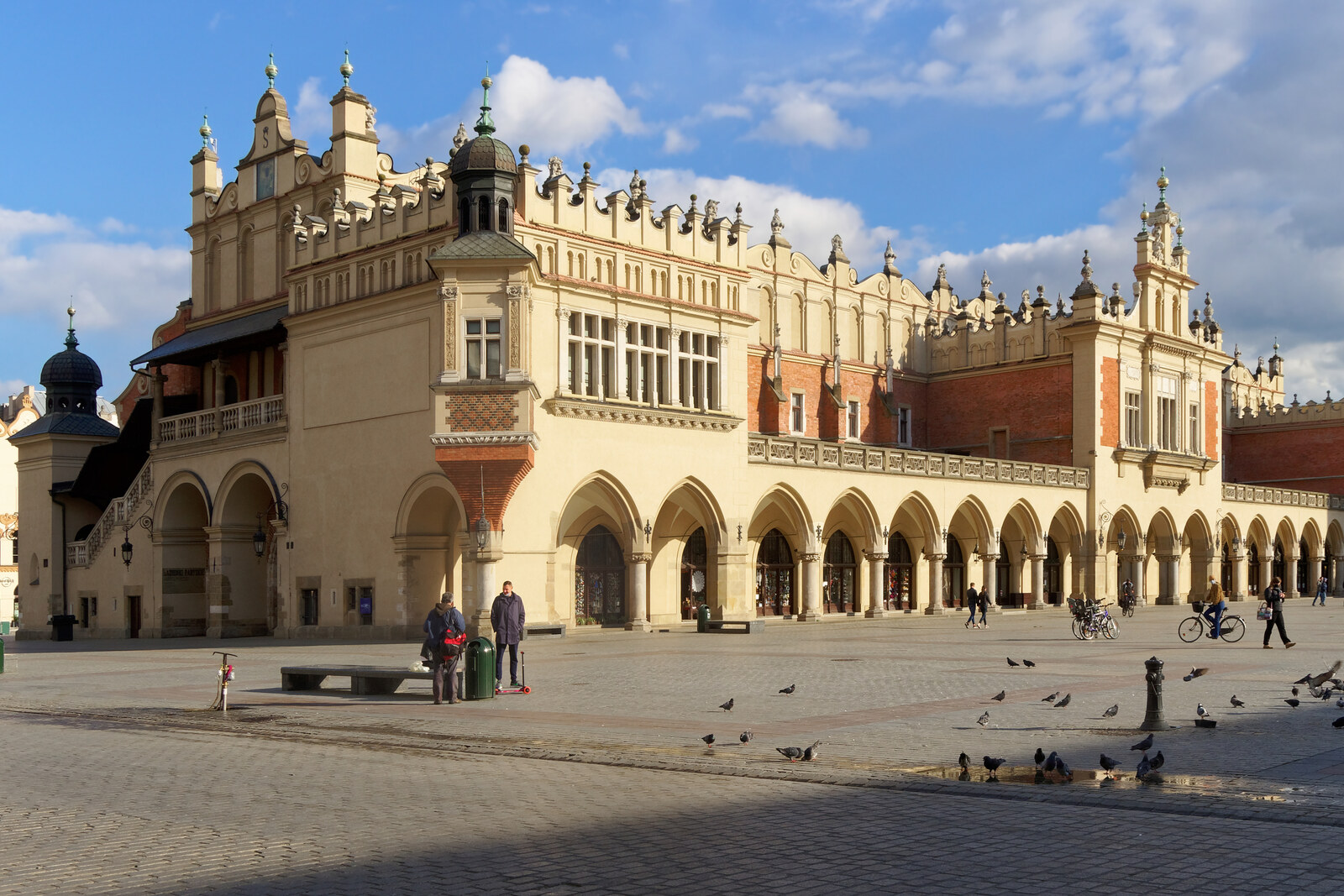
Look around first
What to notice
- Market stalls in the lower gallery
- Museum halls on the upper floor
- The painting Nero's Torches
The story of the place
In the lower gallery, stalls selling amber, jewelry, and crafts open in the morning, while halls of nineteenth-century Polish painting are located above them. This arrangement grew out of the building’s old function: two stone rows for cloth merchants stood in the middle of the market square, with a narrow passage left between them and locked with grilles at night. When Krakow was laid out anew under Magdeburg Law, this section was set aside for trade in costly imported cloth. Visiting merchants could sell their cloth only here, while the city’s collectors kept watch over the goods and duties.
On October fifth, eighteen seventy-nine, a grand dinner was held on the upper floor of the recently renovated Cloth Hall in honor of the fiftieth anniversary of the literary work of the writer Józef Ignacy Kraszewski. The Polish state did not exist at the time: its lands were divided among three empires, and Krakow was part of Austria-Hungary. Poles from all three parts of the divided country therefore came to the jubilee.
Among the guests was Henryk Siemiradzki, a celebrated academic painter who lived in Rome. He supported himself through painting and gained European fame with enormous works on classical and biblical subjects. During the dinner, Siemiradzki announced that he was giving Nero's Torches to the public—a seven-meter canvas created only three years earlier that had already brought him international awards. In the painting, condemned Christians are tied to poles in the gardens of Emperor Nero: they are to be burned, turned into torches for a celebration.
The artist immediately decided the fate of the gift: the painting was to be hung here, in the Cloth Hall, and a national collection of art was to begin with it. Siemiradzki gave away the work on which his professional fame rested, rather than a painting that had been lying around in his studio. Other artists followed his example and gave the commission several dozen of their own canvases. On October seventh, the city council established the National Museum in Krakow. Nero's Torches was entered into its inventory under number one.
The museum was given the upper floor, while the lower floor was left to merchants. This division explains the entire building. In twelve fifty-seven, Prince Bolesław V Wstydliwy laid out Krakow anew as a city under Magdeburg Law and set aside the middle of the market square for stone stalls. Cloth merchants received two rows of counters with a narrow passage between them; at night, the passage was locked with grilles. Later, a royal decree required visiting merchants to sell their own cloth only here. This allowed the city’s collectors to keep track of costly imported goods, while trade brought Krakow a steady income. The name Cloth Hall comes from cloth.
Today, the lower level sells mostly jewelry, amber, crafts, and souvenirs. Above the trading gallery are halls of nineteenth-century Polish art. Nero's Torches still hangs upstairs, with museum number one; directly beneath the painting, tenants open their market stalls every morning.
Useful on site
The outdoor stop itself and the passage beneath the arcades function as outdoor space. The museum and underground sections inside follow separate schedules.
Checked: June 16, 2026. Check the official source before visiting.The passage remains a busy trading space, so listen by the wall and do not stop across the flow. The upper exhibitions require a separate visit.