 Guide On Map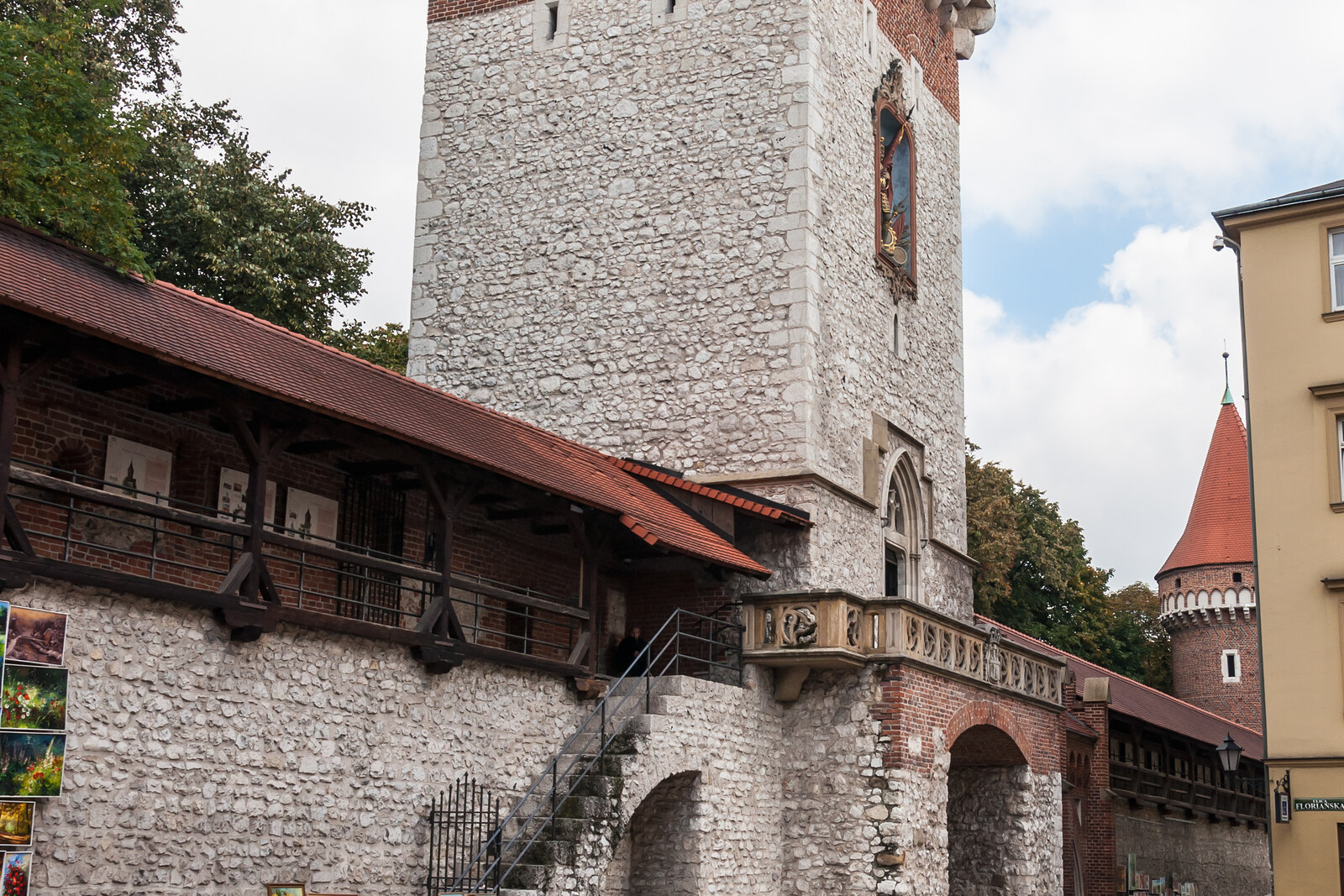
Look around first
What to notice
- The passage arch
- The relief of St. Florian
- The surviving stone wall
- The commemorative plaque between the gate and the Beltmakers' Tower
The story of the place
The passage arch leads from the Krakow Barbican onto Floriańska Street, along which the route runs toward Wawel. The gate's name comes from the relief of St. Florian facing the Old Town: his relics arrived in Krakow in eleven eighty-four, and a church was founded for them in Kleparz. From there, people entered the city through this gate; this was also where future monarchs were greeted before the coronation procession.
At the beginning of the nineteenth century, Krakow officials planned to demolish this tower along with the rest of the fortifications. The medieval walls had long ceased to protect against modern artillery, their upkeep was expensive, and the silted-up moat had become a public-health problem. The Austrian administration hoped to open up and clear the city, using the stone for new buildings. From eighteen ten, workers dismantled gates and towers and filled in the moat. Within four years, almost the entire line of fortifications had disappeared.
At the northern entrance, Florian Gate, the Krakow Barbican, three towers, and part of the wall still remained. In December eighteen sixteen, Feliks Radwański spoke up for them. He was an architect, a former professor of mechanics and hydraulics, and a lifetime senator representing the university. He wanted to preserve the structures as a historical monument, although his colleagues saw only a dilapidated and useless obstruction.
Radwański compared the Krakow Barbican and the gate to Roman antiquities, which people preserve precisely because it is no longer possible to rebuild them. Then the architect began speaking the language of city management. If the northern wall were removed, he argued, the open expanse of Kleparz would direct snowstorms and rubbish straight toward the center of Krakow. His memorandum mentioned rheumatism and even paralysis, which drafts supposedly threatened women and children with. The well-known tale of wind lifting Krakow women's skirts is a later retelling; Radwański's surviving appeal speaks of snow, mud, and illness.
In January eighteen seventeen, the senate abandoned immediate demolition and resolved to retain Florian Gate along with roughly two hundred meters of fortifications. But opponents returned to the matter after Radwański's death. In eighteen twenty-seven, residents of neighboring districts again demanded that the gate be demolished. This time it was defended by Jan Librowski, a justice of the peace. He repeated the late senator's arguments, and the dismantling was again cancelled.
Builders destroyed the remaining walls, filled in the moat, and later created Planty Park on the cleared strip. Here, the line breaks off differently: the arch, three towers, the stone wall, and the Krakow Barbican remain in their original places. Between Florian Gate and the Beltmakers' Tower hangs a plaque installed a hundred years after Radwański's death. Its inscription states directly that he saved these fortifications from demolition in eighteen seventeen.
The gate's name is explained by the relief of St. Florian on the side facing the Old Town. Florian was a Roman officer and a Christian martyr. In eleven eighty-four, Prince Kazimierz II Sprawiedliwy brought his relics to Krakow and founded Church of St. Florian in Kleparz for them. The road from that church entered the city through the main northern gate, and so it was named Florian Gate. This was also where coronation entries began: the future monarch was greeted at the church, then the procession passed through the Krakow Barbican and this arch toward Wawel. The church stands beyond the Krakow Barbican; the direct road from it passes through the gate and is then called Floriańska Street.
Useful on site
The street stop is freely accessible. The museum route along the defensive walls operates Tuesday–Sunday, 10:00–16:00.
Checked: June 16, 2026. Check the official source before visiting.Do not linger in the middle of the narrow passage: look at the outer façade, pass beneath the vault, and stop on the street side.