 Guide On Map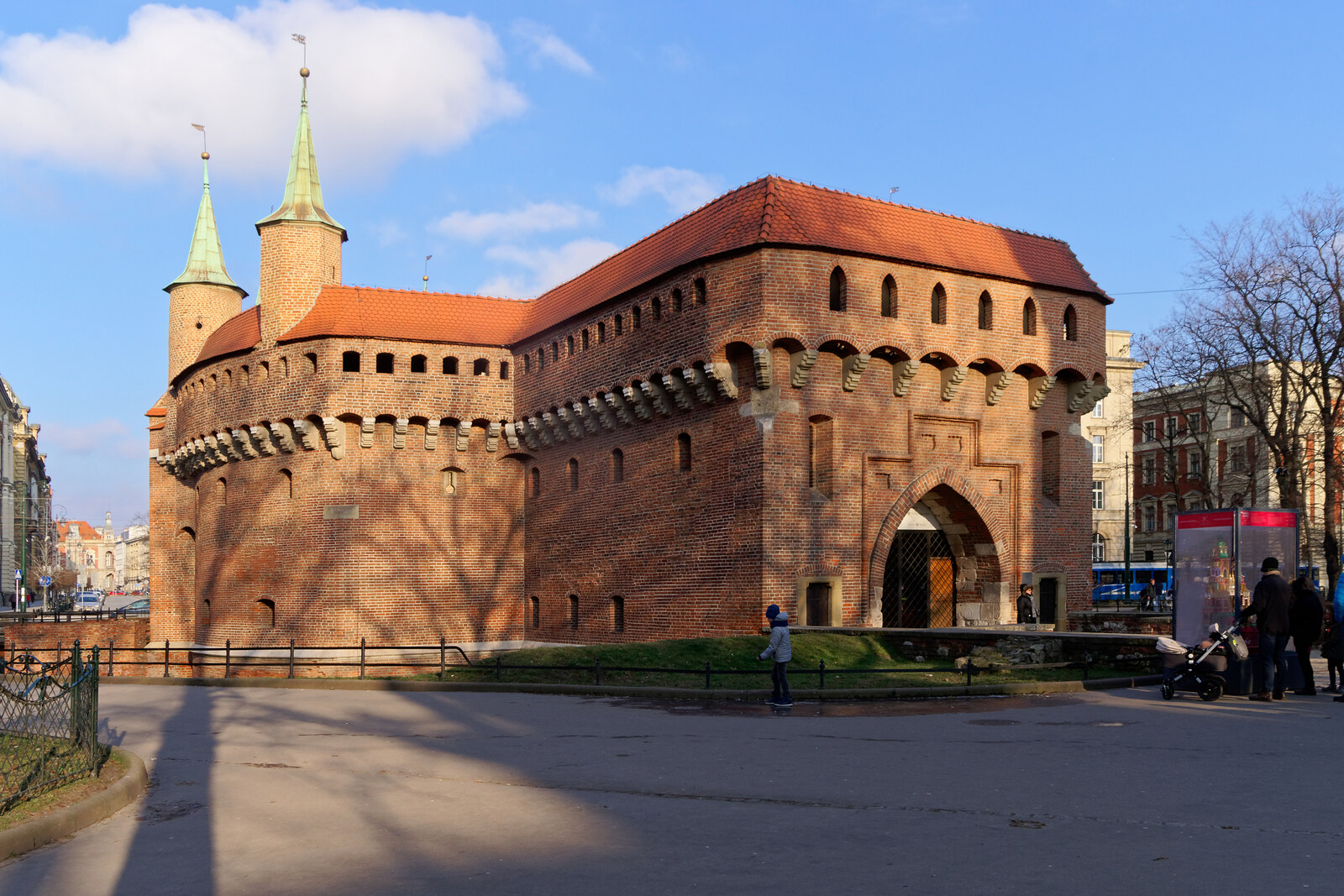
Look around first
What to notice
- Round brick structure
- Rows of embrasures
- Commemorative plaque on the eastern wall
The story of the place
Today, the Krakow Barbican looks like a separate round fortress. At the end of the fifteenth century, there was no park behind it. A moat surrounded the brick walls, and a covered passage over the water connected the fortification with Florian Gate. An arriving visitor crossed a drawbridge, entered the outer gate, turned, and only then proceeded along this passage toward the city. A direct rush inside was impossible.
Such a fortification was called a barbican—an advanced forecourt for a gate. It was built on the northern side, where the approaches to Krakow were not protected by a natural water barrier. After the unsuccessful campaign of the Polish king Jan Olbracht in Bukovina, raids by Moldavian, Tatar, and Ottoman units reached Lesser Poland. The king pressed for the capital to be prepared in time for a counterattack: in fourteen ninety-eight, he laid the first stone, allocated funds, and supervised the work. Just one year later, walls with one hundred thirty embrasures stood before the main northern entrance.
The test that remained in the city's memory came much later. In June seventeen sixty-eight, members of the Bar Confederation entered Krakow—a military alliance of nobles named after the Podolian town of Bar and formed against Russian interference in the affairs of the Polish-Lithuanian Commonwealth. A Russian detachment led by Lieutenant Colonel Bock approached the northern entrance. He expected to break through Florian Gate before the defenders could gather enough men and weapons.
At that time, sections of the fortifications were assigned to craft guilds. Marcin Oracewicz headed the guild of trimmings makers: in ordinary life, such craftsmen earned their living by making belts, braid, galloons, and fringe. His membership in the city's shooting fraternity explains why the craftsman was on the wall with a rifle and why he, in particular, was entrusted with firing at the commander of the assault. His guild was responsible for the northern section between Florian Gate and Pasamonik Tower.
According to an account later recorded from an eyewitness's words, Oracewicz missed twice. For the third shot, he allegedly tore a metal button from his żupan and loaded it into his rifle. The button struck the enemy commander, after which the detachment stopped its attack. This detail should be regarded as legend. Documents confirm a more restrained version: the assault was commanded by Lieutenant Colonel Bock, and he really was wounded. In the later city legend, General Panin appeared in his place, and the wound became a death.
That shot stopped one assault, but it did not decide the fate of the siege. A few weeks later, Russian troops surrounded Krakow. The defenders were running out of supplies, attacks continued at other gates, and in August the city had to surrender. Oracewicz and his comrades held the northern entrance on the day of the first assault; they could not win the entire campaign.
A commemorative plaque hangs on the eastern wall of the Krakow Barbican. It states that Oracewicz killed a Russian colonel and thereby forced the attackers to retreat. The colonel survived, and Krakow later capitulated. The final qualification in the inscription is accurate: that day, they retreated from the northern entrance.
Useful on site
Museum interior: Tuesday–Sunday 10:00–16:00. The stop can be heard outside at any time.
Checked: June 16, 2026. Check the official source before visiting.The story is easy to hear outside while walking around the structure in an arc. Check separately whether it is possible to go inside.