 Guide On Map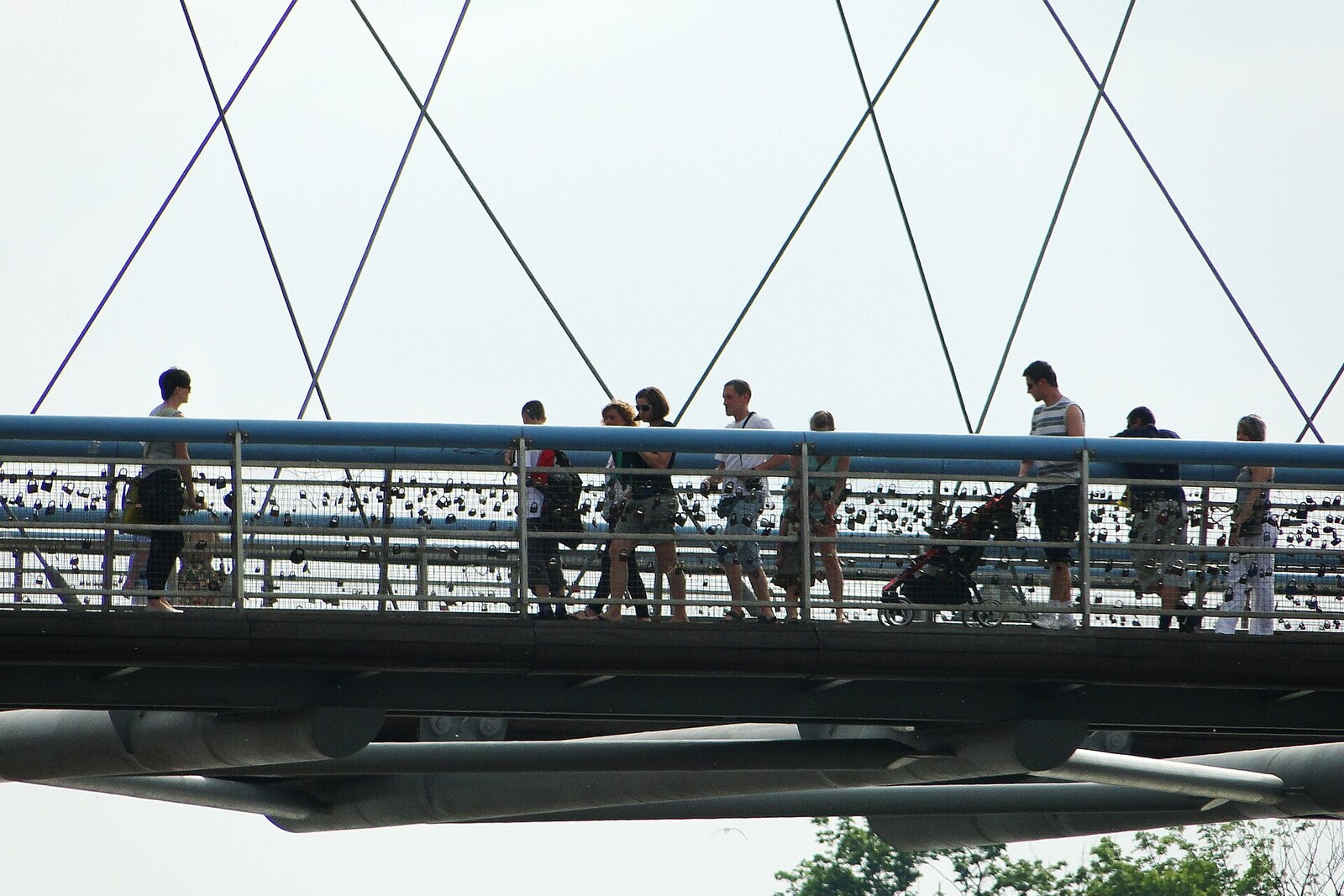
Look around first
What to notice
- Steel arch
- Stone riverbank abutments
- Separate decks
The story of the place
Above the Vistula River, a steel arch carries two separate paths, one for pedestrians and one for cyclists, linking Kazimierz and Podgórze. The stone riverbank abutments beneath it survive from Podgórze Bridge, whose wooden spans the city eventually dismantled. The current crossing returned their function to these abutments, turning the remains of the old crossing into a living link between two neighborhoods.
In eighteen thirty-five, the senators of the Free City of Krakow decided to build a permanent bridge here. The Vistula River was then a border: Krakow stood on one bank, and the Austrian town of Podgórze on the other. After high water swept away the previous wooden bridge, people once again had to use a floating crossing. Austrian officials pressed for construction: they needed a road from Podgórze to the future Krakow railway station.
The two administrations formed a construction commission. Mostowa Street was laid out to provide access to the river, cutting through the garden of the Brothers Hospitallers of St. John of God. Stone supports were placed in the riverbed, and wooden spans were laid across them. In eighteen fifty, Emperor Franz Joseph I Bridge opened. Residents preferred the name Podgórze Bridge.
For thirty-eight years, it remained Krakow's only permanent crossing over the Vistula River. A gas pipeline was run across it to Podgórze, and at the Kazimierz entrance a terminus was set up for the city's first horse-drawn tram—cars that horses pulled through the Main Market to the station. The decision of the two border administrations changed the everyday route of entire neighborhoods.
By nineteen twenty-five, an inspection had declared the wooden parts unsafe, and the city closed the bridge. There was not enough money for a replacement. Engineers installed temporary spans and let people cross again, but now for a fee: the coins collected went toward building Piłsudski Bridge. When it was ready, the old crossing was dismantled. The spans disappeared in nineteen thirty-six, and the supports in the middle of the river were removed later. Only massive stone abutments remained on the banks.
Seventy-four years later, city builders set the current steel structure on them. In nineteen ten, a direct crossing between Kazimierz and Podgórze appeared here again, with separate decks for pedestrians and cyclists.
The new bridge's name is connected with the Brothers Hospitallers of St. John of God, through whose garden Mostowa Street was once laid. Laetus Bernatek, prior of the nearby community—that is, its leader—worked to build a modern hospital for Krakow. Before becoming prior, he graduated from the pharmacy department of the University of Vienna and worked for many years as a pharmacist in his order's hospitals.
During cholera and smallpox epidemics, Bernatek turned the monastery into an infectious-disease hospital. He then took on a separate hospital building. The first benefactors promised money, but their support soon weakened. Bernatek borrowed from savings banks and sought subsidies from the Galician Diet and the city council. Nine years later, the hospital opened: one hundred beds, operating rooms, a pharmacy, central heating, ventilation, hot and cold water. For the beginning of the twentieth century, this was rare equipment.
Although Bernatek is called Father on the plaque, he was not a priest: he studied theology but did not take holy orders. Pharmacy remained his profession. The Hospital of the Brothers Hospitallers on Trinitarska Street continues to receive patients a few blocks from here, while beneath the steel arch of the Father Bernatek Footbridge, the riverbank abutments of Podgórze Bridge have survived.
Useful on site
Open pedestrian and cycling bridge; access depends only on municipal works or temporary closures.
Checked: June 26, 2026. Check the official source before visiting.Pedestrians and cyclists are constantly moving across the bridge, so it is more convenient to listen at the edge without blocking the way. All the main details are accessible without entering anywhere.