 Guide On Map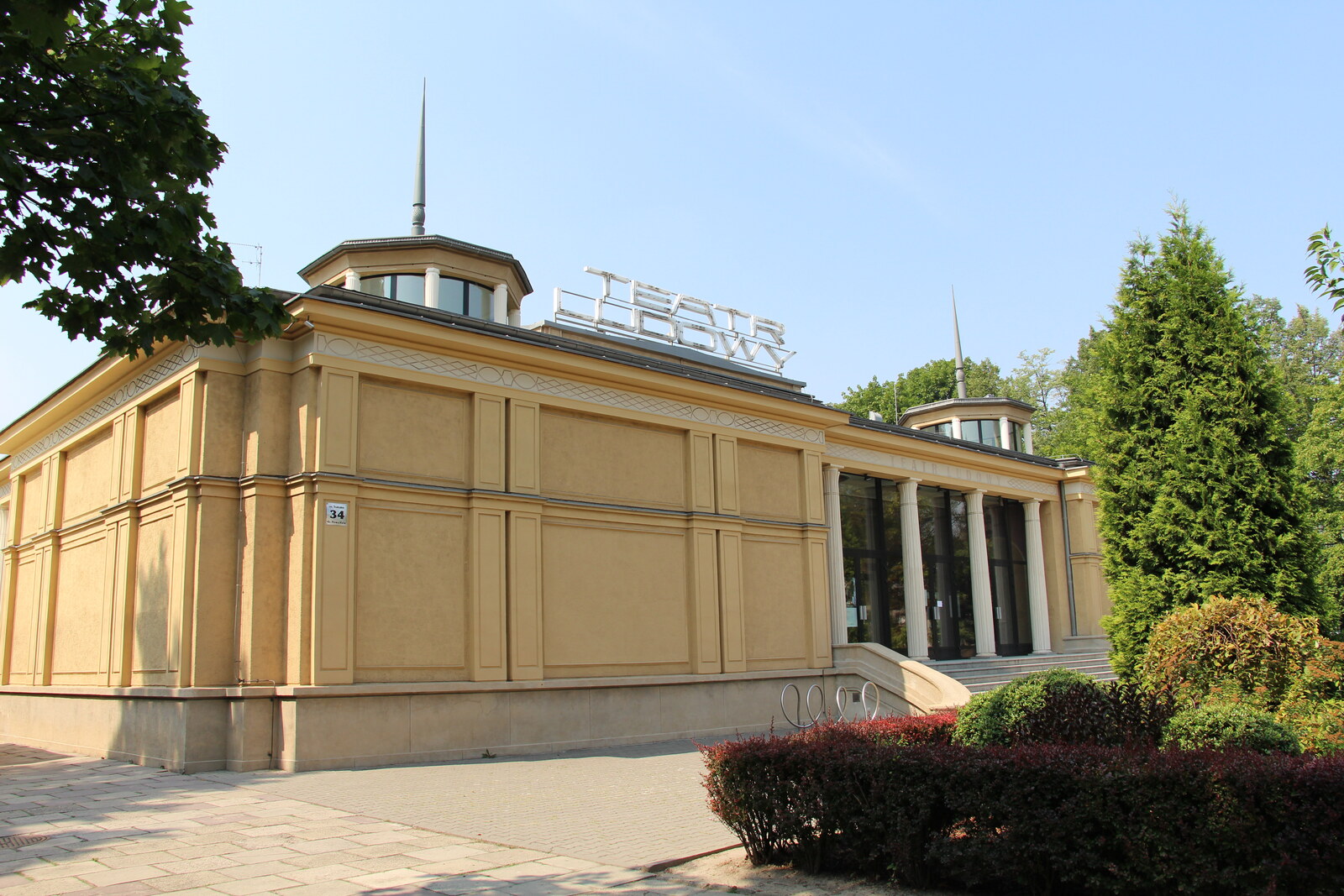
Look around first
What to notice
- The theater facade
- Main entrance
The story of the place
The facade and main entrance stand among the apartment buildings of the Theatre Housing Estate; behind them, the main stage of Ludowy Theatre is still housed. The district was created for workers at the metallurgical works, but they had previously had no professional stage near their homes. The first playbills here were aimed above all at factory families—an audience that still had to be gathered.
The four-hundred-twenty-two-seat building was designed as an intimate stage. Nowa Huta's main theater was to be built at Central Square, but that construction was abandoned, and the small hall at the edge of the city plan was given the entire role intended for the larger one.
In the spring of nineteen fifty-five, Krystyna Skuszanka was appointed director of the theater, which had not yet opened. She was thirty-one years old. She was responsible for both the repertoire and an audience that did not yet exist: the residents of the new district had never had their own professional theater before. The word “Ludowy” meant a very specific audience—above all, workers at the metallurgical works and their families. Whether they would attend determined Skuszanka's position as director.
The first evening took place on December third. Director Wanda Wróblewska opened the stage with Wojciech Bogusławski's play The Pretended Miracle, or Cracovians and Highlanders. Its action takes place in Mogiła, an old village nearby. In the play, Cracovians and highlanders are ready to come to blows over a wedding until the student Bardos stops them with an electric machine passed off as a miracle. For the young district, they chose a story about neighboring land and people recognizable by their clothing and speech.
After that, Skuszanka, together with resident director Jerzy Krasowski and scenographer Józef Szajna, refused to be content with accessible folk comedies. They staged William Shakespeare, Albert Camus, and Juliusz Słowacki, replacing conventional sets with Szajna's abstract constructions. Skuszanka said directly that she wanted to develop the new audience's theatrical imagination. Her The Princess Turandot was performed one hundred two times for about twenty-two thousand people.
But these figures concealed an unpleasant detail for the director: complex productions attracted audiences from old Krakow, while many Nowa Huta residents, for whom Ludowy Theatre had opened, boycotted them. After two seasons, lighter productions were added to the bill. At the same time, Skuszanka and Krasowski continued their previous line and, in nineteen sixty-two, staged Adam Mickiewicz's Forefathers' Eve here—a sharp political production with Szajna's scenography. A year later, both left for Warsaw.
Szajna took on the position of director and continued the experiments. Audiences grew smaller; in nineteen sixty-six, he left. The new director, Irena Babel, turned the repertoire toward comedies, vaudevilles, and children's performances—the very accessible theater that the first team had been expected to provide for eight years.
The main stage is still in this building, and the first premiere remains in the city's addresses. The theater stands in the Theatre Housing Estate. Nearby are the Krakowiaków Housing Estate and the Górali Housing Estate—the two groups named in the play that began the first season here.
Useful on site
You can look around outside freely; go inside only according to the current schedule of performances, box-office hours, or public events.
Checked: July 1, 2026. Check the official source before visiting.This audio stop works entirely from outside. To see the auditorium or a performance, check the current program and the conditions for a separate visit in advance.