 Guide On Map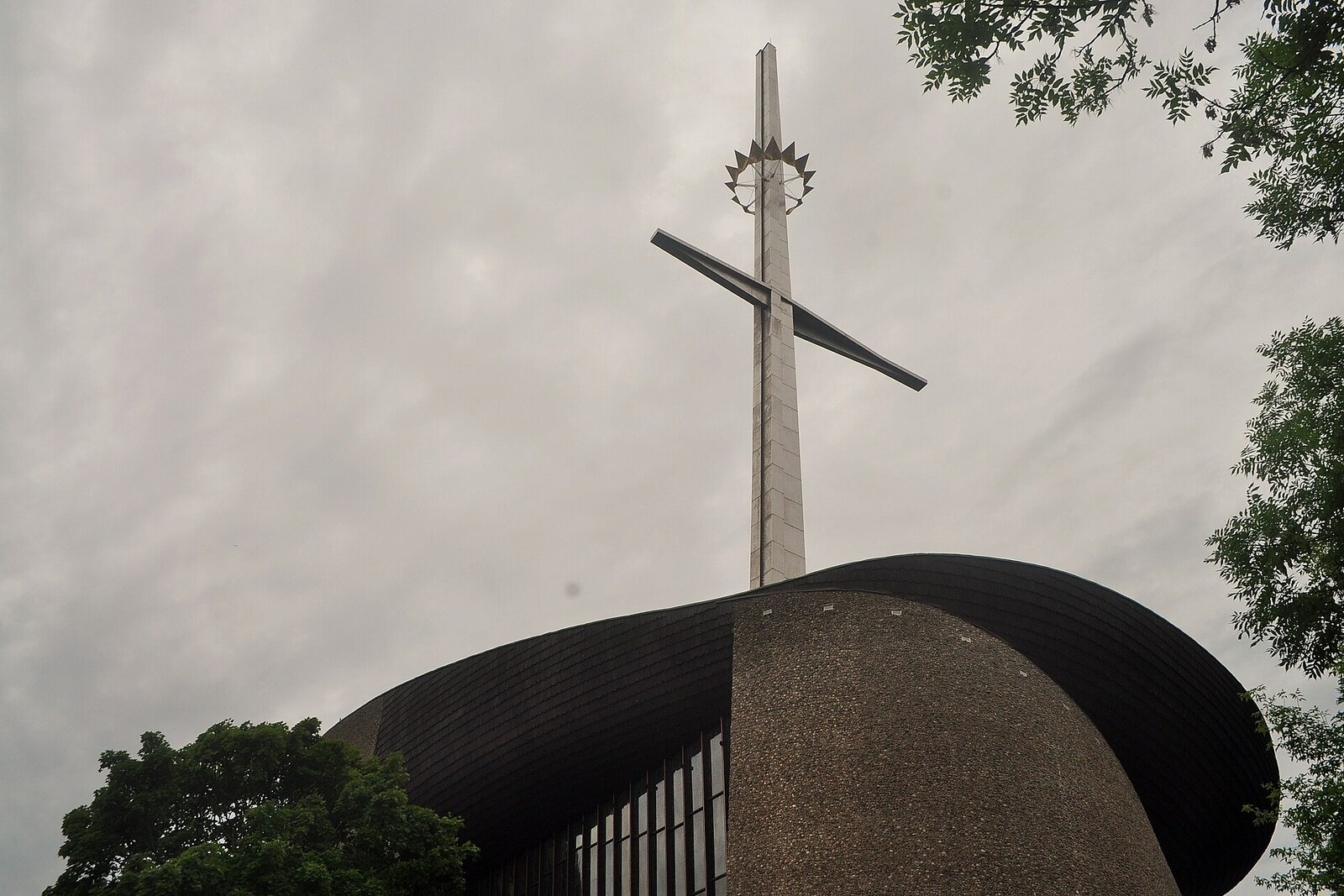
Look around first
What to notice
- A ship's-hull roof
- Sloping sail-walls
- A tall mast-cross
- Eight bells at the entrance
The story of the place
A cramped chapel of the enormous Bieńczyce Parish once stood on this site: it could not hold the people, services took place in the courtyard, and the priests lived in rented rooms. The church is dedicated to Our Lady, Queen of Poland; its Polish name, Arka Pana, means “Ark of the Lord.” The roof profile repeats the hull of a ship, slanting walls rise at its sides, and a tall cross stands above them. About two million river pebbles are built into the exterior walls, and eight bells named for people involved in the construction hang at the entrance.
Permission for this church was issued as though no new church were going to be built here at all.
Before it, the enormous Bieńczyce Parish had a cramped chapel. People could not fit inside, services were moved to the courtyard, and the priests rented rooms in residential buildings. The first proposed church was to stand about a kilometer from here, in the Theatre Housing Estate, a residential district. In nineteen fifty-nine, officials withdrew permission, seized the money that had been collected and the construction materials. An attempt to remove the cross from the seized site ended in clashes, arrests, and prison sentences for its defenders. In their memory, the present-day street in front of the church is called Defenders of the Cross Street. Ark of the Lord Church itself stands on another site—where the old chapel once stood.
In nineteen sixty-five, the Krakow Metropolitan Karol Wojtyła appointed Father Józef Gorzelany to lead the parish. Wojtyła sought permission for the church and chose a priest whom state institutions could accept. Gorzelany had previously belonged to the movement of “patriot priests”—the name for clergy who demonstrated loyalty to the communist state. He had also already managed to build a church in his previous parish. Now he had to use his reputation as someone acceptable to officials for the benefit of the Bieńczyce parishioners.
After four months of going from office to office, Gorzelany received a document for the “expansion of a chapel in Nowa Huta.” That wording let a new church through under the guise of remodeling the old premises. Two years later, Karol Wojtyła dug up the first clods of earth here.
After that, the trick in the paperwork stopped helping. The design by architect Wojciech Pietrzyk was approved in parts, the parish was not entitled to state quotas for materials, and state enterprises were forbidden to take part in the work. Gorzelany organized the construction with the very people for whom he had sought permission. Steelworkers and employees of other Nowa Huta enterprises came here after their shifts with shovels, pickaxes, and wheelbarrows. They earned their living at the steelworks and factories, but built the church for free in their remaining hours.
Parishioners brought river pebbles from the Dunajec and the Raba. Those stones were not in the original drawings; in the end, about two million pebbles covered the exterior walls. Construction lasted ten years. In May nineteen seventy-seven, Wojtyła consecrated the completed church, and the former giant parish was divided into four: one church had finally given rise to several new communities. Gorzelany remained its parish priest until nineteen eighty-six.
Officially, the church is dedicated to Our Lady, Queen of Poland, and was conceived as a votive offering for the millennium of the country's baptism. “Ark of the Lord” is the meaning of “Arka Pana” in Polish. Pietrzyk gave the roof the form of a ship's hull, the sloping walls the shape of sails, and made the tall cross a mast. Eight bells hang before the entrance, bearing the names of people involved in the construction; among them are Karol, Józef, and Wojciech. And the hands of unnamed builders left the river pebbles they brought in the walls.
Useful on site
An active parish; enter only when the church is open, do not disturb services, and check the current rules on site.
Checked: July 1, 2026. Check the official source before visiting.The building can be viewed from outside without preparation. Inside, keep quiet and do not disturb services; the possibility of looking around peacefully depends on parish life.