 Guide On Map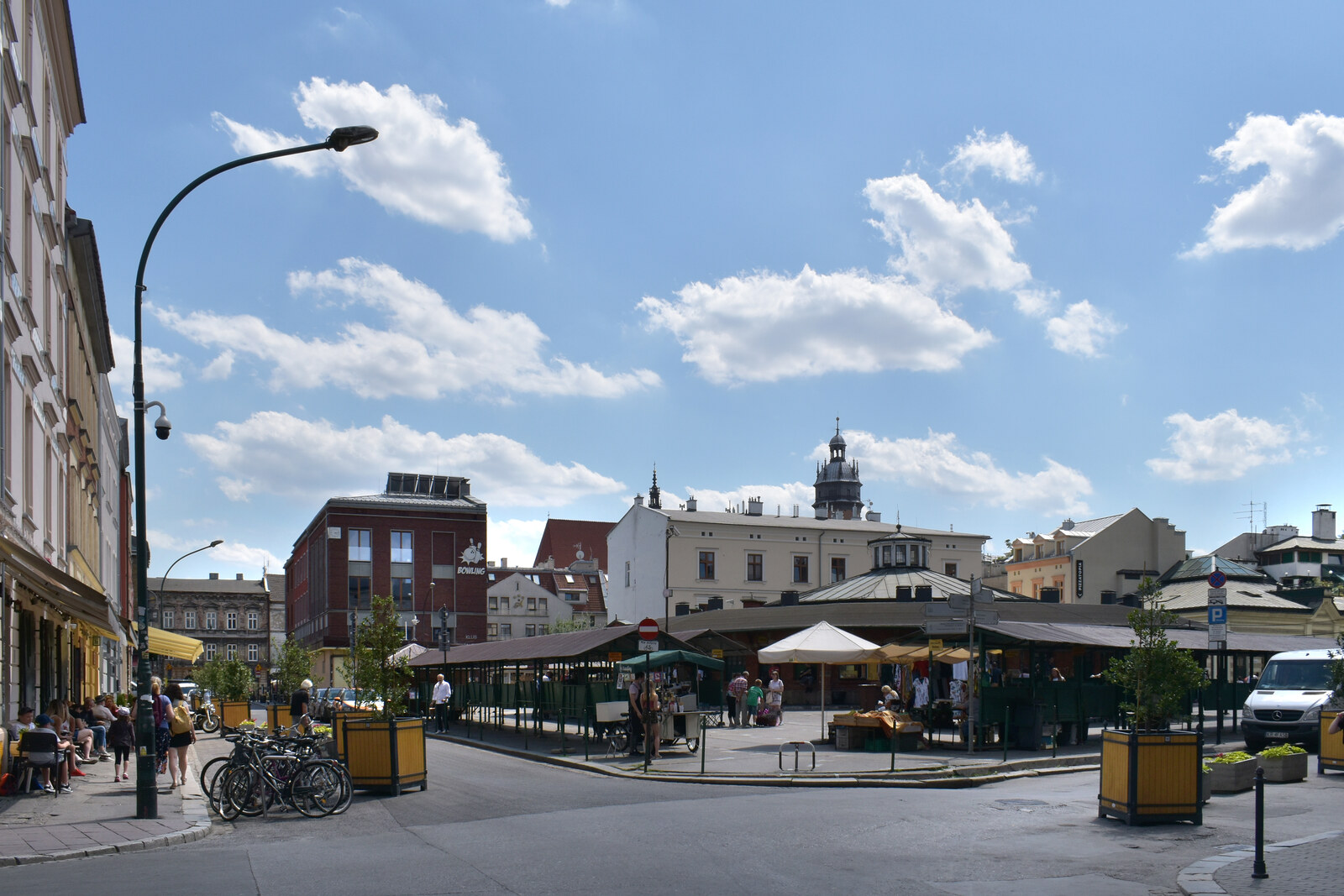
Look around first
What to notice
- The twelve-sided pavilion
- The ring of shop windows
- Market stalls
- The interior of Okrąglak
The story of the place
Plac Nowy grew out of the westward expansion of Jewish Kazimierz: plots here were divided into small houses for craftspeople, synagogue attendants, and families of modest means. The open market space took shape later, when the dense development was cleared and its present boundaries were set. In the middle of the square stands a low twelve-sided pavilion with shop windows around its perimeter, while an inner courtyard is hidden behind this ring. After the war, the market began operating again, but the former Jewish trading community did not return here.
At the center of the square stands a low twelve-sided pavilion. Krakow residents call it Okrąglak—“the little round one.” Its windows now sell zapiekanki: halves of baguettes with cheese, mushrooms, and other toppings. On the open part of the square, vendors sell vegetables, old items, clothes, and poultry on different days. Yet the pavilion’s current layout was determined by the Kazimierz Jewish community’s shortage of money.
By the nineteen twenties, the small ritual slaughterhouse in the eastern part of Okrąglak could no longer handle the volume of poultry. For families observing kashrut, it mattered who slaughtered the birds and how: trained slaughterers did this according to prescribed religious rules. The traders’ income and the buyers’ ability to put permitted meat on the table depended on their work.
The community leaders wanted to expand the slaughterhouse, but they could not afford a separate building. In nineteen twenty-seven, the city leased part of Okrąglak to the community. The architect Józef Weinberger placed the new rooms inside the empty courtyard of the existing shopping gallery. The slaughterhouse opened on January second, nineteen twenty-eight. The outer ring with thirty-seven shops was retained, while the courtyard was built over.
One of Krakow’s most visited markets operated around it. Prewar residents recalled that the vegetable and fruit stalls belonged mainly to Jewish women traders. Housewives came here from distant parts of the city: Plac Nowy was thought to have cheaper produce. Some women lived on the income from their stalls; others tried to save money on everyday purchases. The slaughterhouse, the shops, and the street stalls served the same trade.
The square’s name appeared long before Okrąglak. In sixteen oh seven and sixteen oh eight, the Jewish city was expanded westward by nearly forty percent. Two prosperous community members, Moshe Jakubowicz and the physician Moshe Kalahora, bought land here from Kazimierz councilors and sold off individual plots. Historians conclude that the expansion was intended primarily for the poorest residents. Bookbinders, glaziers, furriers, slaughterers, and synagogue attendants settled in wooden houses. In the tax register of sixteen fifty-three, this entire plot was called Plac Nowy for the first time. There was not yet an open space in its present form: it was cleared and marked out only by eighteen seventy-three.
During the German occupation, the slaughterhouse was closed and the pavilion was locked. Krakow’s Jews were forcibly resettled in the ghetto on the other bank of the Vistula River; most of Kazimierz’s former residents were killed. After the war, traders returned to the square, but the former Jewish community was no longer among them.
The slaughterhouse equipment is no longer here. Its site remains inside Okrąglak—behind the ring of shop windows, in the very courtyard that the community built over because it could not afford a separate building.
Useful on site
The square is always open; market stalls, food, and the flea market depend on the day of the week, weather, and tenants. The most reliable time for a walk is during the day; there is more trade in the morning and more bar noise in the evening.
Checked: June 29, 2026. Check the official source before visiting.Walk around the pavilion: it has no single main facade. During trading hours, do not obstruct queues or vendors at work; for the story of the pogrom, it is enough to listen in the square without looking for a dramatic spot for a photograph.