 Guide On Map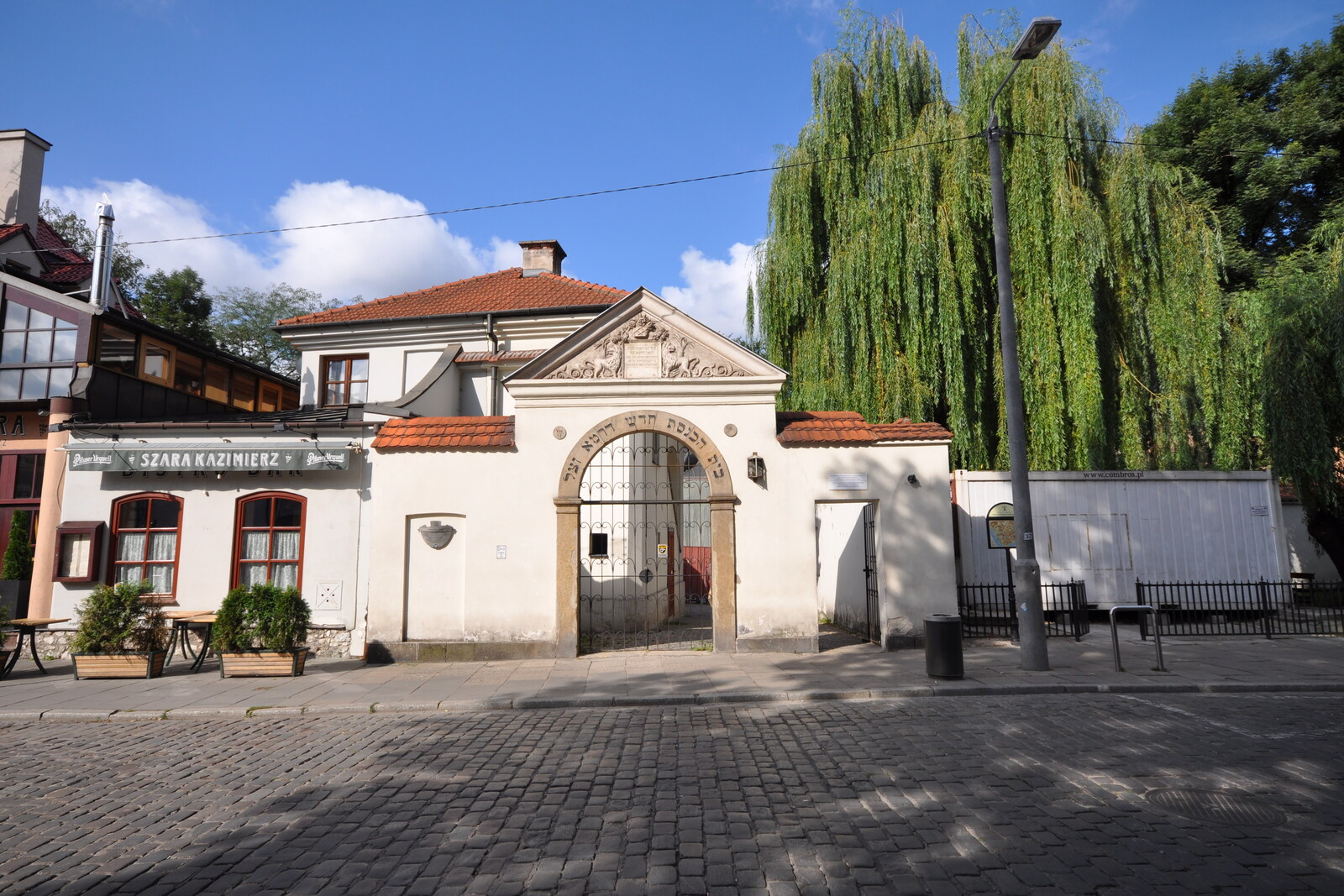
Look around first
What to notice
- The inscription above the gate
- Remuh's gravestone
- The mosaic of gravestone fragments
- Rows of reinstalled slabs
The story of the place
Above the gate is an inscription: “The New Synagogue in Blessed Memory of Remuh.” Remuh is a name formed from the initial letters of “Rabbi Moshe Isserles.” At first, this house of prayer was called the New Synagogue to distinguish it from the nearby Old Synagogue. The rabbi's name became attached to it later, together with his grave beyond the wall.
The cemetery appeared before the synagogue. The community bought the land as early as fifteen thirty-three, but opened it for burials during an epidemic, when there was not enough room in the former cemetery for two hundred twenty deceased people. In those same years, the young Krakow rabbi Moshe Isserles lost his wife and mother.
In fifteen fifty-three, his father, the wealthy merchant and royal banker Israel Isserles, obtained permission from Zygmunt II August to establish a synagogue here. A widespread tradition calls it a gift to his scholarly son. The surviving inscription clarifies the family cost of this construction: the father paid for it from the inheritance of his deceased wife, Moshe's mother. That is how a cemetery opened because of an epidemic and a house of prayer built with the money of one of its victims came to stand side by side.
Moshe headed the Krakow yeshiva, a school where the Talmud and religious law were studied. Students came here from Czechia, Silesia, the German lands, and Hungary; Isserles supported some of them at his own expense. The family's banking money sustained the school, but the rabbi's own standing rested on something else: he settled real disputes, answered questions from different countries, and had to explain the rules by which Jewish communities in Central and Eastern Europe lived.
In fifteen sixty-five, Rabbi Yosef Karo, who lived in the city of Safed and sought to compile a convenient code of religious law, published Shulchan Aruch—“The Set Table.” The book offered ready-made rulings for everyday life, marriage, trade, holidays, and mourning. But Karo relied primarily on the tradition of Sephardic Jews, who came from Spain and Portugal. The customs of the Ashkenazi communities that Isserles dealt with every day often remained outside this code.
Isserles could have published a competing book and demanded that people choose between the two systems. He acted differently: he preserved Karo's text and wrote brief additions alongside it—where Polish and German Jews followed a different ruling, he added their custom. The rabbi called his work HaMapah, meaning “The Tablecloth”: Karo set the table, and Isserles laid a tablecloth on it.
More than a new commentary came from this decision. Ashkenazi communities were able to adopt Karo's code without abandoning their own rules. The text of one rabbi and the notes of the other began to be printed together; for many Orthodox Jews, they still form a single practical code. Isserles did not displace Karo—he made Karo's book suitable for the people whose lives he dealt with as a Krakow judge and teacher.
After Rabbi Moshe Isserles (Remuh) died in fifteen seventy-two, he was buried beside the synagogue. His gravestone became a destination for pilgrims, and the nickname passed both to the cemetery and to the house of prayer. On the anniversary of the rabbi's death, believers come here and leave kvitlech—notes with requests—by the grave.
During the German occupation, most gravestones were broken or knocked over, while Isserles's monument survived. A legend says that a person who raised a hand against it fainted; only the fact that the stone survived can be confirmed. In nineteen fifty-nine, researchers found more than seven hundred gravestones beneath the ground and rubble. Intact slabs were set up again, while fragments were arranged into a long mosaic on the inner side of the wall. Most of the stones standing around you are now no longer above their own graves. Remuh's gravestone remained at his burial place—a few steps from the synagogue built for his prayer and school.
Useful on site
The Jewish community lists seasonal hours: in summer 10:00–18:00, in winter 10:00–16:00; closed on Saturdays and Jewish holidays. Entry is by donation, usually 10–15 zlotys. Morning prayers take place daily, so behave inside as you would in an active synagogue.
Checked: June 29, 2026. Check the official source before visiting.Check access and possible restrictions on religious days. Dress modestly, follow the rules on head coverings, do not move stones, and do not open other people's notes.