 Guide On Map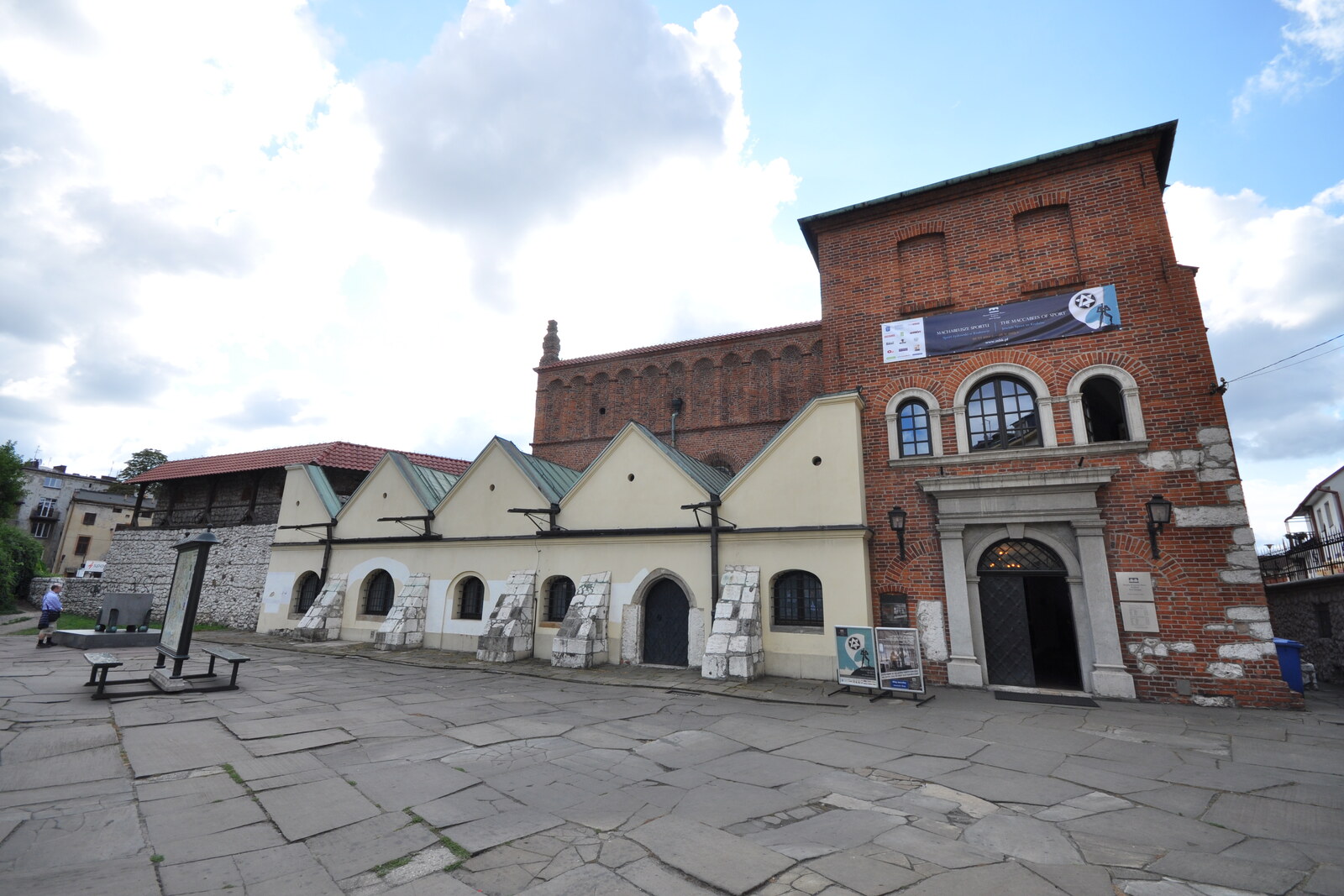
Look around first
What to notice
- The double-nave prayer hall
- The restored bima
- The stone ark in the eastern wall
- The commemorative plaque in the vestibule
The story of the place
Today, the building houses a museum. The name “Old” appeared long before the museum plaques: documents from the mid-sixteenth century already distinguished it this way from a new synagogue built nearby. The building itself dates from the fifteenth century and is considered the oldest surviving synagogue in Poland. After a reconstruction completed in fifteen seventy, it retained a medieval double-nave hall and Renaissance wall crowns.
Before the war, this was the main house of prayer of Krakow’s Jewish community. Women’s prayer rooms and the community administration building adjoined the hall: internal matters were heard here, family representatives gathered, and decisions were announced. A bima stood in the center—a raised platform from which the Torah was read and those assembled were addressed.
In the first days of the Kościuszko Uprising in seventeen ninety-four, Tadeusz Kościuszko stepped onto this bima. A year earlier, Russia and Prussia had carried out the Second Partition of Poland—the Polish-Lithuanian Commonwealth, the shared Polish-Lithuanian state. Kościuszko became the leader of the uprising and tried to assemble an army from people whom previous policy had almost excluded from state affairs: townspeople, peasants, and Jews.
Kazimierz was then a separate city next to Krakow, and this was the easiest place to find the leaders of its Jewish community. Kościuszko came to ask them for men and support. He declared that he sought nothing for himself and considered Jews to be residents of the country just like everyone else, whose well-being he was obliged to safeguard. The stakes were clear to both sides: Jews did not yet have equal civil rights, but they were being asked to sacrifice money and their lives on equal terms with everyone else.
One speech could not immediately create an army. Yet a few months later, the merchants Berek Joselewicz and Józef Aronowicz proposed that Kościuszko form a separate Jewish light-cavalry regiment. Before the uprising, Joselewicz had earned his living through trade and carried out commercial commissions; he was not a professional officer. Kościuszko approved the idea, and Joselewicz and Aronowicz issued an appeal in Yiddish. About five hundred volunteers joined.
Joselewicz required that the soldiers be given kosher food, be allowed to wear beards, and, whenever possible, be excused from service on the Sabbath. In this way, the men agreed to fight without giving up the rules by which they had lived before enlisting. In the autumn, the regiment defended Praga, a suburb of Warsaw, against Russian troops and suffered heavy losses during the assault. Joselewicz survived, but many of his soldiers were killed. The uprising itself was suppressed, and the following year, after the Third Partition, the Polish-Lithuanian Commonwealth disappeared from the map.
The bima that Kościuszko stepped onto did not survive to the present day. In nineteen forty-one, when the German occupiers forced Krakow’s Jews into the Krakow Ghetto, the German trusteeship administration took the synagogue from the community and turned it into a uniform warehouse. The ritual objects, archive, and library were removed or destroyed. By the end of the war, the building had lost its vault.
In the nineteen fifties, municipal restorers restored the hall. One of the main supporters of this work, the chemist and chairman of the city’s cultural commission Bolesław Drobner, pressed for a museum of Jewish history to open here. In nineteen fifty-nine, the chairman of Krakow’s Jewish community, Maciej Jakubowicz, handed the restored building over to the Historical Museum of Krakow for such an exhibition.
A commemorative plaque in the vestibule marks Kościuszko’s speech. The bima in the middle of the hall was restored after the war, while the original stone ark, where Torah scrolls were kept, remains in the eastern wall.
Useful on site
Museum of Krakow: Monday 10:00–15:00, Tuesday — Sunday 9:00–17:00; last entry 30 minutes before closing for individual visitors and 60 minutes for groups. Free admission may be available on Mondays, but the museum publishes separate closure dates.
Checked: June 29, 2026. Check the official source before visiting.The exhibition requires a separate museum entry. If you remain outside, do not regard this stop as a visit to an active synagogue: today its main function is preserving and explaining memory.