 Guide On Map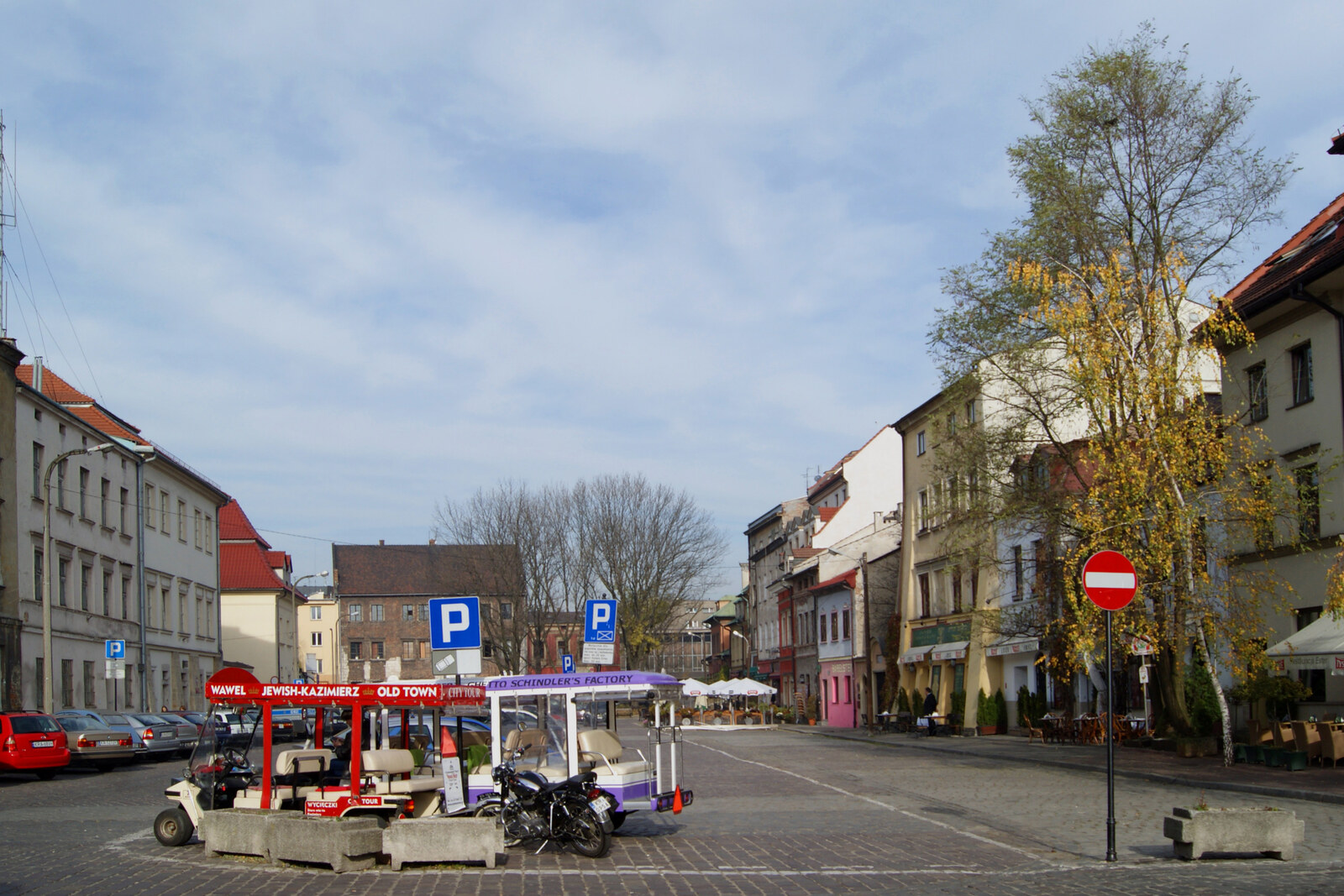
Look around first
What to notice
- Long open strip
- Stone facades along the square
- Old Synagogue at the southern end
The story of the place
The Old Synagogue forms the southern end of the square, while houses of the families for whom this space was the center of the Jewish part of Kazimierz stand along its sides. The quarter was once separated from Christian streets by an internal enclosure; prayer houses and a ritual bathhouse operated inside, and elected elders settled residents’ disputes. Several families sometimes fit into cramped houses, and wealthy townspeople built stone townhouses by the square. The enclosure has long been gone, but the open space amid the buildings still retains the town’s former plan.
Szeroka means “Broad” in Polish. The name describes its shape: an elongated square lies between the facades. Even before the Jewish quarter appeared, this was the village green of Bawół, onto which peasant plots opened. In thirteen forty, Bawół was incorporated into Kazimierz—then an independent town next to Krakow—but the center of the village was not built up.
A century and a half later, people who found it increasingly difficult to remain in Krakow began moving here. Jews earned their living through trade, linked the city with distant markets, and lent money. Krakow merchants saw them as competitors. In fourteen eighty-five, the elders of the Jewish community, who were defending their families’ right to earn a living, were forced to give up retail trade and crafts with Christians within the city limits.
In the summer of fourteen ninety-four, a great fire broke out in Krakow. Attacks on and looting of Jewish homes began afterward. The Polish king Jan Olbracht, deciding how to stop the clashes, ordered Krakow’s Jews to be settled in Kazimierz the following year.
Historians dispute whether this was an expulsion or a move for safety. The king’s order existed, but many families chose Kazimierz themselves: here they were less threatened by the crowd. They did not come to an empty place. City records from before the fire already mention a Jewish bathhouse and a Jewish market here. The Old Synagogue probably already existed as well.
The newcomers built cramped brick houses along the former village green. Elected elders settled disputes within the community, a synagogue and a ritual bathhouse operated nearby, and residential plots were made subject to one necessity—to accommodate as many families as possible. The Jewish town was separated from the Christian part of Kazimierz by internal walls. Szeroka became its main square.
The move did not sever old trading ties: Jewish merchants continued doing business in Krakow, although they still had to defend their right to trade there for a long time. Living, however, was now required within a cramped boundary. By fifteen seventy, more than two thousand people were housed in seventy or eighty homes—an average of five families under one roof. The community negotiated several times to expand the quarter. On the new land, wooden houses for the poor were built, while wealthier families along Szeroka Street raised stone townhouses and opened prayer houses with their own money. By the middle of the seventeenth century, about four and a half thousand people lived in two hundred buildings in the Jewish town.
At the beginning of the nineteenth century, the internal walls were dismantled, and residents began settling beyond the former boundary. Nothing of the enclosure remains here. The long open strip has survived, around which the newcomers of fourteen ninety-five built their town. On the sign, it is still called Szeroka.
Useful on site
An open city street. Access may become more restricted during festivals, filming, services at neighboring synagogues, or because of venue terraces.
Checked: June 29, 2026. Check the official source before visiting.It is best to take this stop slowly through the open part of the square: many of the places mentioned have been lost or changed purpose, so do not expect a preserved, unified ensemble.