 Guide On Map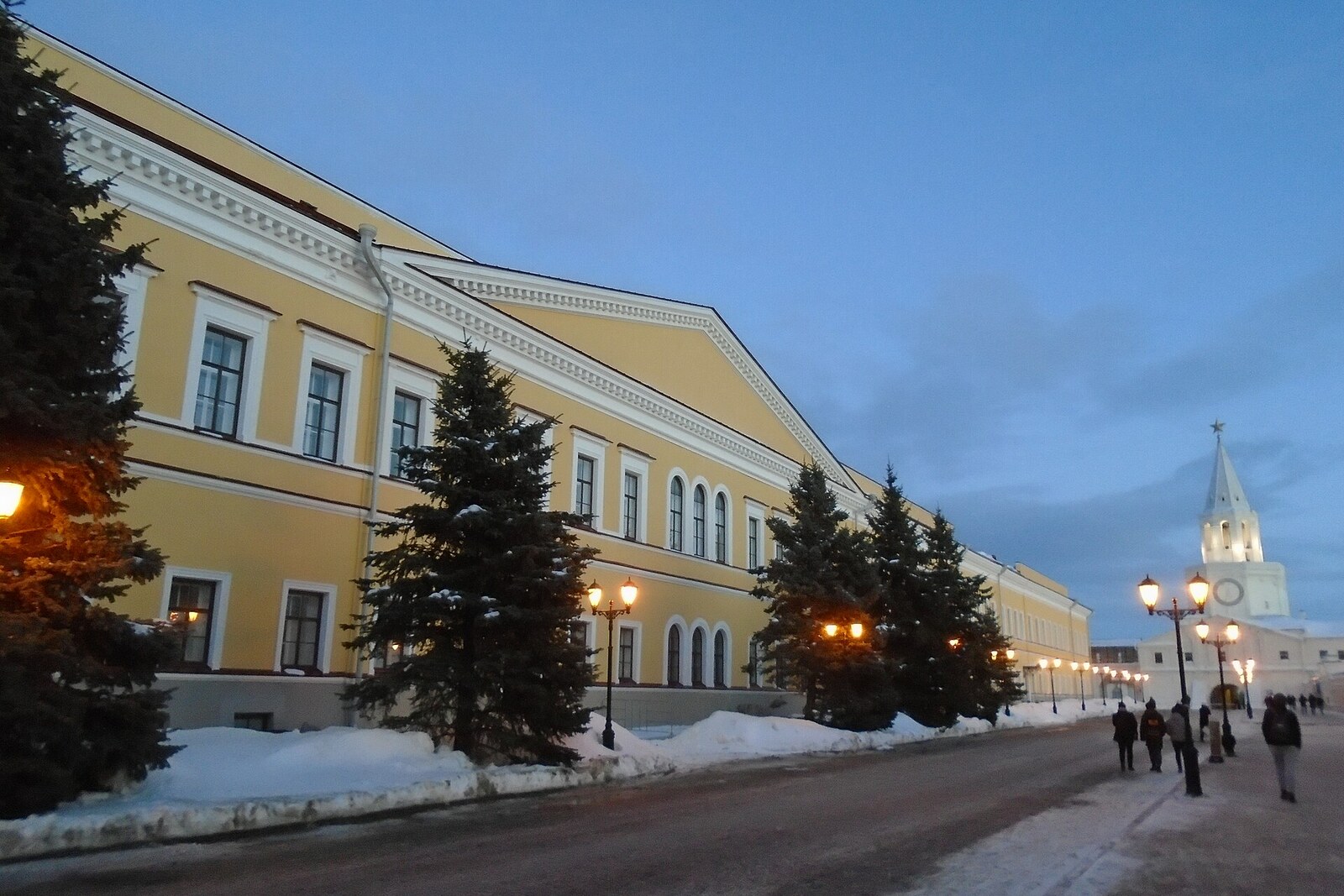
Look around first
What to notice
- Long unified facade
- Inner courtyard
- Cast-iron staircases
- Exhibition halls
The story of the place
Behind this long facade once operated the provincial chancellery, where officials received petitions, held meetings, and heard court cases. Adjoining it was the governor-general’s residence, with a ceremonial hall for official receptions, while musicians were placed in the gallery. After the fire, the separate rooms were brought together into one building, and cast-iron staircases still lead from here to the exhibition halls.
In May seventeen ninety-eight, the landowner and theatrical entrepreneur Pavel Esipov brought his serf actors here. Esipov kept a home theater in the village of Yumatovo, but sought the right to open a permanent public stage in Kazan. A city troupe had existed before, but performances stopped after the death of Catherine the Second. For Esipov, the arrival of Emperor Pavel I was a rare chance to obtain permission from someone who could grant it at once.
The performance was arranged during a ball on the second floor of the provincial chancellery. At the time, “Public Offices” meant state institutions where officials held meetings, received petitions, and heard court cases. But the governor-general’s residence, connected to the chancellery, also contained a throne room—with a gallery for musicians and space for official receptions. That is why the imperial celebration took place here.
Nobles, the wealthiest Tatar merchants with their wives and daughters, Muslim clergy, and the mufti were summoned to the ball. Before this audience, Esipov’s serf troupe performed a play. Acting was a trade for these people, but it did not give them freedom: Esipov could send a talented performer to study in Saint Petersburg, assign a role, or take the performer back to his estate.
According to the accepted history of Kazan theater, after the performance Esipov asked Pavel I for the right to establish a city stage—on condition that he himself would build a separate building for it. Formal permission from the Directorate of the Imperial Theatres arrived in eighteen oh two. Esipov built a wooden theater, lived there, invited professional actors, and had his serfs trained by masters from the capital.
Permission was followed by bills that Esipov paid himself: salaries for the invited actors, costumes, scenery, and upkeep of the building. By eighteen ten, he had gone bankrupt and asked the Kazan governor for a subsidy, but was refused. Esipov died four years later. In his will, he ordered that eight household actors be freed together with their families and left three hundred rubles to the actor Aleksei Volkov. Without their master and his money, the troupe fell apart, and after the fire of eighteen fifteen, the wooden theater was dismantled.
Historians have not yet found a document by which Pavel I authorized the theater immediately after the Kremlin performance, so this connection is more accurately called an accepted theatrical tradition. The official permission of eighteen oh two itself and Esipov’s subsequent fate are confirmed.
The throne room where the ball took place was destroyed in the fire of eighteen fifteen. After the building was restored, its rooms were joined behind one long facade. Inside, old cast-iron staircases to the second floor survive; they now lead to exhibition halls, while the former officials’ rooms are occupied by a visitor center and public spaces.
Useful on site
The courtyard and exterior can be viewed during the site’s opening hours; exhibition halls follow the museum schedule.
Checked: date not specified. Check the official source before visiting.The story can be followed from outside; for this stop, there is no need to seek access to administrative or exhibition rooms.