 Guide On Map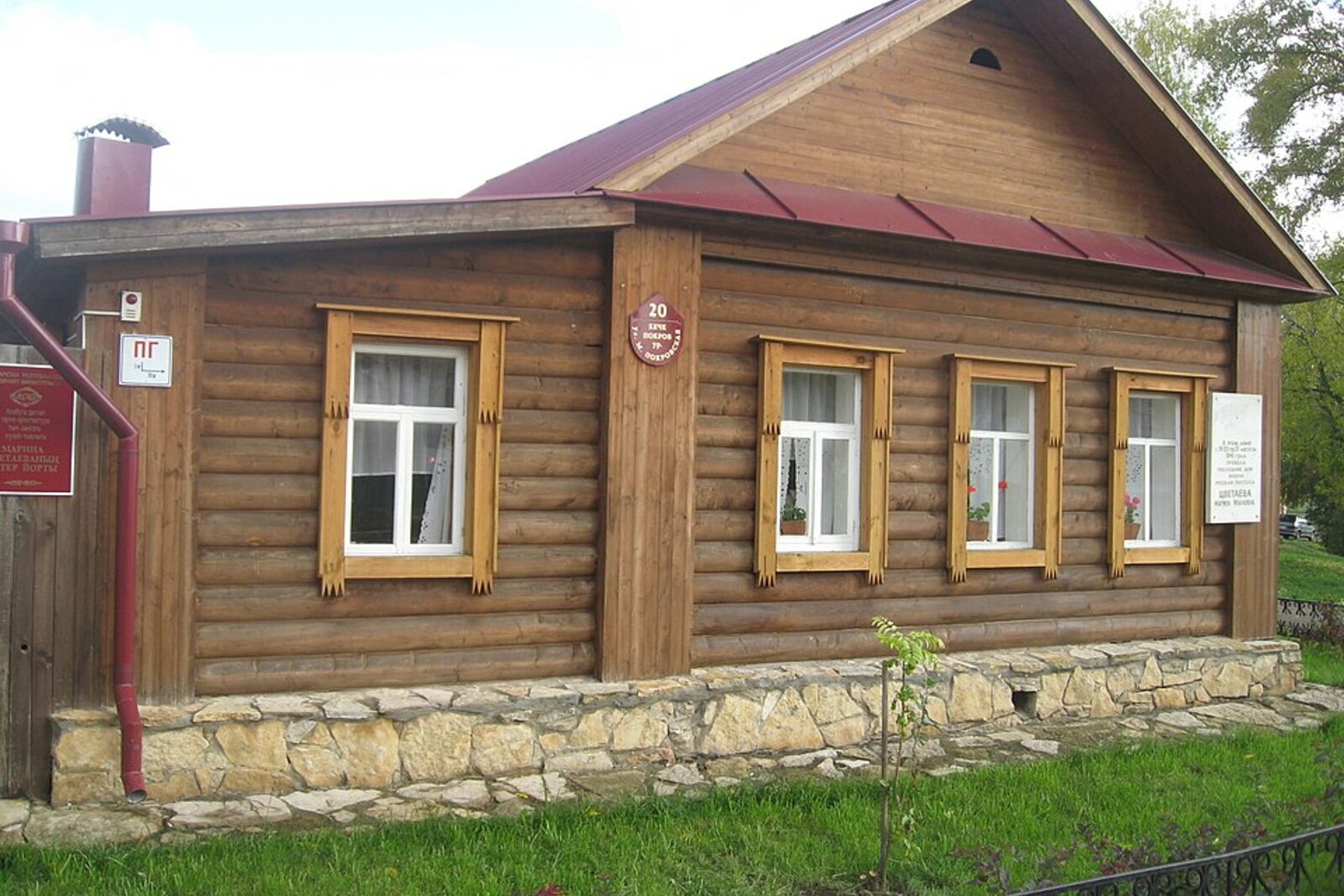
Look around first
What to notice
- Plank partition
- Iron bed
- Couch
- Beam in the entryway
The story of the place
Since two thousand five, the Museum-Reserve has preserved this old Yelabuga house: the room layout and domestic furnishings were restored from the recollections of the former owners’ grandson. Behind the plank partition stand an iron bed and a couch, and a beam survives in the entryway; nearby are belongings of the family who lived here before. The poet’s literary biography is presented in the neighboring museum, while these rooms hold on to the memory of the house itself.
On August twenty-first, nineteen forty-one, a representative of the Yelabuga city council, who was settling evacuees, brought a group of Muscovites to this house. It belonged to the blacksmith Mikhail Brodelshchikov and his wife Anastasia Brodelshchikova, who earned money through fine custom sewing.
Among the arrivals was Marina Tsvetaeva, a poet who needed lodging and any work she could find for herself and her sixteen-year-old son Georgy Efron. Her husband and adult daughter were under arrest; Tsvetaeva went into evacuation with only her son. Anastasia Brodelshchikova later recalled that the new lodger was the first to enter the house, sat down on the sofa, and said she would stay here. This is how the address entered Tsvetaeva’s biography: the apartments had been assigned in advance, and the Brodelshchikovs’ house was the first place to which the group was brought. The street was then called Voroshilov Street; it has now regained its former name, Malaya Pokrovskaya Street.
The owners separated off part of the front room for Tsvetaeva and Georgy with a wooden partition that did not reach the ceiling. Her son slept on an iron bed, and his mother on a couch. The six hundred rubles brought from Moscow were quickly spent, only a few possessions could be sold, and there was no steady work. Tsvetaeva was willing to wash dishes or teach French.
She traveled to Chistopol, where writers she knew were staying, obtained permission to relocate, and submitted an application for a dishwasher’s position at the writers’ cafeteria. This story is sometimes retold as a humiliating rejection. There was no rejection: the cafeteria itself would not open until October. Tsvetaeva returned to the Brodelshchikovs, intending to move to Chistopol later.
On August thirty-first, residents and evacuees went to clear a site for a future airfield. Georgy went with everyone else, Anastasia Brodelshchikova also left, and Mikhail Brodelshchikov took his grandson fishing. Tsvetaeva said she was ill and stayed alone. She left three notes and hanged herself in the entryway. Anastasia was the first to return: she took the key from its usual place, opened the door, and found the lodger.
Georgy was left without parents. He had to apply to the Yelabuga civil registry office himself for permission to bury his mother; soon afterward, he left for the Chistopol boarding school.
In two thousand five, staff of the Yelabuga State Museum-Reserve opened the Memorial House here. The owners’ grandson, Pavel Volkov, helped restore the layout of the rooms and the furnishings. The exhibition is devoted to Tsvetaeva’s final days; her literary biography is presented in the neighboring museum. The house retains belongings of the Brodelshchikov family; behind the plank partition stand the iron bed and couch, and the very same beam remains in the entryway.
Useful on site
Tuesday–Sunday 09:00–18:00; Monday closed. Changes are possible on public holidays.
Checked: date not specified. Check the official source before visiting.The exhibition speaks directly about suicide and displays documents connected with it. If that subject feels difficult right now, limit your visit to viewing the house from outside.