 Guide On Map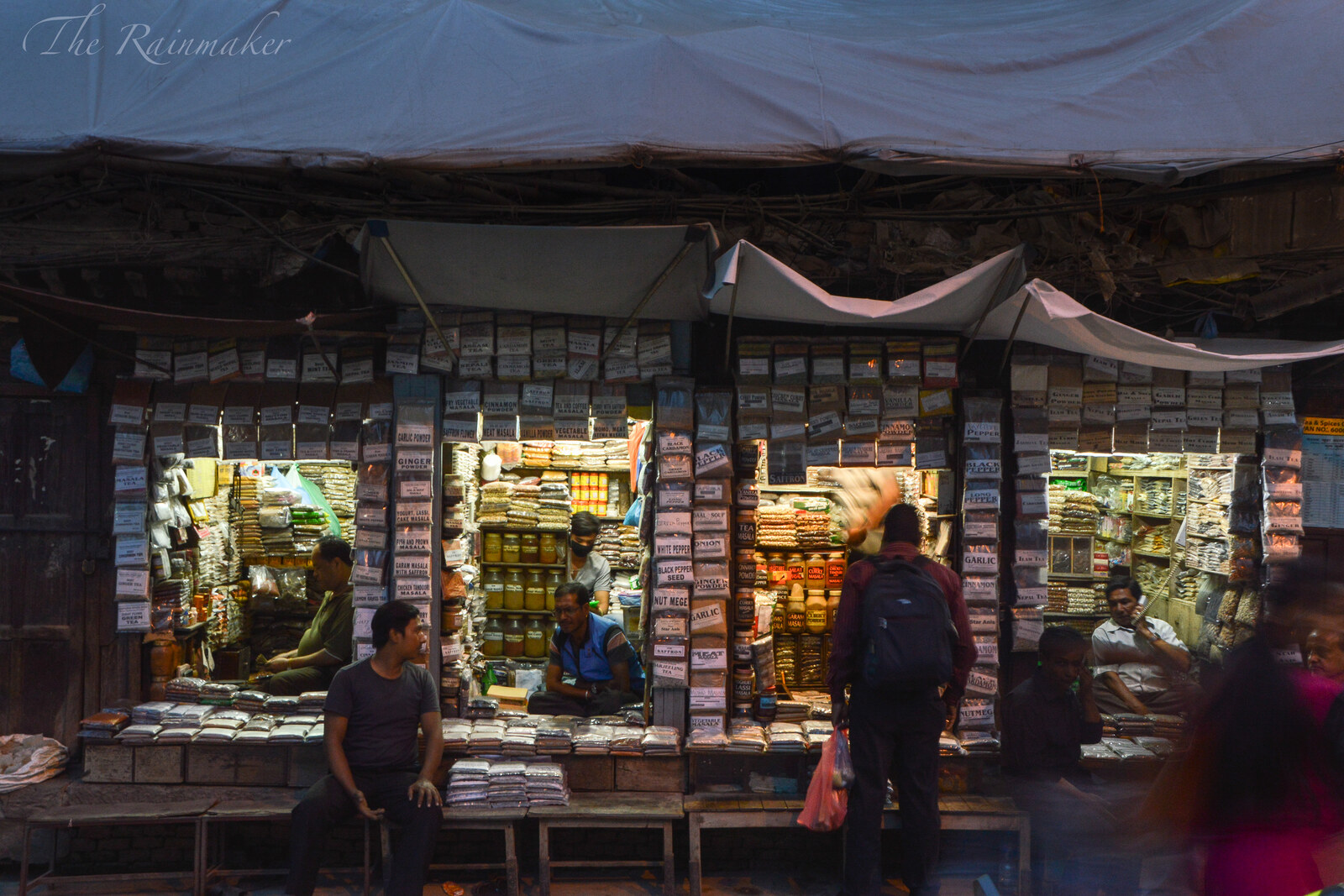
Look around first
What to notice
- Three-tiered Annapurna Temple
- Vessel with grain
- Stone fish Nyalon
- Six converging streets
The story of the place
Six streets meet at Asan Tole. A road from the royal palace ran across the square toward the northeast, to the trade route to Tibet. Farmers from Thimi brought rice, cracked grain, lentils, and beans here, and carried back salt, oil, and spices. Both visiting sellers and families from the surrounding houses made their living from this trade.
Grain was traded beside the three-tiered Annapurna Temple. Before selling it, merchants gave the goddess a portion of their goods. Inside the sanctuary, she is represented by a purna kalasha, a vessel filled with grain. The market has long sold clothing, dishes, and household odds and ends as well, but the vessel has remained in place.
Nearby lies another, much smaller shrine: the stone fish Nyalon, meaning “fish stone.” Residents explain its origin through a legend about the astrologer Barami and his son Dak.
Barami earned his living through astrological calculations and wanted to cast an infallible horoscope for his firstborn. He hung a bell beside the midwife and told her to ring it at the moment of birth. Hearing the bell, Barami noted the time and cast the horoscope. The calculation showed that the child supposedly could not be his son. Barami trusted his craft more than his wife: he left the family and departed Kathmandu.
The boy Dak grew up without a father and became a famous astrologer himself. When the Indian emperor Ashoka was looking for an auspicious day to begin a pilgrimage, he summoned the finest calendar experts. Among them were both Dak and Barami, who had been wandering for many years. They did not recognize each other. Dak was the first to name the required day, and the others confirmed his calculation. Barami was so impressed that he asked the young man to take him on as a student.
During the journey, Dak decided to test his new student. He told him to determine the day, the hour, the object that would fall from the sky, and the place where it would land. Barami answered: on the full moon of the spring month of Chaitra, twelve minutes after noon, a fish would fall at Asan Tole—twelve cubits from Annapurna Temple. Dak agreed with everything except the distance: the fish was to fall closer to the temple.
At the appointed hour, both came to the square. According to the legend, the fish did indeed fall where Dak had indicated. He explained Barami's mistake: Barami had calculated the trajectory but had not taken the wind into account.
For Barami, this was the second calculation ruined by a slight delay. He remembered the bell at his son's birth: the sound had not reached him instantly, but he had taken the moment he heard it for the exact time of birth. Barami recalculated the old horoscope and realized that he had wrongly accused his wife and abandoned his child. When he returned home, he found Dak there. The teacher was his son, and the student was the father Dak had never known. The family was reunited.
One difficulty remained, one that mattered to people of that era: a son must honor his father, and a student must honor his teacher. The family's vajracharya, a Newar Buddhist priest, suggested that Barami and Dak set up a commemorative marker together where the test had ended. According to the legend, they placed a carved stone fish at the spot where it had fallen.
Nyalon still stands among the market rows of Asan Tole. In local tradition, people ask the stone fish for help with dizziness. It lies beside the temple with the grain-filled vessel—where, according to the legend, the wind shifted the fish and corrected Barami's calculation.
Useful on site
Open market hub; best in the morning and daytime; in the evening, stay on busy streets.
Checked: date not specified. Check the official source before visiting.Do not stand in the middle of the flow or block the passage by the stalls; it is more convenient to listen from the edge of the market hub.